Tag Archives: Alex Benay

Canada’s Phoenix pay system, AI, the union and more (this is an update)

I last wrote about Canada’s Phoenix pay system in an August 20, 2024 posting “From the Phoenix payroll system to Dayforce? Hopefully an improvement for Canadian government employees—one day” when a new pay system was being discussed,

July 2024 update

A July 10, 2024 article by Emma Weller for CBC news online notes this,

A payroll system for federal workers intended to replace the much-maligned Phoenix platform is still years away from being fully implemented, according to a senior government official.

At a new conference on Tuesday [July 9, 2024], Alex Benay, associate deputy minister of Public Services and Procurement, said testing began on Phoenix’s replacement, Dayforce, in 2022.

“This is the year that we are building Dayforce as a replacement system for HR and pay and determining if it is a feasible solution for the Government of Canada,” Benay said. 

Benay said the switch won’t happen overnight, however, and cautioned it may take years until the new system is fully implemented. In the meantime, Phoenix will remain in use.

Brief background information

I have covered the debacle that is the implementation of the Canadian federal government’s disastrous implementation of the Phoenix pay system in early 2016 (see my December 27, 2019 post for a comprehensive overview). In 2019, there was a then new Minister of Digital Government, Joyce Murray. That position was eliminated in 2021 and Murray became the Minister of Fisheries, Oceans and the Canadian Coast Guard leaving no one at the cabinet level in charge of ‘digital government’. Four years later, with the advent of Mark Carney as the Prime Minister of Canada, as of June 2025, there is now a Minister of Artificial Intelligence and Digital Innovation, Evan Solomon.

Early 2025

Early this year (2025) before the new government was elected, there were news reports suggesting that the Phoenix pay system situation had not improved much, from a January 24, 2025 article “Ottawa to tap AI to assist with Phoenix pay system backlog” by Adam Huras in the Vancouver Sun. p. NP6,

The federal government says it’s slowly inching closer to a permanent replacement of the controversial [emphasis mine] Phoenix pay system, with officials to decide by the end of March [2025] whether a new payroll platform can be implemented next year [2026] [emphasis mine].

But it will be another 18 months of configuration and testing to fully launch the change.

And the new system will likely also run in parallel with the existing one [emphasis mine] for another four to six months after that to ensure thing work they way they should.

That’s as massive backlogs persist.

An online dashboard last updated in December [2024] by the federal government shows a backlog of 388,00 transaction. That’s down from 416,000 last June [2024].

More than half 201,000 are more than a year old.

To help the federal government is expanding its use of artificial intelligence [AI] [emphasis mine], specifically a virtual assistant tool that helps fix data discrepancies in pay and compensation services.

That tool has bee in testing. With the help of 30 compensation advisers. …

Controversy? There is none. Even the contractor, IBM, advised against the implementation as the Phoenix pay system wasn’t tested in the field. Plus, there was no backup system in place. On a happier note, it seems that it’s being done differently this time.

There is more to the Phoenix pay system failure as Jamey Mills (regional executive vice-president for the Public Service Alliance of Canada, BC Region. PSAC) notes in her February 27, 2025 article for vancouverisawesome.com,

Trust is the foundation of any workplace. Workers commit to doing their jobs, and in return, they expect to be treated with respect and paid fairly. But for the past nine years, the federal government has broken that trust with its own workers.

Nine years ago, the federal government launched the Phoenix pay system, promising efficiency and accuracy. Instead, it delivered chaos. From the very start, workers reported missing paycheques, incorrect salaries, and severe financial hardship.

Nearly a decade later, the crisis remains unresolved, with more than 383,000 pay issues still in the backlog. The workers affected by Phoenix are not just numbers in a system—they are people with mortgages, bills, and families to support.

No one should have to worry about whether their next paycheque will arrive on time or in the right amount. But Phoenix is just one example of a broader issue: a pattern of neglect when it comes to supporting federal public service workers. Chronic understaffing, outsourcing, and budget cuts [emphasis mine] have put incredible strain on these workers, forcing them to do more with less while dealing with the ongoing stress of an unreliable payroll system. These are the same workers who process our passports, protect our borders, support veterans, inspect our food and transportation, and keep government programs running. They are the backbone of the public services we all depend on.

This isn’t just about solving the issues with this broken pay system. It’s about rebuilding trust in the federal government as an employer and ensuring that public service workers are valued, respected, and properly supported. When these workers are treated as an afterthought, it’s not just them who suffer—it’s every Canadian who relies on strong, well-functioning public services.

If the federal government wants to recruit and retain the best talent, it needs to do better. [emphasis mine] That starts with listening to workers, investing in stable and well-staffed public services, and fixing Phoenix once and for all.

Mills and, by extension, PSAC are not the only ones to note problems with the federal civil service. I’ve heard at least one political pundit stating that the federal civil service is ‘broken’, while notice was made that it was at one time considered excellent.

June 2025

Perhaps there’ll be some relief for employees, from a June 11, 2025 Public Services and Procurement Canada news release, Note: A link has been removed,

The Government of Canada is taking the next step toward replacing the Phoenix pay system to drive efficiency and effectiveness across government. 

Today, the Honourable Joël Lightbound, Minister of Government Transformation, Public Works and Procurement, announced that the Government of Canada is moving forward to the final build and testing phase of the Dayforce HR and pay solution. This decision follows the completion of a rigorous feasibility study and marks a significant step toward modernizing the government’s HR and pay systems.

The Dayforce solution will replace a significant number of HR systems in use across the Government of Canada. It reflects the government’s continued commitment to business and digital transformation built on transparency, efficiency, and employee experience.

The Government of Canada will finalize the configuration and testing of Dayforce and work with departments to confirm their readiness to onboard. This phased approach builds on lessons learned and will help reduce risks associated with large-scale transformation and ensure a smooth transition for employees.

Employee engagement will continue to be a key focus throughout the transformation process. By involving employees in readiness activities and ensuring continuous feedback mechanisms, the government is implementing an HR and pay solution that offers an efficient people-centric platform aligned with workforce needs. 

Quotes

“The Government of Canada remains committed to modernizing its HR and pay systems in a responsible and transparent manner. By investing in the future of HR and pay, we are taking an important step forward in ensuring an efficient, secure, and sustainable solution for public service employees.”

The Honourable Joël Lightbound
Minister of Government Transformation, Public Works and Procurement

“We are excited to strengthen our partnership with the Government of Canada. Dayforce brings together advanced technologies into a single, AI-powered people platform designed to simplify processes and deliver real value. We are committed to supporting this transformative HR and pay initiative, ensuring it enhances work-life and drives meaningful improvements for government employees across the country.”

David Ossip
Chair and Chief Executive Officer of Dayforce, Inc.

Quick facts

  • The current pay system is used to deliver pay to an average of 431,000 current and former employees bi-weekly. In 2024, this represented approximately 13.4 million payments, totalling approximately $40.1 billion.
  • The complexity of the Government of Canada HR and pay environment includes the challenge of applying almost 150 different collective agreements representing employees from over 100 departments and agencies.
  • The initiative is incorporating lessons learned from the previous pay system implementation and recommendations intended to guide future projects of similar size and scope. In particular, recommendations around stakeholder engagement and governance were guided by Lessons Learned from the Transformation of Pay Administration Initiative (Goss Gilroy report).
  • Over 3,000 public servants participated in user awareness sessions during the feasibility project, with the majority of participants reporting that they found Dayforce simple and easy to use. Feedback from participants is being used to improve the system further. 
  • Dayforce is a global human capital management technology company with deep Canadian roots. Its single AI-powered people platform for HR, pay, time, talent and analytics is trusted by thousands of customers and serves millions of employees worldwide.      
  • Over the next 2 years, the deployment of the Dayforce solution will begin to progressively onboard starting with two departments and a separate agency, where the Government of Canada will focus on departmental readiness as it prepares to deploy the system. 

Josh Pringle’s June 12, 2025 article (with files from The Canadian Press and CTV News Ottawa’s William Eltherington and Ted Raymond) for CTV news online is a little less ebullient,

The days of the troubled Phoenix pay system appear to be numbered, as the federal government moves forward with implementing the new Dayforce system for human resources and payroll tasks.

Public Works and Procurement Minister Joël Lightbound announced Wednesday [June 11, 2025] that the government is moving ahead to the “final build and testing phase” of the Dayforce HR and pay solution for government employees, replacing the Phoenix system.

….

The Phoenix pay system was launched by the federal government in 2016. Since then, thousands of civil servants have been paid incorrectly by the pay system.

At least $3.5 billion has been spent by the government on the Phoenix pay system since 2017.

There were 327,000 transactions waiting to be processed through the Phoenix pay system, including 331,000 financial transactions and 9,000 transactions related to collective bargaining agreements. The government’s website shows 49 per cent of the outstanding transactions are over a year old.

In 2018, the government announced plans to replace the Phoenix pay system. More than $150 million has been spent looking into a new platform to replace the pay system.

Sharon DeSousa, national president for the Public Service Alliance of Canada, said in a statement the new pay system must be proven to work.

“After everything our members have been through at the hands of the Phoenix disaster [emphasis mine], the next pay system has to work, and it has to work from day one. That’s why PSAC is at the table asking the tough questions — to prevent another pay system disaster,” DeSousa said. “This isn’t just a tech upgrade — it’s about rebuilding trust. That starts with paying workers accurately and on time, every time. It’s the most basic obligation of any employer.”

She added that the government must not ignore the ongoing issues with Phoenix.

“With 327,000 outstanding cases, stabilizing the current system and hiring enough compensation advisors to handle pay issues has to be a top priority.”

I wish them well with their efforts to finally make bring this Phoenix pay system debacle to an end.

It is a bit curious to me that there isn’t a quote from Evan Solomon, Minister of Artificial Intelligence and Digital Innovation, in a government news release where there’s a major initiative involving the use of artificial intelligence.

From the Phoenix payroll system to Dayforce? Hopefully an improvement for Canadian government employees—one day

For anyone who’s unfamiliar with the Phoenix payroll system debacle, I have a rundown in my December 27, 2019 post. Briefly, the Canadian government (led by the newly elected Justin Trudeau and his Liberals) implemented a new pay system for the entire federal civil service in 2016. A disaster from Day 1, the system is still not properly functional as of this writing.

Daniel LeBlanc’s May 16, 2024 article for the Canadian Broadcasting (CBC) news online site gives a bit more detail about the debacle and a proposed remedy,

The federal government is accelerating plans to put the Phoenix public service pay system out of its misery.

Launched in 2016, the system — which cost taxpayers nearly $4 billion — has failed regularly [emphasis mine] to deliver public servants’ paycheques on time, or in the right amounts.

According to the government’s latest tally, more than 300,000 of 425,000 Phoenix transactions had failed to meet service standards as of last month — including 213,000 that were more than a year late.

Alex Benay, the federal official responsible for the file [Associate Deputy Minister of Public Services and Procurement (Enterprise Pay Coordination)], said $135 million set aside in this year’s budget will give a big boost to the development of Dayforce, the system which is expected to replace Phoenix in the coming years.

Ottawa didn’t make any specific announcement related to Phoenix when the new spending was made public. It’s still a major increase in funding for the Dayforce project, which was launched in 2018 with an average annual budget of $25 million.

Dayforce is a payroll and human resources management system already in use by 6,000 organizations, including the governments of Ontario and California.

The federal government plans to make Dayforce its new pay system in the coming years, after conducting a series of tests that concluded in February [2024?]. Ottawa pays $36 billion a year in salaries to 420,000 people.

Benay struck a cautious note, pointing out that there’s still a lot of work to do before the transition to the new system. But Ottawa has abandoned all hopes of trying to salvage Phoenix for the long term.

A major problem with Phoenix is that it needs to operate in tandem with more than 30 distinct human resources management systems in various departments and agencies, as well as more than 100 collective bargaining agreements.

A large number of payroll officers are needed to perform different calculations for each department. And when civil servants change departments, Phoenix struggles to overcome a series of technological challenges.

The federal government’s hope is that Dayforce will allow it to rely on a single tool for both payroll and managing employees’ personnel files at all stages, from hiring to retirement.

“We have no intention of disintegrating [the payroll and human resource management systems] a second time and making the same mistake,” Benay said. [Comment: A mistake that should never have been made in the first place. Even the contractor {IBM} warned that Phoenix wasn’t ready when it was implemented.]

According to Public Services and Procurement Canada, Phoenix initially cost taxpayers $300 million and the federal government has spent another $3.5 billion on it since.

As it prepares to transition to a new payroll system, the government says it will use artificial intelligence tools [emphasis mine] to clean up the data in the Phoenix system and reduce the number of late payments.

The plan is to introduce Dayforce gradually in several federal departments [that’s what should have happened with Phoenix], so that when Phoenix is finally ​​scrapped, the new system can take off as smoothly as possible.

The Public Service Alliance of Canada said certain compensation rules could be standardized across government to ease the transition to a new pay system. However, it insisted that unions should help design and test the new system.

“If the members don’t suffer, we’re ready to co-operate in setting up a payroll system that works,” said spokesperson Yvon Barrière. “But we need to be certain that the system will work, and that it will not disadvantage our members under collective bargaining agreements.”

It would have been nice to get more information about the artificial intelligence tools they propose using, especially in light of the many problems associated with those tools. (See my December 29, 2020 posting, “Governments need to tell us when and how they’re using AI (artificial intelligence) algorithms to make decisions.” Also, Associate Deputy Minister of Public Services and Procurement (Enterprise Pay Coordination), Alex Benay is mentioned in the post as he was leaving his job as Canada’s Chief Information Officer, a position created after the Phoenix Pay System debacle.)

So who is Alex Benay?

Since Benay was first mentioned here in a June 19, 2014 posting, “Canada Science and Technology Museums Corporation welcomes Alex Benay as president and chief executive officer (CEO),” I was quite curious as to what he’s been doing since returning to the federal government civil service,

First, there’s the May 11, 2023 Government of Canada news release announcing Mr. Benay’s latest appointment to the civil service,

The Prime Minister, Justin Trudeau, today announced the following changes in the senior ranks of the Public Service:

Alex Benay, currently Vice-Chair of the National Arts Centre and Senior Partner, Levio Business and Technology, becomes Associate Deputy Minister of Public Services and Procurement (Enterprise Pay Coordination), effective June 26, 2023.

Biographical Notes

Alex Benay

If you click on Alex Benay, you’ll find this,

Education

Bachelor of Arts, History, University of Ottawa

Professional Experience

Since April 2023
Senior Partner, Levio Business and Technology
[emphasis mine]

Since May 2022
Vice-Chair of the National Arts Centre

2020 – 2022
Global Lead, Government Azure Strategy, Microsoft

2019 – 2020
Partner, KPMG Canada

2017 – 2019
Chief Information Officer, Government of Canada

2014 – 2017
President and Chief Executive Officer, Ingenium Corporation

2011 – 2014
Vice-President, Open Text Corporation

2010 – 2011
Senior Director, Industry Marketing, Open Text Corporation

2009 – 2010
Senior Director, Customer Enablement, Open Text Corporation

2004 – 2009
Director, Foreign Affairs and International Trade Canada

One comment: it seems odd to leave off your master’s degree in your official government of Canada biographical notes. This contrasts somewhat with the Alex Benay profile on Boardroominsiders.com,

Alex Benay

Associate Deputy Minister, Enterprise Pay Coordination, Public Services and Procurement Canada
Government of Canada

Executive Summary

Alex Benay is an Associate Deputy Minister of Enterprise Pay Coordination for Public Services and Procurement Canada at the Government of Canada, a role to which he was named in June 2023. Most recently, he served as Head of Program Management at Microsoft Corporation. [emphasis mine] Prior to that, Benay was a Partner of Digital and Government Solutions at KPMG Canada and Chief Client Officer at MindBridge Analytics Inc. Before joining MindBridge, Benay was Chief Information Officer of Canada and Deputy Minister at the Treasury Board of Canada Secretariat. He also served as President and Chief Executive Officer at Canada Science and Technology Museum Corporation. Earlier in his career, he held leadership and marketing roles at Open Text Corporation. He holds a BA in History from the University of Ottawa and a Master’s Degree in History from Athabasca University. [emphasis mine].

Employment History

  • Associate Deputy Minister, Enterprise Pay Coordination, Public Services and Procurement Canada, Government of Canada (from 2023)
  • Senior Partner, Levio Business and Technology, Levio Conseils Inc. (from 2023) [emphasis mine]
  • Head, Program Management, Microsoft Corporation (from 2022 to 2023)
  • Global Lead, Government Azure Strategy, Microsoft Corporation (from 2021 to 2022)
  • Partner, Digital and Government Solutions, KPMG Canada, KPMG International Limited (from 2019 to 2021)
  • Chief Client Officer, MindBridge Analytics Inc. (from 2019 to 2019)
  • Deputy Minister, Treasury Board of Canada Secretariat and CIO, Government of Canada (from 2017 to 2019)
  • President and CEO, Canada Science and Technology Museum Corporation (from 2014 to 2017)
  • VP, Government Affairs and Business Development, Open Text Corporation (from 2011 to 2014)
  • Senior Director, Global Industry Marketing, Open Text Corporation (from 2010 to 2011)
  • Senior Director, National Customer Enablement, Open Text Corporation (from 2009 to 2010)
  • Director, Global Affairs Canada, Government of Canada (from 2006 to 2009)
  • Director, Policy, Global Affairs Canada, Government of Canada (from 2004 to 2006)
  • Senior Program Manager, Global Affairs Canada, Government of Canada (from 2003 to 2004)
  • Manager, Information, Communications and Knowledge Management, Natural Resources Canada, Government of Canada (from 2001 to 2003)
  • Information Services Officer, Global Affairs Canada, Government of Canada (from 2000 to 2001)
  • Medical Assistant, Canadian Armed Forces, Government of Canada (from 1999 to 2000)
  • Archival Assistant, Library and Archives Canada, Government of Canada (from 1998 to 1999)

Comment: Both the government profile and the boardroom profile agree that Benay is a current partner in Levio Business and Technology. This partnership started in April 2023 (govt. profile), a scant two months before his move (?) to his current government position. Consequently, it makes sense that the Boardroom profile lists Benay’s most recent role as “Head of Program Management at Microsoft Corporation.” As noted earlier, there’s the addition of a master’s degree to the Boardroom profile. Let’s see what’s next in an Alex Benay profile on FWD50.com,

Alex Benay (he/him)

Associate Deputy Minister, Enterprise Pay Coordination

Alex Benay became Associate Deputy Minister of Enterprise Pay Coordination in June 2023.

Prior to this appointment, Alex was [emphasis mine] a senior partner with Levio Business and Technology and Vice Chair of the National Arts Centre. From 2020 to 2022, he served as the Global Lead of Government Azure Strategy at Microsoft where he helped governments around the world adopt cloud technologies.

From 2019 to 2020, Alex was a partner with KPMG where he led the digital transformation of governments and Fortune 500 companies in the areas of technology, people and strategy.

Alex was a Deputy Minister at the Treasury Board of Canada Secretariat from 2017 to 2019 where he served as Chief Information Officer. In this role, he oversaw key information technology initiatives in service modernization, legacy system management, good governance, and open and transparent government.

Alex was also the President and Chief Executive Officer of the Canada Science and Technology Museums Corporation (Ingenium) where he oversaw the transformation of the country’s national museums. In addition, he is a former Global Affairs Canada executive.

Alex is the author of 2 books: Canadian Failures and Government Digital. He holds a bachelor of arts in history from the University of Ottawa.

Nothing jumps out other than the past tense used to describe Benay’s partnership at Levio.

Thoughts

The omission of a master’s degree from Benay’s list of educational accomplishments seems odd but inconsequential. The mention of his two month long (?) partnership at Levio is a little more than odd especially with the confusion over his status as a partner (is or was?). Here’s why it seems concerning to me, Levio Business and Technology, from tho company’s homepage,

Levio is a digital native business and technology consulting firm.

As a true partner from start to finish, our goal is a long-lasting transformation that’s right for your business model. We provide a tailored approach, streamlined execution and a commitment to deliver digital transformation ventures that create value and measurable achievements.

It seems as if Mr Benay’s firm (past or present?) could be a good fit as a contractor for Dayforce as would one or more of his previous employers.

That said, it would be impossible to find anyone with the experience necessary to properly oversee the transition from Phoenix who does not have many connections within the industry. It’s a very incestuous business.

I trust Mr. Benay is aware of and taken steps to deal with a federal government that has a notably poor record with implementing technology and dealing with contractors.

The Canadian federal government and a problem with contractors

Here’s an example of the Canadian federal government’s problem with contractors, from a February 12, 2024 article by Darren Major for CBC news online,

The final cost of the controversial ArriveCan app is impossible to determine due to poor financial record-keeping, a new auditor general report has found.

It is just one of the findings that Canada’s Auditor General Karen Hogan highlighted in a damning report about the pandemic-era tool.

Overall, Hogan found that the Canada Border Services Agency (CBSA), the Public Health Agency of Canada (PHAC) and Public Services and Procurement Canada “repeatedly failed to follow good management practices in the contracting, development and implementation of the ArriveCan application.” [emphasis mine]

“This is probably the first example that I’ve seen such a glaring disregard for some of the most basic and fundamental policies and rules,” Hogan told the House public accounts committee on Monday [February 12, 2024].

“I have to say I am deeply concerned by what this audit didn’t find,” she told MPs on the committee. 

“We didn’t find records to accurately show how much was spent on what, who did the work, or how and why contracting decisions were made — and that paper trail should have existed.”

CBSA said previously the development and operation of the app cost an estimated $54 million.

Hogan estimates the project cost was $59.5 million — but, as the report notes, she was only able to arrive at that figure based on the information available to her.

CBSA depended heavily on third-party contractors [emphasis mine] to develop the app. The report cites that reliance as a major factor in its ballooning costs.

Hogan’s report suggests that a reduction in the use of outside contractors could have lowered costs and “enhanced value for money.”

NDP Leader Jagmeet Singh blamed the rise in government outsourcing on both Liberal and Conservative governments.

“This is the result of years of Conservatives and Liberals creating a system that allows wealthy consultants to procure government contracts and make millions in profits at the expense of our professional public service and Canadian taxpayers,” he said in a media statement.

There is also little documentation to show why or how the biggest contractor — GC Strategies — was chosen for the project. [emphasis mine]

The company is a two-person consulting firm that advertises itself as being able to help companies navigate the government’s procurement process.

GC Strategies was given a sole-source contract in April 2020 despite a lack of evidence that the firm provided a proposal document for the project, [emphasis mine] the report says.

Hogan notes that at least one other firm provided an initial proposal for the same contract.

The report indicates that the auditor general couldn’t determine which government official made the final decision to select GC Strategies for the April 2020 contract.

And Hogan also found that GC Strategies was later involved in developing requirements that were later used for a competitive contract. That contract — valued at $25 million — was awarded to GC Strategies, the report says.

What you might call a boondoggle from beginning to end.

July 2024 update

A July 10, 2024 article by Emma Weller for CBC news online notes this,

A payroll system for federal workers intended to replace the much-maligned Phoenix platform is still years away from being fully implemented, according to a senior government official.

At a new conference on Tuesday [July 9, 2024], Alex Benay, associate deputy minister of Public Services and Procurement, said testing began on Phoenix’s replacement, Dayforce, in 2022.

“This is the year that we are building Dayforce as a replacement system for HR and pay and determining if it is a feasible solution for the Government of Canada,” Benay said. 

Benay said the switch won’t happen overnight, however, and cautioned it may take years until the new system is fully implemented. In the meantime, Phoenix will remain in use.

“In order to do this well and steadily, there will be a world where we continue to see an IBM Phoenix contract and a Dayforce contract for the foreseeable future in order to make sure that we don’t replicate the mistakes that we did in 2017,” he said.

When launched in 2016, Phoenix initially cost taxpayers about $300 million. The cost has now ballooned to $3.5 billion. 

The federal government expects to spend an additional $936 million over the 2024-2025 fiscal year. Benay said half of that will be allocated to Phoenix while the other half will go toward the transformation to a new system. 

Much of the Phoenix costs are directed at managing and reducing a serious backlog of transactions waiting to be processed. 

According to the Public Service Pay Centre dashboard, 416,000 transactions were waiting to be processed on June 19 [2024]. 

Benay said the goal is to process them all by March 2025. To achieve that goal, he said 200 compensation advisers have been specifically tasked with helping resolve those outstanding cases, and they’ll have artificial intelligence (AI) tools at their disposal for support. [emphasis mine]

Weller’s July 10, 2024 article doesn’t offer any details about the AI tools but she does include comments, which indicate that I’m not the only AI skeptic,

Mixed reaction from unions 

Eva Henshaw, acting president of the Professional Institute of the Public Service of Canada (PIPSC) said knowing a new system is in the works gives her members some hope.

“This might be the concrete commitment that we were looking for, but we will have to see,” Henshaw said. 

She added that she wants to see greater consultation, and for the unions and their members to be part of the solution. 

Henshaw said she remains skeptical of integrating AI into the operations and would like to see a risk plan. [emphasis mine]

“AI in itself may be very helpful and be a lot faster, but we have to make sure that AI doesn’t create other problems for our members,” she noted.

Sharon DeSousa, national president of Public Service Alliance of Canada, agreed and added that the country’s largest employer has failed in its most basic task. 

“We live in a world where the principle is simple — you go to work and you get paid,” DeSousa said.

Hopes and dreams

I’m really hoping that the government has addressed the issues revealed by the Auditor General and that all contracts including those associated with Dayforce will be carefully vetted, that financial records will be properly kept, and that there will be conscientious oversight.

Most of all, I hope Canadian federal employees will finally get some stability with regard to their paycheques. It’s past due.

Governments need to tell us when and how they’re using AI (artificial intelligence) algorithms to make decisions

I have two items and an exploration of the Canadian scene all three of which feature governments, artificial intelligence, and responsibility.

Special issue of Information Polity edited by Dutch academics,

A December 14, 2020 IOS Press press release (also on EurekAlert) announces a special issue of Information Polity focused on algorithmic transparency in government,

Amsterdam, NL – The use of algorithms in government is transforming the way bureaucrats work and make decisions in different areas, such as healthcare or criminal justice. Experts address the transparency challenges of using algorithms in decision-making procedures at the macro-, meso-, and micro-levels in this special issue of Information Polity.

Machine-learning algorithms hold huge potential to make government services fairer and more effective and have the potential of “freeing” decision-making from human subjectivity, according to recent research. Algorithms are used in many public service contexts. For example, within the legal system it has been demonstrated that algorithms can predict recidivism better than criminal court judges. At the same time, critics highlight several dangers of algorithmic decision-making, such as racial bias and lack of transparency.

Some scholars have argued that the introduction of algorithms in decision-making procedures may cause profound shifts in the way bureaucrats make decisions and that algorithms may affect broader organizational routines and structures. This special issue on algorithm transparency presents six contributions to sharpen our conceptual and empirical understanding of the use of algorithms in government.

“There has been a surge in criticism towards the ‘black box’ of algorithmic decision-making in government,” explain Guest Editors Sarah Giest (Leiden University) and Stephan Grimmelikhuijsen (Utrecht University). “In this special issue collection, we show that it is not enough to unpack the technical details of algorithms, but also look at institutional, organizational, and individual context within which these algorithms operate to truly understand how we can achieve transparent and responsible algorithms in government. For example, regulations may enable transparency mechanisms, yet organizations create new policies on how algorithms should be used, and individual public servants create new professional repertoires. All these levels interact and affect algorithmic transparency in public organizations.”

The transparency challenges for the use of algorithms transcend different levels of government – from European level to individual public bureaucrats. These challenges can also take different forms; transparency can be enabled or limited by technical tools as well as regulatory guidelines or organizational policies. Articles in this issue address transparency challenges of algorithm use at the macro-, meso-, and micro-level. The macro level describes phenomena from an institutional perspective – which national systems, regulations and cultures play a role in algorithmic decision-making. The meso-level primarily pays attention to the organizational and team level, while the micro-level focuses on individual attributes, such as beliefs, motivation, interactions, and behaviors.

“Calls to ‘keep humans in the loop’ may be moot points if we fail to understand how algorithms impact human decision-making and how algorithmic design impacts the practical possibilities for transparency and human discretion,” notes Rik Peeters, research professor of Public Administration at the Centre for Research and Teaching in Economics (CIDE) in Mexico City. In a review of recent academic literature on the micro-level dynamics of algorithmic systems, he discusses three design variables that determine the preconditions for human transparency and discretion and identifies four main sources of variation in “human-algorithm interaction.”

The article draws two major conclusions: First, human agents are rarely fully “out of the loop,” and levels of oversight and override designed into algorithms should be understood as a continuum. The second pertains to bounded rationality, satisficing behavior, automation bias, and frontline coping mechanisms that play a crucial role in the way humans use algorithms in decision-making processes.

For future research Dr. Peeters suggests taking a closer look at the behavioral mechanisms in combination with identifying relevant skills of bureaucrats in dealing with algorithms. “Without a basic understanding of the algorithms that screen- and street-level bureaucrats have to work with, it is difficult to imagine how they can properly use their discretion and critically assess algorithmic procedures and outcomes. Professionals should have sufficient training to supervise the algorithms with which they are working.”

At the macro-level, algorithms can be an important tool for enabling institutional transparency, writes Alex Ingrams, PhD, Governance and Global Affairs, Institute of Public Administration, Leiden University, Leiden, The Netherlands. This study evaluates a machine-learning approach to open public comments for policymaking to increase institutional transparency of public commenting in a law-making process in the United States. The article applies an unsupervised machine learning analysis of thousands of public comments submitted to the United States Transport Security Administration on a 2013 proposed regulation for the use of new full body imaging scanners in airports. The algorithm highlights salient topic clusters in the public comments that could help policymakers understand open public comments processes. “Algorithms should not only be subject to transparency but can also be used as tool for transparency in government decision-making,” comments Dr. Ingrams.

“Regulatory certainty in combination with organizational and managerial capacity will drive the way the technology is developed and used and what transparency mechanisms are in place for each step,” note the Guest Editors. “On its own these are larger issues to tackle in terms of developing and passing laws or providing training and guidance for public managers and bureaucrats. The fact that they are linked further complicates this process. Highlighting these linkages is a first step towards seeing the bigger picture of why transparency mechanisms are put in place in some scenarios and not in others and opens the door to comparative analyses for future research and new insights for policymakers. To advocate the responsible and transparent use of algorithms, future research should look into the interplay between micro-, meso-, and macro-level dynamics.”

“We are proud to present this special issue, the 100th issue of Information Polity. Its focus on the governance of AI demonstrates our continued desire to tackle contemporary issues in eGovernment and the importance of showcasing excellent research and the insights offered by information polity perspectives,” add Professor Albert Meijer (Utrecht University) and Professor William Webster (University of Stirling), Editors-in-Chief.

This image illustrates the interplay between the various level dynamics,
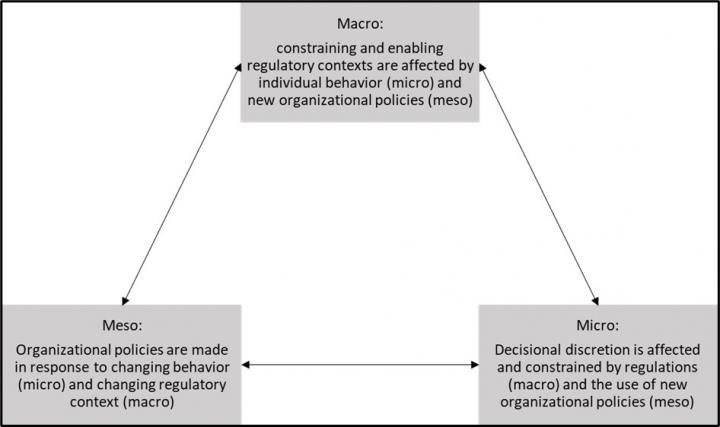
Caption: Studying algorithms and algorithmic transparency from multiple levels of analyses. Credit: Information Polity.

Here’s a link, to and a citation for the special issue,

Algorithmic Transparency in Government: Towards a Multi-Level Perspective
Guest Editors: Sarah Giest, PhD, and Stephan Grimmelikhuijsen, PhD
Information Polity, Volume 25, Issue 4 (December 2020), published by IOS Press

The issue is open access for three months, Dec. 14, 2020 – March 14, 2021.

Two articles from the special were featured in the press release,

“The agency of algorithms: Understanding human-algorithm interaction in administrative decision-making,” by Rik Peeters, PhD (https://doi.org/10.3233/IP-200253)

“A machine learning approach to open public comments for policymaking,” by Alex Ingrams, PhD (https://doi.org/10.3233/IP-200256)

An AI governance publication from the US’s Wilson Center

Within one week of the release of a special issue of Information Polity on AI and governments, a Wilson Center (Woodrow Wilson International Center for Scholars) December 21, 2020 news release (received via email) announces a new publication,

Governing AI: Understanding the Limits, Possibilities, and Risks of AI in an Era of Intelligent Tools and Systems by John Zysman & Mark Nitzberg

Abstract

In debates about artificial intelligence (AI), imaginations often run wild. Policy-makers, opinion leaders, and the public tend to believe that AI is already an immensely powerful universal technology, limitless in its possibilities. However, while machine learning (ML), the principal computer science tool underlying today’s AI breakthroughs, is indeed powerful, ML is fundamentally a form of context-dependent statistical inference and as such has its limits. Specifically, because ML relies on correlations between inputs and outputs or emergent clustering in training data, today’s AI systems can only be applied in well- specified problem domains, still lacking the context sensitivity of a typical toddler or house-pet. Consequently, instead of constructing policies to govern artificial general intelligence (AGI), decision- makers should focus on the distinctive and powerful problems posed by narrow AI, including misconceived benefits and the distribution of benefits, autonomous weapons, and bias in algorithms. AI governance, at least for now, is about managing those who create and deploy AI systems, and supporting the safe and beneficial application of AI to narrow, well-defined problem domains. Specific implications of our discussion are as follows:

  • AI applications are part of a suite of intelligent tools and systems and must ultimately be regulated as a set. Digital platforms, for example, generate the pools of big data on which AI tools operate and hence, the regulation of digital platforms and big data is part of the challenge of governing AI. Many of the platform offerings are, in fact, deployments of AI tools. Hence, focusing on AI alone distorts the governance problem.
  • Simply declaring objectives—be they assuring digital privacy and transparency, or avoiding bias—is not sufficient. We must decide what the goals actually will be in operational terms.
  • The issues and choices will differ by sector. For example, the consequences of bias and error will differ from a medical domain or a criminal justice domain to one of retail sales.
  • The application of AI tools in public policy decision making, in transportation design or waste disposal or policing among a whole variety of domains, requires great care. There is a substantial risk of focusing on efficiency when the public debate about what the goals should be in the first place is in fact required. Indeed, public values evolve as part of social and political conflict.
  • The economic implications of AI applications are easily exaggerated. Should public investment concentrate on advancing basic research or on diffusing the tools, user interfaces, and training needed to implement them?
  • As difficult as it will be to decide on goals and a strategy to implement the goals of one community, let alone regional or international communities, any agreement that goes beyond simple objective statements is very unlikely.

Unfortunately, I haven’t been able to successfully download the working paper/report from the Wilson Center’s Governing AI: Understanding the Limits, Possibilities, and Risks of AI in an Era of Intelligent Tools and Systems webpage.

However, I have found a draft version of the report (Working Paper) published August 26, 2020 on the Social Science Research Network. This paper originated at the University of California at Berkeley as part of a series from the Berkeley Roundtable on the International Economy (BRIE). ‘Governing AI: Understanding the Limits, Possibility, and Risks of AI in an Era of Intelligent Tools and Systems’ is also known as the BRIE Working Paper 2020-5.

Canadian government and AI

The special issue on AI and governance and the the paper published by the Wilson Center stimulated my interest in the Canadian government’s approach to governance, responsibility, transparency, and AI.

There is information out there but it’s scattered across various government initiatives and ministries. Above all, it is not easy to find, open communication. Whether that’s by design or the blindness and/or ineptitude to be found in all organizations I leave that to wiser judges. (I’ve worked in small companies and they too have the problem. In colloquial terms, ‘the right hand doesn’t know what the left hand is doing’.)

Responsible use? Maybe not after 2019

First there’s a government of Canada webpage, Responsible use of artificial intelligence (AI). Other than a note at the bottom of the page “Date modified: 2020-07-28,” all of the information dates from 2016 up to March 2019 (which you’ll find on ‘Our Timeline’). Is nothing new happening?

For anyone interested in responsible use, there are two sections “Our guiding principles” and “Directive on Automated Decision-Making” that answer some questions. I found the ‘Directive’ to be more informative with its definitions, objectives, and, even, consequences. Sadly, you need to keep clicking to find consequences and you’ll end up on The Framework for the Management of Compliance. Interestingly, deputy heads are assumed in charge of managing non-compliance. I wonder how employees deal with a non-compliant deputy head?

What about the government’s digital service?

You might think Canadian Digital Service (CDS) might also have some information about responsible use. CDS was launched in 2017, according to Luke Simon’s July 19, 2017 article on Medium,

In case you missed it, there was some exciting digital government news in Canada Tuesday. The Canadian Digital Service (CDS) launched, meaning Canada has joined other nations, including the US and the UK, that have a federal department dedicated to digital.

At the time, Simon was Director of Outreach at Code for Canada.

Presumably, CDS, from an organizational perspective, is somehow attached to the Minister of Digital Government (it’s a position with virtually no governmental infrastructure as opposed to the Minister of Innovation, Science and Economic Development who is responsible for many departments and agencies). The current minister is Joyce Murray whose government profile offers almost no information about her work on digital services. Perhaps there’s a more informative profile of the Minister of Digital Government somewhere on a government website.

Meanwhile, they are friendly folks at CDS but they don’t offer much substantive information. From the CDS homepage,

Our aim is to make services easier for government to deliver. We collaborate with people who work in government to address service delivery problems. We test with people who need government services to find design solutions that are easy to use.

Learn more

After clicking on Learn more, I found this,

At the Canadian Digital Service (CDS), we partner up with federal departments to design, test and build simple, easy to use services. Our goal is to improve the experience – for people who deliver government services and people who use those services.

How it works

We work with our partners in the open, regularly sharing progress via public platforms. This creates a culture of learning and fosters best practices. It means non-partner departments can apply our work and use our resources to develop their own services.

Together, we form a team that follows the ‘Agile software development methodology’. This means we begin with an intensive ‘Discovery’ research phase to explore user needs and possible solutions to meeting those needs. After that, we move into a prototyping ‘Alpha’ phase to find and test ways to meet user needs. Next comes the ‘Beta’ phase, where we release the solution to the public and intensively test it. Lastly, there is a ‘Live’ phase, where the service is fully released and continues to be monitored and improved upon.

Between the Beta and Live phases, our team members step back from the service, and the partner team in the department continues the maintenance and development. We can help partners recruit their service team from both internal and external sources.

Before each phase begins, CDS and the partner sign a partnership agreement which outlines the goal and outcomes for the coming phase, how we’ll get there, and a commitment to get them done.

As you can see, there’s not a lot of detail and they don’t seem to have included anything about artificial intelligence as part of their operation. (I’ll come back to the government’s implementation of artificial intelligence and information technology later.)

Does the Treasury Board of Canada have charge of responsible AI use?

I think so but there are government departments/ministries that also have some responsibilities for AI and I haven’t seen any links back to the Treasury Board documentation.

For anyone not familiar with the Treasury Board or even if you are, December 14, 2009 article (Treasury Board of Canada: History, Organization and Issues) on Maple Leaf Web is quite informative,

The Treasury Board of Canada represent a key entity within the federal government. As an important cabinet committee and central agency, they play an important role in financial and personnel administration. Even though the Treasury Board plays a significant role in government decision making, the general public tends to know little about its operation and activities. [emphasis mine] The following article provides an introduction to the Treasury Board, with a focus on its history, responsibilities, organization, and key issues.

It seems the Minister of Digital Government, Joyce Murray is part of the Treasury Board and the Treasury Board is the source for the Digital Operations Strategic Plan: 2018-2022,

I haven’t read the entire document but the table of contents doesn’t include a heading for artificial intelligence and there wasn’t any mention of it in the opening comments.

But isn’t there a Chief Information Officer for Canada?

Herein lies a tale (I doubt I’ll ever get the real story) but the answer is a qualified ‘no’. The Chief Information Officer for Canada, Alex Benay (there is an AI aspect) stepped down in September 2019 to join a startup company according to an August 6, 2019 article by Mia Hunt for Global Government Forum,

Alex Benay has announced he will step down as Canada’s chief information officer next month to “take on new challenge” at tech start-up MindBridge.

“It is with mixed emotions that I am announcing my departure from the Government of Canada,” he said on Wednesday in a statement posted on social media, describing his time as CIO as “one heck of a ride”.

He said he is proud of the work the public service has accomplished in moving the national digital agenda forward. Among these achievements, he listed the adoption of public Cloud across government; delivering the “world’s first” ethical AI management framework; [emphasis mine] renewing decades-old policies to bring them into the digital age; and “solidifying Canada’s position as a global leader in open government”.

He also led the introduction of new digital standards in the workplace, and provided “a clear path for moving off” Canada’s failed Phoenix pay system. [emphasis mine]

I cannot find a current Chief Information of Canada despite searches but I did find this List of chief information officers (CIO) by institution. Where there was one, there are now many.

Since September 2019, Mr. Benay has moved again according to a November 7, 2019 article by Meagan Simpson on the BetaKit,website (Note: Links have been removed),

Alex Benay, the former CIO [Chief Information Officer] of Canada, has left his role at Ottawa-based Mindbridge after a short few months stint.

The news came Thursday, when KPMG announced that Benay was joining the accounting and professional services organization as partner of digital and government solutions. Benay originally announced that he was joining Mindbridge in August, after spending almost two and a half years as the CIO for the Government of Canada.

Benay joined the AI startup as its chief client officer and, at the time, was set to officially take on the role on September 3rd. According to Benay’s LinkedIn, he joined Mindbridge in August, but if the September 3rd start date is correct, Benay would have only been at Mindbridge for around three months. The former CIO of Canada was meant to be responsible for Mindbridge’s global growth as the company looked to prepare for an IPO in 2021.

Benay told The Globe and Mail that his decision to leave Mindbridge was not a question of fit, or that he considered the move a mistake. He attributed his decision to leave to conversations with Mindbridge customer KPMG, over a period of three weeks. Benay told The Globe that he was drawn to the KPMG opportunity to lead its digital and government solutions practice, something that was more familiar to him given his previous role.

Mindbridge has not completely lost what was touted as a start hire, though, as Benay will be staying on as an advisor to the startup. “This isn’t a cutting the cord and moving on to something else completely,” Benay told The Globe. “It’s a win-win for everybody.”

Via Mr. Benay, I’ve re-introduced artificial intelligence and introduced the Phoenix Pay system and now I’m linking them to government implementation of information technology in a specific case and speculating about implementation of artificial intelligence algorithms in government.

Phoenix Pay System Debacle (things are looking up), a harbinger for responsible use of artificial intelligence?

I’m happy to hear that the situation where government employees had no certainty about their paycheques is becoming better. After the ‘new’ Phoenix Pay System was implemented in early 2016, government employees found they might get the correct amount on their paycheque or might find significantly less than they were entitled to or might find huge increases.

The instability alone would be distressing but adding to it with the inability to get the problem fixed must have been devastating. Almost five years later, the problems are being resolved and people are getting paid appropriately, more often.

The estimated cost for fixing the problems was, as I recall, over $1B; I think that was a little optimistic. James Bagnall’s July 28, 2020 article for the Ottawa Citizen provides more detail, although not about the current cost, and is the source of my measured optimism,

Something odd has happened to the Phoenix Pay file of late. After four years of spitting out errors at a furious rate, the federal government’s new pay system has gone quiet.

And no, it’s not because of the even larger drama written by the coronavirus. In fact, there’s been very real progress at Public Services and Procurement Canada [PSPC; emphasis mine], the department in charge of pay operations.

Since January 2018, the peak of the madness, the backlog of all pay transactions requiring action has dropped by about half to 230,000 as of late June. Many of these involve basic queries for information about promotions, overtime and rules. The part of the backlog involving money — too little or too much pay, incorrect deductions, pay not received — has shrunk by two-thirds to 125,000.

These are still very large numbers but the underlying story here is one of long-delayed hope. The government is processing the pay of more than 330,000 employees every two weeks while simultaneously fixing large batches of past mistakes.

While officials with two of the largest government unions — Public Service Alliance of Canada [PSAC] and the Professional Institute of the Public Service of Canada [PPSC] — disagree the pay system has worked out its kinks, they acknowledge it’s considerably better than it was. New pay transactions are being processed “with increased timeliness and accuracy,” the PSAC official noted.

Neither union is happy with the progress being made on historical mistakes. PIPSC president Debi Daviau told this newspaper that many of her nearly 60,000 members have been waiting for years to receive salary adjustments stemming from earlier promotions or transfers, to name two of the more prominent sources of pay errors.

Even so, the sharp improvement in Phoenix Pay’s performance will soon force the government to confront an interesting choice: Should it continue with plans to replace the system?

Treasury Board, the government’s employer, two years ago launched the process to do just that. Last March, SAP Canada — whose technology underpins the pay system still in use at Canada Revenue Agency — won a competition to run a pilot project. Government insiders believe SAP Canada is on track to build the full system starting sometime in 2023.

When Public Services set out the business case in 2009 for building Phoenix Pay, it noted the pay system would have to accommodate 150 collective agreements that contained thousands of business rules and applied to dozens of federal departments and agencies. The technical challenge has since intensified.

Under the original plan, Phoenix Pay was to save $70 million annually by eliminating 1,200 compensation advisors across government and centralizing a key part of the operation at the pay centre in Miramichi, N.B., where 550 would manage a more automated system.

Instead, the Phoenix Pay system currently employs about 2,300.  This includes 1,600 at Miramichi and five regional pay offices, along with 350 each at a client contact centre (which deals with relatively minor pay issues) and client service bureau (which handles the more complex, longstanding pay errors). This has naturally driven up the average cost of managing each pay account — 55 per cent higher than the government’s former pay system according to last fall’s estimate by the Parliamentary Budget Officer.

… As the backlog shrinks, the need for regional pay offices and emergency staffing will diminish. Public Services is also working with a number of high-tech firms to develop ways of accurately automating employee pay using artificial intelligence [emphasis mine].

Given the Phoenix Pay System debacle, it might be nice to see a little information about how the government is planning to integrate more sophisticated algorithms (artificial intelligence) in their operations.

I found this on a Treasury Board webpage, all 1 minute and 29 seconds of it,

The blonde model or actress mentions that companies applying to Public Services and Procurement Canada for placement on the list must use AI responsibly. Her script does not include a definition or guidelines, which, as previously noted, as on the Treasury Board website.

As for Public Services and Procurement Canada, they have an Artificial intelligence source list,

Public Services and Procurement Canada (PSPC) is putting into operation the Artificial intelligence source list to facilitate the procurement of Canada’s requirements for Artificial intelligence (AI).

After research and consultation with industry, academia, and civil society, Canada identified 3 AI categories and business outcomes to inform this method of supply:

Insights and predictive modelling

Machine interactions

Cognitive automation

PSPC is focused only on procuring AI. If there are guidelines on their website for its use, I did not find them.

I found one more government agency that might have some information about artificial intelligence and guidelines for its use, Shared Services Canada,

Shared Services Canada (SSC) delivers digital services to Government of Canada organizations. We provide modern, secure and reliable IT services so federal organizations can deliver digital programs and services that meet Canadians needs.

Since the Minister of Digital Government, Joyce Murray, is listed on the homepage, I was hopeful that I could find out more about AI and governance and whether or not the Canadian Digital Service was associated with this government ministry/agency. I was frustrated on both counts.

To sum up, there is no information that I could find after March 2019 about Canada, it’s government and plans for AI, especially responsible management/governance and AI on a Canadian government website although I have found guidelines, expectations, and consequences for non-compliance. (Should anyone know which government agency has up-to-date information on its responsible use of AI, please let me know in the Comments.

Canadian Institute for Advanced Research (CIFAR)

The first mention of the Pan-Canadian Artificial Intelligence Strategy is in my analysis of the Canadian federal budget in a March 24, 2017 posting. Briefly, CIFAR received a big chunk of that money. Here’s more about the strategy from the CIFAR Pan-Canadian AI Strategy homepage,

In 2017, the Government of Canada appointed CIFAR to develop and lead a $125 million Pan-Canadian Artificial Intelligence Strategy, the world’s first national AI strategy.

CIFAR works in close collaboration with Canada’s three national AI Institutes — Amii in Edmonton, Mila in Montreal, and the Vector Institute in Toronto, as well as universities, hospitals and organizations across the country.

The objectives of the strategy are to:

Attract and retain world-class AI researchers by increasing the number of outstanding AI researchers and skilled graduates in Canada.

Foster a collaborative AI ecosystem by establishing interconnected nodes of scientific excellence in Canada’s three major centres for AI: Edmonton, Montreal, and Toronto.

Advance national AI initiatives by supporting a national research community on AI through training programs, workshops, and other collaborative opportunities.

Understand the societal implications of AI by developing global thought leadership on the economic, ethical, policy, and legal implications [emphasis mine] of advances in AI.

Responsible AI at CIFAR

You can find Responsible AI in a webspace devoted to what they have called, AI & Society. Here’s more from the homepage,

CIFAR is leading global conversations about AI’s impact on society.

The AI & Society program, one of the objectives of the CIFAR Pan-Canadian AI Strategy, develops global thought leadership on the economic, ethical, political, and legal implications of advances in AI. These dialogues deliver new ways of thinking about issues, and drive positive change in the development and deployment of responsible AI.

Solution Networks

AI Futures Policy Labs

AI & Society Workshops

Building an AI World

Under the category of building an AI World I found this (from CIFAR’s AI & Society homepage),

BUILDING AN AI WORLD

Explore the landscape of global AI strategies.

Canada was the first country in the world to announce a federally-funded national AI strategy, prompting many other nations to follow suit. CIFAR published two reports detailing the global landscape of AI strategies.

I skimmed through the second report and it seems more like a comparative study of various country’s AI strategies than a overview of responsible use of AI.

Final comments about Responsible AI in Canada and the new reports

I’m glad to see there’s interest in Responsible AI but based on my adventures searching the Canadian government websites and the Pan-Canadian AI Strategy webspace, I’m left feeling hungry for more.

I didn’t find any details about how AI is being integrated into government departments and for what uses. I’d like to know and I’d like to have some say about how it’s used and how the inevitable mistakes will be dealh with.

The great unwashed

What I’ve found is high minded, but, as far as I can tell, there’s absolutely no interest in talking to the ‘great unwashed’. Those of us who are not experts are being left out of these earlier stage conversations.

I’m sure we’ll be consulted at some point but it will be long past the time when are our opinions and insights could have impact and help us avoid the problems that experts tend not to see. What we’ll be left with is protest and anger on our part and, finally, grudging admissions and corrections of errors on the government’s part.

Let’s take this for an example. The Phoenix Pay System was implemented in its first phase on Feb. 24, 2016. As I recall, problems develop almost immediately. The second phase of implementation starts April 21, 2016. In May 2016 the government hires consultants to fix the problems. November 29, 2016 the government minister, Judy Foote, admits a mistake has been made. February 2017 the government hires consultants to establish what lessons they might learn. February 15, 2018 the pay problems backlog amounts to 633,000. Source: James Bagnall, Feb. 23, 2018 ‘timeline‘ for Ottawa Citizen

Do take a look at the timeline, there’s more to it than what I’ve written here and I’m sure there’s more to the Phoenix Pay System debacle than a failure to listen to warnings from those who would be directly affected. It’s fascinating though how often a failure to listen presages far deeper problems with a project.

The Canadian government, both a conservative and a liberal government, contributed to the Phoenix Debacle but it seems the gravest concern is with senior government bureaucrats. You might think things have changed since this recounting of the affair in a June 14, 2018 article by Michelle Zilio for the Globe and Mail,

The three public servants blamed by the Auditor-General for the Phoenix pay system problems were not fired for mismanagement of the massive technology project that botched the pay of tens of thousands of public servants for more than two years.

Marie Lemay, deputy minister for Public Services and Procurement Canada (PSPC), said two of the three Phoenix executives were shuffled out of their senior posts in pay administration and did not receive performance bonuses for their handling of the system. Those two employees still work for the department, she said. Ms. Lemay, who refused to identify the individuals, said the third Phoenix executive retired.

In a scathing report last month, Auditor-General Michael Ferguson blamed three “executives” – senior public servants at PSPC, which is responsible for Phoenix − for the pay system’s “incomprehensible failure.” [emphasis mine] He said the executives did not tell the then-deputy minister about the known problems with Phoenix, leading the department to launch the pay system despite clear warnings it was not ready.

Speaking to a parliamentary committee on Thursday, Ms. Lemay said the individuals did not act with “ill intent,” noting that the development and implementation of the Phoenix project were flawed. She encouraged critics to look at the “bigger picture” to learn from all of Phoenix’s failures.

Mr. Ferguson, whose office spoke with the three Phoenix executives as a part of its reporting, said the officials prioritized some aspects of the pay-system rollout, such as schedule and budget, over functionality. He said they also cancelled a pilot implementation project with one department that would have helped it detect problems indicating the system was not ready.

Mr. Ferguson’s report warned the Phoenix problems are indicative of “pervasive cultural problems” [emphasis mine] in the civil service, which he said is fearful of making mistakes, taking risks and conveying “hard truths.”

Speaking to the same parliamentary committee on Tuesday, Privy Council Clerk [emphasis mine] Michael Wernick challenged Mr. Ferguson’s assertions, saying his chapter on the federal government’s cultural issues is an “opinion piece” containing “sweeping generalizations.”

The Privy Council Clerk is the top level bureaucrat (and there is only one such clerk) in the civil/public service and I think his quotes are quite telling of “pervasive cultural problems.” There’s a new Privy Council Clerk but from what I can tell he was well trained by his predecessor.

Do* we really need senior government bureaucrats?

I now have an example of bureaucratic interference, specifically with the Global Public Health Information Network (GPHIN) where it would seem that not much has changed, from a December 26, 2020 article by Grant Robertson for the Globe & Mail,

When Canada unplugged support for its pandemic alert system [GPHIN] last year, it was a symptom of bigger problems inside the Public Health Agency. Experienced scientists were pushed aside, expertise was eroded, and internal warnings went unheeded, which hindered the department’s response to COVID-19

As a global pandemic began to take root in February, China held a series of backchannel conversations with Canada, lobbying the federal government to keep its borders open.

With the virus already taking a deadly toll in Asia, Heng Xiaojun, the Minister Counsellor for the Chinese embassy, requested a call with senior Transport Canada officials. Over the course of the conversation, the Chinese representatives communicated Beijing’s desire that flights between the two countries not be stopped because it was unnecessary.

“The Chinese position on the continuation of flights was reiterated,” say official notes taken from the call. “Mr. Heng conveyed that China is taking comprehensive measures to combat the coronavirus.”

Canadian officials seemed to agree, since no steps were taken to restrict or prohibit travel. To the federal government, China appeared to have the situation under control and the risk to Canada was low. Before ending the call, Mr. Heng thanked Ottawa for its “science and fact-based approach.”

It was a critical moment in the looming pandemic, but the Canadian government lacked the full picture, instead relying heavily on what Beijing was choosing to disclose to the World Health Organization (WHO). Ottawa’s ability to independently know what was going on in China – on the ground and inside hospitals – had been greatly diminished in recent years.

Canada once operated a robust pandemic early warning system and employed a public-health doctor based in China who could report back on emerging problems. But it had largely abandoned those international strategies over the past five years, and was no longer as plugged-in.

By late February [2020], Ottawa seemed to be taking the official reports from China at their word, stating often in its own internal risk assessments that the threat to Canada remained low. But inside the Public Health Agency of Canada (PHAC), rank-and-file doctors and epidemiologists were growing increasingly alarmed at how the department and the government were responding.

“The team was outraged,” one public-health scientist told a colleague in early April, in an internal e-mail obtained by The Globe and Mail, criticizing the lack of urgency shown by Canada’s response during January, February and early March. “We knew this was going to be around for a long time, and it’s serious.”

China had locked down cities and restricted travel within its borders. Staff inside the Public Health Agency believed Beijing wasn’t disclosing the whole truth about the danger of the virus and how easily it was transmitted. “The agency was just too slow to respond,” the scientist said. “A sane person would know China was lying.”

It would later be revealed that China’s infection and mortality rates were played down in official records, along with key details about how the virus was spreading.

But the Public Health Agency, which was created after the 2003 SARS crisis to bolster the country against emerging disease threats, had been stripped of much of its capacity to gather outbreak intelligence and provide advance warning by the time the pandemic hit.

The Global Public Health Intelligence Network, an early warning system known as GPHIN that was once considered a cornerstone of Canada’s preparedness strategy, had been scaled back over the past several years, with resources shifted into projects that didn’t involve outbreak surveillance.

However, a series of documents obtained by The Globe during the past four months, from inside the department and through numerous Access to Information requests, show the problems that weakened Canada’s pandemic readiness run deeper than originally thought. Pleas from the international health community for Canada to take outbreak detection and surveillance much more seriously were ignored by mid-level managers [emphasis mine] inside the department. A new federal pandemic preparedness plan – key to gauging the country’s readiness for an emergency – was never fully tested. And on the global stage, the agency stopped sending experts [emphasis mine] to international meetings on pandemic preparedness, instead choosing senior civil servants with little or no public-health background [emphasis mine] to represent Canada at high-level talks, The Globe found.

The curtailing of GPHIN and allegations that scientists had become marginalized within the Public Health Agency, detailed in a Globe investigation this past July [2020], are now the subject of two federal probes – an examination by the Auditor-General of Canada and an independent federal review, ordered by the Minister of Health.

Those processes will undoubtedly reshape GPHIN and may well lead to an overhaul of how the agency functions in some areas. The first steps will be identifying and fixing what went wrong. With the country now topping 535,000 cases of COVID-19 and more than 14,700 dead, there will be lessons learned from the pandemic.

Prime Minister Justin Trudeau has said he is unsure what role added intelligence [emphasis mine] could have played in the government’s pandemic response, though he regrets not bolstering Canada’s critical supplies of personal protective equipment sooner. But providing the intelligence to make those decisions early is exactly what GPHIN was created to do – and did in previous outbreaks.

Epidemiologists have described in detail to The Globe how vital it is to move quickly and decisively in a pandemic. Acting sooner, even by a few days or weeks in the early going, and throughout, can have an exponential impact on an outbreak, including deaths. Countries such as South Korea, Australia and New Zealand, which have fared much better than Canada, appear to have acted faster in key tactical areas, some using early warning information they gathered. As Canada prepares itself in the wake of COVID-19 for the next major health threat, building back a better system becomes paramount.

If you have time, do take a look at Robertson’s December 26, 2020 article and the July 2020 Globe investigation. As both articles make clear, senior bureaucrats whose chief attribute seems to have been longevity took over, reallocated resources, drove out experts, and crippled the few remaining experts in the system with a series of bureaucratic demands while taking trips to attend meetings (in desirable locations) for which they had no significant or useful input.

The Phoenix and GPHIN debacles bear a resemblance in that senior bureaucrats took over and in a state of blissful ignorance made a series of disastrous decisions bolstered by politicians who seem to neither understand nor care much about the outcomes.

If you think I’m being harsh watch Canadian Broadcasting Corporation (CBC) reporter Rosemary Barton interview Prime Minister Trudeau for a 2020 year-end interview, Note: There are some commercials. Then, pay special attention to the Trudeau’s answer to the first question,

Responsible AI, eh?

Based on the massive mishandling of the Phoenix Pay System implementation where top bureaucrats did not follow basic and well established information services procedures and the Global Public Health Information Network mismanagement by top level bureaucrats, I’m not sure I have a lot of confidence in any Canadian government claims about a responsible approach to using artificial intelligence.

Unfortunately, it doesn’t matter as implementation is most likely already taking place here in Canada.

Enough with the pessimism. I feel it’s necessary to end this on a mildly positive note. Hurray to the government employees who worked through the Phoenix Pay System debacle, the current and former GPHIN experts who continued to sound warnings, and all those people striving to make true the principles of ‘Peace, Order, and Good Government’, the bedrock principles of the Canadian Parliament.

A lot of mistakes have been made but we also do make a lot of good decisions.

*’Doe’ changed to ‘Do’ on May 14, 2021.

Wizards wanted for Canadian federal government positions

The final (you may want to apply as soon as possible) deadline for applying is August 30, 2019 and the salary range is from $57,000 $61,000. (H/T: Liz Haq’s March 27, 2019 article for Huffington Post Canada.) While this might seem like a departure from my usual fare, it’s possible there’s some science involved since the Treasury Board President, Joyce Murray, is also the Minister of Digital Government and that ‘ministry’ is tightly interwoven with the Treasury Board Secretariat. Other than having a deputy minister and chief information office, Alex Benay, who reports to the Treasury Board President, there doesn’t appear to be an office or even a webpage dedicated to this ‘ministry’. You can find the Office of the Chief Information Officer in the Treasury Board’s Organizational Structure webpage. Moving on.

Has there been anything this whimsical from any Canadian government (pick your jurisdiction, federal, provincial, or municipal) job posting since the fabled 1960s and 70s? From the Government of Canada Jobs webpage hosting: AS-02 Various Administrative Wizardry Positions – INVENTORY (Note: I’ve changed some of the formatting),

Work environment
Are you a Gryffindor (brave, loyal, courageous and adventurous), a Ravenclaw (wise, creative, clever and knowledgeable) a Hufflepuff (hard working, dedicated, fair, patient) or a Slytherin (resourceful, ambitious, determined and crave leadership)?

No matter what ‘house’ you belong to, Treasury Board of Canada Secretariat (TBS) has various teams that we would love to use our ‘sorting hat’ to place you into. We are looking for strong and motivated candidates that are interested in making an impact on Canadian citizens. With our Talent Management Program, we will help you grow, learn and further develop your magical career within the Public Service. Come and let TBS become your home away from home!

Intent of the process
We will conduct the first random selection of applicants – also known as “wizards” – on April 8, 2019. Therefore, if you would like to increase your chance of being considered in this first group, please ensure to submit your application by April 7, 2019.

A pool of partially qualified persons resulting from this process WILL be created and WILL be used to fill similar positions with linguistic profiles (Bilingual Imperative BBB/BBB and CBC/CBC. In order to continue creating a diverse workforce, some positions may be filled on a bilingual Non-Imperative BBB/BBB and CBC/CBC basis for the following Employment Equity groups: Indigenous Persons, Visible Minorities and Persons with Disabilities) as well as tenures (please refer to Employment Tenure section of this poster) that may vary according to the position being staffed. This pool may be used to staff similar positions in other organizations within the core public administration (http://www.psc-cfp.gc.ca/plcy-pltq/rfli-lirf/index-eng.htm). By applying to this process, you consent to your personal application-related information being shared with other government departments interested in staffing similar positions.

Positions to be filled: Number to be determined
Information you must provide
Your résumé.
In order to be considered, your application must clearly explain how you meet the following (essential qualifications)
Education:
• A secondary school diploma or an acceptable combination of education, training and/or experience.
Degree equivalency
Experience:
• Significant* experience in providing administrative support services;
• Significant* experience in processing, tracking and proof reading documents such as reports, letters, briefing notes, memos or correspondence;
• Experience liaising with and providing advice or guidance to management, staff or clients.

*Significant experience is defined as having performed the duties for a minimum of one (1) year.
The following will be applied / assessed at a later date (essential for the job)
Various language requirements
Bilingual Imperative BBB/BBB and CBC/CBC
Bilingual Non-Imperative BBB/BBB and CBC/CBC. In order to continue creating a diverse workforce, some positions may be filled on a bilingual Non-Imperative BBB/BBB and CBC/CBC basis for the following Employment Equity groups: Indigenous Persons, Visible Minorities and Persons with Disabilities
Information on language requirements
Second Language Writing Skills Self-Assessment
In order to help you decide if you should apply to a bilingual position, an optional self-assessment of your writing skills in your second official language is available for you to take before completing your application.
For more information, please consult:
Unsupervised Internet Test of Second Language Writing Skills
Competencies:
• Demonstrates integrity and respect;
• Thinking things through;
• Working effectively with others;
• Showing initiative and being action-oriented.
Abilities:
• Ability to communicate effectively in writing;
• Ability to communicate effectively orally.
Personal Suitability:
• Reliability;
• Attention to detail.
The following may be applied / assessed at a later date (may be needed for the job)
Asset Qualifications (Although these are not mandatory to be found qualified in this appointment process, you must clearly demonstrate in your resume how you meet the asset criterion if you respond yes.)

Experience:
• Experience working in a legal environment;
• Experience working in a Human Resources environment;
• Experience in using a human resources information management system;
• Experience providing functional support and advice to clients on systems;
• Experience working with advanced Excel functions (for example: macros, pivot tables, formulas, etc.);
• Experience working in a security environment or related field;
• Experience in scheduling and coordinating an Executives calendar (EX-01 level or equivalent or above);
• Experience supervising/managing a team;
• Experience in providing budget support and financial services;
• Experience organizing events or government travel arrangements;
• Experience working on a project or program;
• Experience working in a communication environment;
• Experience working in accommodations or facilities management.
Other information

The Public Service of Canada is committed to building a skilled and diverse workforce that reflects the Canadians we serve. We promote employment equity and encourage you to indicate if you belong to one of the designated groups when you apply.
Information on employment equity

We will communicate with you about this process by email. As a result, you must update your Public Service Resourcing System profile if it changes as well as advise us of these changes via email. Applicants should use an email address that accepts messages from unknown senders (some email systems block such messages).

Come join TBS the “Hogwarts” of the Public Service!
Preference
Preference will be given to veterans and to Canadian citizens, in that order, with the exception of a job located in Nunavut, where Nunavut Inuit will be appointed first.
Information on the preference to veterans
We thank all those who apply. Only those selected for further consideration will be contacted.
Contact information
AS-02 Inventory team / “Dumbledore’s army”
AS02.TBS-AS02.SCT@tbs-sct.gc.ca

Apply online

Here are a few more details that might help you decide if you want to ‘throw your hat in’, from the Government of Canada Jobs webpage hosting: AS-02 Various Administrative Wizardry Positions – INVENTORY (Note: I’ve changed some of the formatting),

Treasury Board of Canada Secretariat
Ottawa (Ontario)
AS-02
Permanent, acting and temporary
$57,430 to $61,877

For further information on the organization, please visit Treasury Board of Canada Secretariat
The Cracking the Code video helps people who are looking for a new career with the Government of Canada to navigate the application process step by step.
Closing date: 30 August 2019 – 23:59, Pacific Time
Who can apply: Persons residing in Canada and Canadian citizens residing abroad. Apply online

I think they’re trying to introduce some fresh air into the federal civil service (or public service, if you prefer) . It is badly needed if the about-to-be former Clerk of the Privy Council (Canada’s top ranking bureaucrat), Michael Wernick is any indication of the state of our government bureaucracy (from a March 18, 2019 news item on CTV [Canadian Television] news online),

He [Martin Wernick] was directly named by Jody Wilson-Raybould [former Attorney General and Justice Minister] as one of the senior officials who she alleges was involved in a “sustained effort” to politically interfere in the criminal prosecution of SNC-Lavalin. She accused Wernick of issuing “veiled threats” if she did not change her mind about instructing federal prosecutors to pursue a remediation agreement rather than continuing with the criminal trial.

During his two appearances before the House Justice Committee on this matter, Wernick delivered direct and sometimes terse responses to MPs’ questions about his alleged involvement. He denied ever making any threats in relation to Wilson-Raybould’s handling of the criminal case against the Quebec company, as she had alleged.

He also raised eyebrows during his first round of testimony when he offered off-topic opening remarks on the state of online discourse, partisanship and the prospect of political assassinations in the upcoming campaign. [emphases mine]

In addition to concerns over his behaviour and perceived partisan comments as part of the SNC-Lavalin affair, MPs have also registered their discomfort with a related role he held: being part of a high-level panel responsible for deciding when and how to inform Canadians about concerning online behaviour during an election campaign.

NDP MP and ethics critic Charlie Angus sent an open letter to Prime Minister Justin Trudeau prior to Wernick’s second round of testimony, saying that Wernick was “deeply compromised,” has “overstepped his role,” and could not remain in his position

In the video clips I’ve seen of Wernick’s testimony before the Justice Committee , he seemed a little condescending and arrogant. If you want to see for yourself, there’s an embedded video of the CTV report on Wernick’s resignation in the March 18, 2019 CTV news item, which includes some of his testimony.

Ingenium or (as we used to call it) the Canada Science and Technology Museums Corporation (CSTMC)

The Canada Science and Technology Museums Corporation (CSTMC) has always been an unwieldy name in light of the fact that one of the three museums in the cluster is called the Canada Science and Technology Museum. (The other two are the Canada Agriculture and Food Museum, the Canada Aviation and Space Museum.) So, the July 6, 2017 CSTMC announcement (received via email) is a relief from the unwieldy corporate name,

A new national brand launched on June 26, 2017, to celebrate ingenuity
in Canada. Known as INGENIUM – CANADA’S MUSEUMS OF SCIENCE AND
INNOVATION, this corporate brand encompasses three national
institutions—the Canada Agriculture and Food Museum, the Canada
Aviation and Space Museum, and the Canada Science and Technology Museum.

From the Canadarm to canola and insulin, Canadians have made significant
contributions in the worlds of science and technology. INGENIUM –
CANADA’S MUSEUMS OF SCIENCE AND INNOVATION will continue the important
mission of preserving Canada’s scientific and technological heritage
and sharing its stories with Canadians. Under the Ingenium brand, the
three museums will be places where the past meets the future, with
spaces where visitors can learn and explore, play and discover. Ingenium
will provide an immersive, sensory encounter with human ingenuity and
tell the stories of those who dared to think differently and test the
limits of what we know and what we can do.

Currently under construction, Ingenium’s Collections Conservation
Centre [4], including a Research Institute and Media Lab, will protect
priceless Canadian heritage artifacts for the benefit of Canadians for
generations to come. Ingenium’s unique collection, and digital and
social media platforms will connect Canadians to the world stage in
unexpected ways by sharing their passions, memories, and everyday
experience, no matter where they live

You can find the Ingenium website here. Oddly, the organization’s June 27, 2017 news release is found on the About page,

With Canada just days away [July 1, 2017] from celebrating the 150th anniversary of Confederation, a new national brand is launching to celebrate ingenuity in Canada. Known as Ingenium – Canada’s Museums of Science and Innovation, this corporate brand, inspired from the Latin root for “ingenuity,” [this word will come up again in my commentary at the end of the post] encompasses three national institutions—the Canada Agriculture and Food Museum, the Canada Aviation and Space Museum, and the Canada Science and Technology Museum.

From the Canadarm to canola and insulin, Canadians have made significant contributions in the worlds of science and technology. Ingenium – Canada’s Museums of Science and Innovation will continue the important mission of preserving Canada’s scientific and technological heritage and sharing its stories with Canadians.

Under the Ingenium brand, the three museums will be places where the past meets the future, with spaces where visitors can learn and explore, play and discover. Ingenium will provide an immersive, sensory encounter with human ingenuity and tell the stories of those who dared to think differently and test the limits of what we know and what we can do.

Currently under construction, Ingenium’s Collections Conservation Centre, including a Research Institute and Media Lab, will protect priceless Canadian heritage artifacts for the benefit of Canadians for generations to come‎. Ingenium’s unique collection, and digital and social media platforms will connect Canadians to the world stage in unexpected ways by sharing their passions, memories, and everyday experience, no matter where they live.

November 17, 2017, will mark the next milestone for Ingenium when the Canada Science and Technology Museum reopens its doors. This modern, world-class museum mixes the best of its previous incarnation with new technologies and exhibition techniques to tell Canada’s science and technology story in an immersive, educational, and fun way. It will feature more than 7,400 m2 (80,000 sq. ft.) of completely redesigned exhibition space (the equivalent of nearly five NHL rinks), including a specially designed hall to house international travelling exhibitions.

QUOTES

Ingenium will bring a consistent voice and identity to our corporation. It will allow us to reach beyond our four walls and engage with Canadians from coast to coast to coast, and with international audiences. Ingenium is where the past meets the future and inspires the next generation of young innovators.”
– Fernand Proulx, Interim President and CEO of Ingenium

ABOUT INGENIUM – CANADA’S MUSEUMS OF SCIENCE AND INNOVATION

DIGITAL AND TRAVELLING PRODUCTS

Ingenium offers unique digital and social media platforms that put ingenuity in the spotlight for unforgettable and immediate experiences to inspire children, families, and scientists alike.

Highlights

Mobile games: Ace AcademyAce Academy: Black FlightAce Academy: Skies of FuryBee OdysseySpace Frontiers: Dawn of Mars

Digital platforms: Open HeritageOpen DataOpen Archivesonline collectionReboot: A Future Museum documentaryIngenium Channel

Travelling exhibitions: International Bicycle travelling exhibition (set for July 2017 launch in Israel); Space to SpoonCanola: A Story of Canadian InnovationFood for HealthGame ChangersClimate Change is Here

CANADA AGRICULTURE AND FOOD MUSEUM 

About the Museum: The Canada Agriculture and Food Museum is located at Ottawa’s Central Experimental Farm, which traces its roots to 1886 and is the world’s only working farm in the heart of a capital city. The Museum offers programs and exhibitions on Canada’s agricultural heritage, food literacy, and on the benefits and relationship of agricultural science and technology to Canadians’ everyday lives. It provides visitors with a unique opportunity to see diverse breeds of farm animals important to Canadian agriculture past and present, and to learn about the food they eat. In addition to breeds common to Canadian agriculture, such as Holstein dairy cows and Angus beef cows, the Museum also has Canadienne dairy cows, Tamworth pigs, and Clydesdale horses. Many other breeds of dairy and beef cattle, pigs, sheep, horses, poultry, goats, and rabbits round out the collection.

Public programming includes special weekend theme events, school programs, summer day camps, interpretive tours, demonstrations, and joint undertakings with community groups and associations.

Museum Highlights: Canola! Seeds of Innovation; 150 farm animals in a demonstration farm; historical tractor collection; special events such as BaconpaloozaGlobal Tastes and the Ice Cream Festival.

CANADA AVIATION AND SPACE MUSEUM

About the Museum: Located on a former military air base just 5 kilometres from the Prime Minister’s residence at 24 Sussex Drive in Ottawa, the Museum focuses on aviation in Canada within an international context, from its beginnings in 1909 to the present day. As Canada’s contribution to aviation expanded to include aerospace technology, the Museum’s collection and mandate grew to include space flight. The Collection itself consists of more than 130 aircraft and artifacts (propellers, engines) from both civil and military service. It gives particular, but not exclusive, reference to Canadian achievements. The most extensive aviation collection in Canada, it is also considered one of the finest aviation museums in the world.

Museum Highlights: Largest surviving piece of the famous Avro Arrow (its nose section); the original Canadarm used on the Endeavour space shuttle; Lancaster WWII bomberLife in Orbit: The International Space Station exhibition.

CANADA SCIENCE AND TECHNOLOGY MUSEUM 

Established and opened in 1967 as a Centennial project, the Canada Science and Technology Museum is responsible for preserving, promoting, and sharing knowledge about Canada’s scientific and technological heritage. The Museum is currently undergoing an $80.5-million renewal of its entire building. When it opens, it will feature over 7,400 m2 (80,000 sq. ft.) of redesigned exhibition space, including an 850 m2 (9,200 sq. ft.) temporary exhibition hall to accommodate travelling exhibitions from around the world. It is scheduled to open to the public on November 17, 2017, marking its 50th Anniversary during Canada 150 celebrations.

Museum Highlights: 11 new exhibitions with the capacity to showcase international travelling exhibitions from around the world. Long-time visitor favourites, the Crazy Kitchen and locomotives will also make a comeback in addition to the Game Changers travelling exhibition which is currently touring across Canada, Artifact Alley, a Children’s gallery, a demonstration stage, classrooms, the Exploratek maker studio, and three new apps.

THE NATIONAL COLLECTION

Ingenium is the steward of Canada’s largest and most comprehensive museum collection devoted to science and technology. It preserves and provides access to extensive holdings of artifacts and library and archival materials that document this priceless material heritage. Comprising over 100,000 objects and hundreds of thousands of books, historic photographs, and archival documents, the collection is particularly strong in the areas of transportation (air, space, land, marine), physical sciences, medicine, communications, agriculture, and natural resources.

Collection Highlights: The test model of Alouette 1, Canada’s first satellite; the world’s first IMAX projector and camera; the first successful electron microscope built in North America; the first automobile made in Canada; the oldest surviving aircraft to have flown in Canada; the “Sackbut,“ the world’s first electronic sound synthesizer

This rebranded name bears an uncanny resemblance to the title of new book about Canadian inventions,’ Ingenuity’ (see my May 30, 2017 posting for the Vancouver book launch; scroll down about 60% of the way) by Tom Jenkins and David C. Johnston (current Governor General).

As it turns out, Alex Benay, then president and Chief Executive Officer of the CSTMC (see my June 19, 2014 posting about Benay’s appt.) worked for Tom Jenkins at Open Text for several years.

(As of March 24, 2017 Benay was appointed to the position of Canada’s Chief Information Officer [see March 27, 2017 notice on Libararianship.ca]). Anyone who’s been involved with rebrands and renaming knows that the name is picked in months in advance so this rebrand has Benay’s (and, possibly, Jenkins’) pawprints all over it.

Canada Science and Technology Museums Corporation welcomes Alex Benay as president and chief executive officer (CEO)

The search took over one year as the Canada Science and Technology Museums Corporation (CSTMC) cast about for a new president and CEO in the wake of previous incumbent Denise Amyot’s departure. From the June 17, 2014 CSTMC announcement,

The Canada Science and Technology Museums Corporation (CSTMC) welcomes the appointment by the Minister of Canadian Heritage and Official Languages, the Honourable Shelly Glover, of Alex Benay as its new President and CEO. Mr Benay will assume the role beginning July 2, 2014 for a 5-year term.

“This is excellent news,” said Dr Gary Polonsky, Chair of the CSTMC Board of Trustees. “Alex Benay is an exceptional leader with the capacity to heighten the CSTMC profile as the only national museum institution entirely dedicated to tracking Canada’s rich history and heritage in science, technology and innovation.”

“Alex’s appointment demonstrates the government’s support toward our museums”, added Dr Polonsky. “I wish to recognize Minister Glover’s leadership in this nomination process and express our gratitude for the appointment of a leader with vast experience in managing people, processes and resources. Alex’s significant networks in the private and public sectors in Canada and internationally, and leadership experience with Canada’s digital industry, will be great assets in developing the Corporation.”

Mr Benay was previously Vice-President, Government Affairs and Business Development at Open Text, Canada’s largest software company since 2011.

As President and CEO, Mr Benay will be responsible for the CSTMC’s day-to-day operations and a staff of about 225 employees and an annual budget of $33 million. The CSTMC includes the Canada Agriculture and Food Museum, the Canada Aviation and Space Museum, and the Canada Science and Technology Museum. Collectively, they are responsible for preserving and protecting Canada’s scientific and technological heritage, while also promoting, celebrating, and sharing knowledge of that heritage and how it impacts Canadians’ daily lives.

I took a look at Mr. Benay’s LinkedIn profile and found this,

President and Chief Executive Officer
Canada Science and Technology Museums Corporation

Government Agency; 201-500 employees; Museums and Institutions industry

June 2014 – Present (1 month) Ottawa, Canada Area

VP, Government Relations
OpenText

Public Company; 5001-10,000 employees; OTEX; Computer Software industry

August 2012 – June 2014 (1 year 11 months) Ottawa

VP, Enterprise Software and Cloud Services
Maplesoft Group

Privately Held; 51-200 employees; Information Technology and Services industry

March 2012 – August 2012 (6 months) Canada

VP, Government Relations
OpenText

Public Company; 5001-10,000 employees; OTEX; Computer Software industry

July 2011 – March 2012 (9 months) Ottawa, Ontario

Manage government relations including :
– trade relations
– trade promotion
– global strategic investment programs (G20, Commonwealth, etc.)
– senior level delegations and engagements
– manage government grant and industry investment programs
– Etc.

Provide company wide government thought leadership and strategic planning

Director, Industry Marketing
Open Text

Public Company; 5001-10,000 employees; OTEX; Computer Software industry

August 2010 – March 2012 (1 year 8 months) Ottawa, Ontario

Responsible for marketing and communication strategies for OpenText’s major industry sectors, enabling field sales and providing thought leadership in key priority sectors.

Director, Eastern Canadian Sales
Open Text

Public Company; 5001-10,000 employees; OTEX; Computer Software industry

January 2010 – August 2010 (8 months) Ottawa, Ontario

Responsible for all product, solutions and services sales for Ottawa, Québec and the Maritimes.

Senior Director, Customer Enablement
Open Text

Public Company; 5001-10,000 employees; OTEX; Computer Software industry

2009 – 2010 (1 year) Ottawa, Ontario

Responsible, throughout the Canadian public sector (including healtcare), for all professional services delivery, establishing a national training program, managing partner relations, pubic speaking engagements, technical support and overall existing customer relations.
Strong focus on strategic communications and planning throughout the Canadian Public Sector.

Director, Information Management
Canadian International Development Agency

Government Agency; 1001-5000 employees; Government Administration industry

2006 – 2009 (3 years) Gatineau, Québec

Responsible for all information and communications aspects within the organisation : enterprise technologies, communication strategies, strategic planning, etc. Including all policy, operational and management aspects of managing organisational information and knowledge

Director, Policy
Canadian International Development Agency

Government Agency; 1001-5000 employees; International Affairs industry

2004 – 2006 (2 years)

Define ICT policy framework for CIDA
coordinate with central agencies and other large multilateral organisations

Senior Program Manager
Canadian International Development Agency

Government Agency; 1001-5000 employees; International Affairs industry

2003 – 2004 (1 year)

Managed all information and communications elements for the Multilateral Programs Branch. Responsible for relations with United Nations, World Bank, etc.; ensuring all systems (technical and human) were properly enabling multilateral development; developed large and complex global engagement and communications strategies pertaining to Canadian multilateralism

Manager, Information, Communications and Knowledge Management
Natural Resources Canada

Government Agency; 1001-5000 employees; Government Administration industry

2001 – 2003 (2 years)

Responsible for the Energy Sector information, communication and knowledge management strategies, thought leadership, events, strategic planning and operational management.

Information Services Officer
Department of Foreign Affairs and International Trade

2000 – 2001 (1 year)

Provide global briefing and communications support to various senior Foreign Affairs and International Trade Ministers, Deputy Ministers and Assistant Deputy Ministers

Medical Assistant
Canadian Armed Forces

Government Agency; 10,001+ employees; Military industry

1999 – 2001 (2 years)

Medical Assistant duties included : emergency response, first aid, suturing, orderly duties, basic military training, etc.

Archival Assistant
Library and Archives Canada

Government Agency; 1001-5000 employees; Government Administration industry

1998 – 2000 (2 years)

He certainly brings an interesting and peripatetic work history to the position. Given his previous work record and that he looks to be relatively young (I estimate he’s a few years shy of 40), my most optimistic prediction is that he will last five to six years in this job, assuming he makes it past his first six months.

Alex Benay, president and CEO of the Canada Science and Technology Museums Corporation

Alex Benay, president and CEO of the Canada Science and Technology Museums Corporation

Getting back to his work record, I’m not sure how Mr. Benay manged to be both an archival assistant for Library and Archives Canada and a medical assistant for the Canadian Armed Forces from 1999 – 2000. (Possibly he was working in the Reserves, which, as I understand it, requires weekends and the occasional longterm stint easily contained within one’s work vacation.) There is one other niggling thing, wouldn’t 1998 – 2000 be three years not two?

Interestingly, the company with which Benay has been most closely associated is OpenText whose Chairman, Tom Jenkins, led a  panel to review government funding programmes for research and development (R&D, a term often synonymous with science and technology). The resultant report is known familiarly as the Jenkins Report (Innovation Canada: A Call to Action; Review of Federal Support to R&D;–Expert Panel Report). I’m guessing Mr. Benay brings with him some important connections both corporately and governmentally, which could potentially extend to the University of British Columbia where Arvind Gupta (a member of Jenkins’ expert panel) is due to take up the reins as president when Stephen Toope officially vacates the position June 30, 2014.

I’m not sure how much insight one can derive from this March 6, 2014 article (for Canadian Government Executive) written by Mr. Benay while he was enjoying his second stint as VP Government Relations for Open Text,

With the rise of “smart power,” distinct from “hard” and “soft” power of traditional theories of international relations, the use of online collaboration has become an integral part of government communication.

Public sector employees who adopt partner-based collaboration models will find that they are able to effectively achieve their goals and generate results. Ideas shared through open-platform communication technologies, peer-to-peer networks, and enterprise-grade secure collaboration platforms can help foster greater dialogue and understanding between governments and citizens, ultimately leading to more effective attainment of foreign policy goals.

Increasingly, public-private partnerships are driving this new era of e-diplomacy.

As an example, governments worldwide are achieving tremendous success through their use of Public Service Without Borders (PSWB), the secure, cloud-enabled collaboration and social media environment developed in partnership with the Institute of Public Administration of Canada (IPAC).

Using secure social software solutions, PSWB helps to connect all levels of public service employees to one another to network, engage, share ideas and impart valuable lessons learned in such areas as governance, healthcare, technology and the environment. Whether via desktops or through mobile devices, participants can connect, network, plan and deliver exciting new partnerships and initiatives anytime, from anywhere in the world. This online collaboration platform ultimately fosters better, faster and more efficient services to all constituencies.

Another case in point is the G-20 Summit in Toronto. For the first time in history, policymakers from around the world were able to collaborate over secure social networking software in advance of and during the Toronto G-20 Summit. A confidential and secure social networking application was created to enhance the sharing of government leaders’ stances on important world financial issues. [emphasis mine]

Providing the secure, hosted social networking platform to G-8 and G-20 participants was in itself a collaboration between Open Text, the Canadian Digital Media Network (CDMN) – the organization that attracted high-tech companies to the event – and the then-called Canadian Department of Foreign Affairs and International Trade (DFAIT). [emphasis mine] In addition to secure Web access from anywhere in the world in real time, delegates were also able to access the application from their BlackBerrys, iPhones and iPads. The application supported multiple languages to enhance the ability of delegates to network productively.

The leap from ‘soft power’ in paragraphs one and two  to ‘public-private partnerships’ in paragraph three is a bit startling and suggests Benay’s tendency is towards ‘big picture’ thinking buttressed by a weakness for jumping from one idea to the next without much preparation. This is not a deal breaker as all leaders have weaknesses and a good one knows that sort of thing about him or herself so compensates for it.

Benay’s association with OpenText and, presumably, Jenkins suggests * strongly, when added to his article on public-private partnerships, that the CSTMC museums will be corporatized to a new degree. After all, it was Jenkins who delivered a report with recommendations to tie research funding more directly to business and economic needs. (This report was submitted to then Minister of State for Science and Technology, Gary Goodyear on Oct. 17, 2011 according to this Review of Federal Support to Research and Development  website. For those unfamiliar with the Canadian science and technology scene, this is considered a junior ministry and is part of the Industry Canada portfolio.) Since 2011, a number of these recommendations have been adopted, often accompanied by howls of despair (this May 22, 2013 posting delves into some of the controversies,which attracted attention by US observers).

I am somewhat intrigued by Benay’s experience with content management and digital media. I’m hopeful he will be using that experience to make some changes at the CSTMC such that it offers richer online and outreach experiences in the museums (Canada Agriculture and Food Museum, the Canada Aviation and Space Museum, and the Canada Science and Technology Museum) for those of us who are not resident in Ottawa. Amyot, during her* tenure, made some attempts (my Oct. 28, 2010 posting makes note of one such attempt) but they failed to take root for reasons not known* to me.

Returning to Benay’s old boss for a moment, Tom Jenkins has some connections of his own with regard to digital media and the military (from the OpenText Board of Directors page) ,

Mr. Jenkins was Chair of the Government of Canada’s military procurement review Panel which reported “Canada First: Leveraging Defence Procurement through Key Industrial Sectors (KICs) in February 2013 and reviewed the $490 Billion of federal public spending on defence to determine means by which the Canadian economy could benefit from military procurement.   Mr. Jenkins was Chair of the Government of Canada’s Research and Development Policy Review Panel which reported “Innovation Canada: A Call to Action” in October 2011 and reviewed the $7 Billion of federal public spending on research to assist the Canadian economy in becoming more innovative.   He was also chair of the November 2011 report to the Government of Canada on Innovation and Government Procurement.  He is also the Chair of the federal centre of excellence Canadian Digital Media Network (CDMN) which co-ordinates commercialization activity in the digital economy throughout Canada.  He is a member of the Canadian Government’s Advisory Panel on Open Government.  He is also an appointed member of the Social Sciences and Humanities Research Council of Canada (SSHRC), past appointed member of the Government of Canada’s Competition Policy Review Panel (the Wilson Panel) which reported “Compete to Win” in June 2008, and past appointed member of the Province of Ontario’s Ontario Commercialization Network Review Committee (OCN) which reported in February 2009.  … Mr. Jenkins is also one of the founders of Communitech – the Waterloo Region Technology Association.  Mr. Jenkins served as a commissioned officer in the Canadian Forces Reserve and he currently serves as Honorary Colonel of the Royal Highland Fusiliers of Canada (RHFC), a reserve infantry regiment in the Waterloo Region. [emphases mine]

Meanwhile, Mr. Benay’s appointment takes place within a larger context where the Council of Canadian Academies will be presenting two assessments with direct bearing on the CSTMC. The first, which is scheduled for release in 2014, is The State of Canada’s Science Culture (an assessment requested by the CSTMC which much later was joined by Industry Canada and Natural Resources Canada). The assessment is featured in my Feb. 22, 2013 posting titled: Expert panel to assess the state of Canada’s science culture—not exactly whelming. I will predict now that a main focus of this report will be on children, STEM (science, technology, engineering, and mathematics, and the economy (i.e., how do we get more children to study STEM topics?). Following on that thought, what better to way to encourage children than to give them good experiences with informal science education (code for science museums and centres).

The second assessment is called Memory Institutions and the Digital Revolution and was requested by Library and Archives Canada (museums too perform archival functions). in the context of a Jan. 30,2014 posting about digitizing materials in Fisheries and Oceans Canada libraries I excerpted this from an earlier posting,

Library and Archives Canada has asked the Council of Canadian Academies to assess how memory institutions, which include archives, libraries, museums, and other cultural institutions, can embrace the opportunities and challenges of the changing ways in which Canadians are communicating and working in the digital age.

Background

Over the past three decades, Canadians have seen a dramatic transformation in both personal and professional forms of communication due to new technologies. Where the early personal computer and word-processing systems were largely used and understood as extensions of the typewriter, advances in technology since the 1980s have enabled people to adopt different approaches to communicating and documenting their lives, culture, and work. Increased computing power, inexpensive electronic storage, and the widespread adoption of broadband computer networks have thrust methods of communication far ahead of our ability to grasp the implications of these advances.

These trends present both significant challenges and opportunities for traditional memory institutions as they work towards ensuring that valuable information is safeguarded and maintained for the long term and for the benefit of future generations. It requires that they keep track of new types of records that may be of future cultural significance, and of any changes in how decisions are being documented. As part of this assessment, the Council’s expert panel will examine the evidence as it relates to emerging trends, international best practices in archiving, and strengths and weaknesses in how Canada’s memory institutions are responding to these opportunities and challenges. Once complete, this assessment will provide an in-depth and balanced report that will support Library and Archives Canada and other memory institutions as they consider how best to manage and preserve the mass quantity of communications records generated as a result of new and emerging technologies.

The Council’s assessment is running concurrently with the Royal Society of Canada’s [RSC] expert panel assessment on Libraries and Archives in 21st century Canada. Though similar in subject matter, these assessments have a different focus and follow a different process. The Council’s assessment is concerned foremost with opportunities and challenges for memory institutions as they adapt to a rapidly changing digital environment. In navigating these issues, the Council will draw on a highly qualified and multidisciplinary expert panel to undertake a rigorous assessment of the evidence and of significant international trends in policy and technology now underway. The final report will provide Canadians, policy-makers, and decision-makers with the evidence and information needed to consider policy directions. In contrast, the RSC panel focuses on the status and future of libraries and archives, and will draw upon a public engagement process.

While this could be considered a curse, these are interesting times.

* ‘a’ removed from ‘a strongly’ and ‘strongly’ moved to closer proximity with ‘suggests’, ‘her’ added to ‘her tenure’ and ‘know’ corrected to ‘known’ on June 19, 2014 at 1200 hours PDT.