Before the ‘fletching’ explanation (in the news release), there’s the announcement in a July 27, 2025 news item on ScienceDaily,
A new material developed by researchers from University of Toronto Engineering could offer a safer alternative to the non-stick chemicals commonly used in cookware and other applications.
The new substance repels both water and grease about as well as standard non-stick coatings — but it contains much lower amounts of per- and polyfluoroalkyl substances (PFAS), a family of chemicals that have raised environmental and health concerns.
“The research community has been trying to develop safer alternatives to PFAS for a long time,” says Professor Kevin Golovin, who heads the Durable Repellent Engineered Advanced Materials (DREAM) Laboratory at U of T Engineering.
“The challenge is that while it’s easy to create a substance that will repel water, it’s hard to make one that will also repel oil and grease to the same degree. Scientists had hit an upper limit to the performance of these alternative materials.”
Since its invention in the late 1930s, Teflon — also known as polytetrafluoroethylene or PTFE — has become famous for its ability to repel water, oil and grease alike. Teflon is part of a larger family of substances known as per- and polyfluoroalkyl substances (PFAS).
PFAS molecules are made of chains of carbon atoms, each of which is bonded to several fluorine atoms. The inertness of carbon-fluorine bonds is responsible for the non-stick properties of PFAS.
However, this chemical inertness also causes PFAS to resist the normal processes that would break down other organic molecules over time. For this reason, they are sometimes called ‘forever chemicals.’
In addition to their persistence, PFAS are known to accumulate in biological tissues, and their concentrations can become amplified as they travel up the food chain.
Various studies have linked exposure to high levels of PFAS to certain types of cancer, birth defects and other health problems, with the longer chain PFAS generally considered more harmful than the shorter ones.
Despite the risks, the lack of alternatives means that PFAS remain ubiquitous in consumer products: they are widely used not only in cookware, but also in rain-resistant fabrics, food packaging and even in makeup.
“The material we’ve been working with as an alternative to PFAS is called polydimethylsiloxane or PDMS,” says Golovin.
“PDMS is often sold under the name silicone, and depending on how it’s formulated, it can be very biocompatible — in fact it’s often used in devices that are meant to be implanted into the body. But until now, we couldn’t get PDMS to perform quite as well as PFAS.”
To overcome this problem, PhD student Samuel Au developed a new chemistry technique that the team is calling nanoscale fletching [emphasis mine]. The technique is described in a paper published in Nature Communications.
“Unlike typical silicone, we bond short chains of PDMS to a base material — you can think of them like bristles on a brush,” says Au.
“To improve their ability to repel oil, we have now added in the shortest possible PFAS molecule, consisting of a single carbon with three fluorines on it. We were able to bond about seven of those to the end of each PDMS bristle.
“If you were able to shrink down to the nanometre scale, it would look a bit like the feathers that you see around the back end of an arrow, where it notches to the bow. That’s called fletching, so this is nanoscale fletching.”
Au and the team coated their new material on a piece of fabric, then placed drops of various oils on it to see how well it could repel them. On a scale developed by the American Association of Textile Chemists and Colorists, the new coating achieved a grade of 6, placing it on par with many standard PFAS-based coatings.
“While we did use a PFAS molecule in this process, it is the shortest possible one and therefore does not bioaccumulate,” says Golovin.
“What we’ve seen in the literature, and even in the regulations, is that it’s the longest-chain PFAS that are getting banned first, with the shorter ones considered much less harmful. Our hybrid material provides the same performance as what had been achieved with long-chain PFAS, but with greatly reduced risk.”
Golovin says that the team is open to collaborating with manufacturers of non-stick coatings who might wish to scale up and commercialize the process. In the meantime, they will continue working on even more alternatives.
“The holy grail of this field would be a substance that outperforms Teflon, but with no PFAS at all,” says Golovin.
“We’re not quite there yet, but this is an important step in the right direction.”
Originally, the plan was to produce some sort of a Canadian science culture roundup for 2019 but it came to my attention that 2019 was also an end-of-decade year (sometimes I miss the obvious). I’ll do my best to make this snappy but it is a review (more or less) of the last 10 years (roughly) and with regard to science culture in Canada, I’m giving the term a wide interpretation while avoiding (for the most part) mention of traditional science communication/outreach efforts such as university rresearch, academic publishing, academic conferences, and the like.
Since writing that opening paragraph in late December 2019, COVID-19 took over the world and this review seemed irrelevant for a while but as time passed, Iit occurred to me it might serve as a reminder of past good times and as a hope for the future.
Having started this blog in 2008, I’ve had the good fortune to observe a big increase in the number and range of science outreach/communication/culture initiatives, projects, festivals, etc. It’s tempting to describe it as an explosion of popular interest but I have no idea if this is true. I spend much of my time searching out and writing up this kind of work in addition to the emerging science and technology that I follow and my perception is most likely skewed by my pursuits. What i can say is that in 2019 there was more of everything to do with science culture/outreach/communication than there was when I started in 2008.
Coincidentally, I wrote a three-part series about science communication (including science outreach/culture projects) in Canada in Sept. 2009, just months before the start of this decade. In retrospect, the series is sprawling everywhere and it looks to me like I was desperately trying to make something look bigger than it actually was.
I’m looking at the more formal aspects of science communication and so onto mainstream media and education. This is the saddest section but don’t worry it gets better as it goes on.
Mainstream Media
As I note in the following subsection, there are fewer science writers employed by mainstream media, especially in Canada. The only science writer (that I know of) who’s currently employed by a newspaper is Ivan Semeniuk. for the Globe and Mail.
Margaret Munro who was the science writer for PostMedia (publisher of most newspaper dailies in Canada) is now a freelancer. Kate Lunau, a health and science journalist for Maclean’s Magazine (Canada) until 2016 and then Motherboard/VICE (US online publication) until March 2019 now publishes her own newsletter.
Daily Planet, which was a long running science programme (under various names since 1995) on Discovery Channel Canada and which inspired iterations in other countries, was cancelled in 2018 but there is still a Twitter feed being kept up to date and a webpage with access to archived programmes.
The Canadian Broadcasting Corporation (CBC) programmes, Spark for technology and Quirks & Quarks for science on the radio side and the Nature of Things for science, wildlife, and technology on television carry on year after year and decade after decade.
A more recent addition (2019?) to the CBC lineup is a podcast that touches on science and other topics, Tai Asks Why? According to the programme’s About page, the host (Tai Poole) is in grade seven. No podcasts dated after September 2019 have been posted on Tia’s page.
Yes Magazine for children and Seed magazine (for adults) have both died since 2009. On a happier note, Canadian children’s science magazines are easier to find these days either because I got lucky on my search and/or because there are more of them to find.
Thank you to helpwevegotkids.com for their 10 Awesome Magazines for Canadian Kids webpage. First published in 2016, it is updated from time to time, most recently in October 2019 by Heather Camlot; it’s where I found many of these science/technology magazines (Note: I’m not sure how long these magazines have been published but they are all new to me),
Chickadee Magazine: ages 6-9 ( Every month, the Chickadee team creates a package of interactive stories, puzzles, animal features, and science experiments to educate and entertain readers.) It’s from the folks at owlkids.com
OWL Magazine: ages 9-13 (… highlight the elements of science and tech, engineering, art and math ) Also from the folks at owlkids.com
AdventureBox: ages 6 – 9 (… nature with beautiful photographs and fascinating scientific information … Hilarious and adventurous comic-strips, games and quizzes … An audio CD every 2 months) Also from the folks at owlkids.com
DiscoveryBox: ages 9 – 12 ( … Animals and nature, with spectacular photographs … Fascinating scientific topics, with clear explanations and experiments to carry out …) Also from the folks at owlkids.com BTW, I was not able to find out much about the Owl Kids organization.
WILD magazine ( … jam-packed with fun wildlife stories, games and pictures for youngsters of all ages. It’s a great way to get the children in your life engaged in nature and share your passion for the outdoors. Published 6 times per year) From the folks at the Canadian Wildlife Federation (enough said).
Bazoof! (… suited for ages 7-12 … nutrition, personal care, fitness, healthy lifestyles, character development, eco-education—all in a creative and zany style! Filled with short stories, comics, recipes, puzzles, games, crafts, jokes, riddles, pet care, interviews, healthy snacks, sports, true stories, fun facts, prizes and more!) Bazoof! is being brought to you by the team responsible for Zamoof! You might want to read their About page. That’s all I can dig up.
Brainspace (an augmented reality magazine for kids 8 – 14) As best I can determine they are still ‘publishing’ their interactive magazine but they make finding information about themselves or their organization a little challenging. It’s published in Ontario and its publisher Nicky Middleton had this in her LinkedIn profile: “Publisher of Brainspace interactive magazine for kids 8-12. Creating augmented reality content for teaching resources in partnership with Brock University, District School Board of Niagara.”
One more thing regarding mainstream media
While there are fewer science journalists being employed, there’s still a need for science writing and journalism. The Science Media Centre of Canada (SMCC) opened in 2010 (from its Wikipedia entry),
… to serve journalists with accurate information on scientific matters. The centre has a Research Advisory Panel of 20 Canadian scientists who will make their expertise available in a simple and understandable manner. In order to secure objectivity, the centre has an Editorial Advisory Committee of eight journalists. The centre is bilingual.
As of January 2020, the SMCC is still in operation.
Education
It’s been up and down. Banff Centre (for Arts and Creativity) no longer runs a Science Communication programme in the summer but Laurentian University, which in 2009 seemed to offer a single module for one programme, now offers a Masters of Science Communication or a Science Communication Graduate Diploma.
Mount St. Vincent University in Nova Scotia offers a minor in Science Communication (scroll down). I gather it’s a new minor.
The University of British Columbia’s Journalism School (Vancouver) no longer has a Science Journalism Research Group nor does Concordia University (Montréal) have its Science Journalism Project. I have checked both journalism schools and cannot find any indication there is a science programme or specific science courses of any kind for journalists or other communicators but I didn’t spend a lot of time digging. Interestingly, the chair, David Secko, of Concordia’s journalism programme is a science journalist himself and a member of the Editorial Advisory Committee of the Science Media Centre of Canada.
The lack of science journalism programmes in Canada seems to reflect on overall lack of science journalism. It’s predictable given that the newspapers that once harboured science journalists have trimmed and continue to trim back their staffs.
Miscellaneous
Science centres, museums, and the like are considered part of the informal science community with Makerspaces being a new addition. For the most part, their target audience is children but they are increasingly (since 2010, I believe) offering events aimed at adults. The Canadian Association of Science Centres (CASC) describes itself and its membership this way (from the CASC About Us webpage),
CASC members are a diverse group of organisations that support informal learning of science, technology and nature. Our common bond is that we offer creative programming and exhibitions for visitors that inspire a drive to learn, create, and innovate.
If you are a member of a Science Centres, Museums, Aquariums, Planetariums and Makerspaces [these are a 2010s phenomenon] you could benefit from our reciprocal admission agreement. Not all CASC Members are participants in the Reciprocal Admissions Agreement. Click here for more information.
You can find a full list of their members including the Ingenium museums (the federal consortium of national Canadian science museums), the Saskatchewan Science Centre, the Nunavut Research Institute, Science East, and more, here.
I’m calling what follows ‘truly informal science culture’.
Science: the informal (sometimes cultural) scene
When I first started (this blog) there was one informal science get-together (that I knew of locally) and that was Vancouver Café Scientifque and its monthly events, which are still ongoing. You can find our more about the parent organization, which was started in Leeds, England in 1998. Other Canadian cities listed as having a Café Scientifique: Ottawa, Victoria, Mississauga, and Saskatoon.
Now onto the music, the dance, and more
Sing a song of science
Baba Brinkman is well known for his science raps. The rapper and playwright (from British Columbia) lives in New York City these days with his wife and sometime performance collaborator, neuroscientist Dr. Heather Berlin and their two children (see his Wikipedia entry for more), he is still Canadian (I think).
He got his start rapping science in 2008 when I think he was still living in Vancouver (Canada) after gaining the attention of UK professor Mark Pallen who commissioned him to write a rap about evolution. The Rap Guide to Evolution premiered at the 2009 Edinburgh Fringe Festival. Here’s a video of Brinkman’s latest science rap (Data Science) posted on YouTube on October 21, 2019,
I find this one especially interesting since Brinkman’s mother is the Honourable Joyce Murray, a member of parliament and the Minister of Digital Government in Prime Minister Justin Trudeau’s latest cabinet. (My December 27, 2019 posting highlights what I believe to be the importance of the Minister of Digital Government in the context of the government’s science and technology vision. Scroll down about 25% of the way to the subhead titled “The Minister of Digital Government and a bureaucratic débacle,”) You can find out more about Baba Brinkman here.
Tim Blais of A Capella Science first attracted my notice in 2014 thanks to David Bruggeman and his Pasco Phronesis blog (btw: David, I miss your posts about science and music which are how I found out most of what I know about the Canadian science music scene).
Blais (who has a master’s degree in physics from McGill University in Québec) started producing his musical science videos in 2012. I featured one of his earliest efforts (and one of my favourites, Rolling in the Higgs [Adele parody]) in my July 18, 2014 posting.
Dating back to 2012. The Institute of Quantum Computing at the University of Waterloo held two performances of Quantum: Music at the Frontier of Science. Raymond Laflamme, then director of the institute, wrote a September 20, 2012 article (The Quantum Symphony: A Cultural Entanglement) about the performances. You can see a video (15 mins., 45 secs.,) of the February 2012 performances here.
More recently, the Life Sciences Institute at the University of British Columbia (UBC) hosted a performance of Sounds and Science – Vienna Meets Vancouver in late 2019. I covered it in a November 12, 2019 posting (scroll down to the Sounds and Science subheading). The story about how the series, which has its home base in Vienna, started is fascinating. The sold out Vancouver performance was a combination of music and lecture featuring the Vienna Philharmonic and UBC researchers. According to this Sounds and Science UBC update,
…
For those who missed this exceptional evening, JoyTV and its CARPe Diem show will be producing an episode focusing on the concert, to be aired in February, 2020 [emphasis mine].
…
There is another way to look at musical science and that’s to consider the science of music which is what they do at the Large Interactive Virtual Environment Laboratory (LIVELab) at McMaster University (Hamilton, Ontario, Canada). it’s “a research concert hall. It functions as both a high-tech laboratory and theatre, opening up tremendous opportunities for research and investigation”, you can read more about it in my November 29, 2019 posting.
One last thing, there is data sonification which means finding a way to turn data into music or a sound which can more or less be defined as musical. There may be other data sonification projects and presentations in Canada but these are the ones I’ve tripped across (Note: Some links have bee removed),
Songs of the Ottawa From the website: “Songs of the Ottawa” is the Master’s Research Project of Cristina Wood, under the co-supervision of Dr. Joanna Dean and Dr. Shawn Graham. She completed her Master’s of Arts in Public History with a Specialization in Digital Humanities at Carleton University in spring 2019. She will continue her explorations of the Ottawa River in the Ph.D. program at York University [fall 2020]. Be in touch with Cristina on Twitter or send an email to hello [at] cristinawood [dot] ca.”
The Art of Data Sonification (This January 2019 workshop at Inter/Access in Toronto is over.) From the website: “Learn how to turn data into sound! Dan Tapper will teach participants how to apply different data sonification techniques, collect and produce a variety of sonifications, and how to creatively use these sonifications in their own work. The workshop will move from looking at data sonification through the lens of Dan Tapper’s work sonifying data sets from NASA, to collecting, cleaning and using your own data for artistic creation. Participants will work with pre-gathered and cleaned data sets before collecting and working with personal data and online data sets. Tools will be provided by Tapper created in Pure Data and Processing, as well as versions for Max/MSP users. A particular focus will be placed on how to use data sets and the created sonifications in creative practice – moving beyond quantitative sonic representations to richer material. “
Sonification: Making Data Sound (This September 2019 workshop at the Peter Wall Institute for Advanced Studies at the University of British Columbia is also over.) From the website: ” Computers and music have been mingling their intimate secrets for over 50 years. These two worlds evolve in tandem, and where they intersect they spawn practices that are entirely novel. One of these is “sonification,” turning raw data into sounds and sonic streams to discover new musical relationships within the dataset. This is similar to data visualization, a strategy that reveals new insights from data when it is made for the eye to perceive as graphs or animations. A key advantage with sonification is sound’s ability to present trends and details simultaneously at multiple time scales, allowing us to absorb and integrate information in the same way we listen to music. In this workshop, Chris Chafe will lead a discussion of the practice and application of sonification in a wide array of disciplines, drawing on his own extensive experience in this field.”
I have been looking for data sonification projects in Canada for years. It’s amazing to me that all of this sprung up in the last year of this decade. If there’s more, please do let me know in the Comments section.
Science blogging in Canada
The big news for the decade was the founding and launch of Science Borealis, a Canadian science blog aggregator in 2013. Assuming I counted right in December 2019, there are 146 blogs. These are not all independent bloggers, many institutional blogs are included. Also, I’m not sure how active some of these blogs are. Regardless, that’s a pretty stunning number especially when I consider that my annual Canadian blog roundup from 2010 -2012 would have boasted 20 – 30 Canadian science blogs at most.
I’m not sure why ASAP Science (Michael Moffit and Gregory Brown) isn’t included on Science Borealis but maybe the science vloggers (video bloggers) prefer to go it alone. or they fit into another category of online science. Regardless, ASAP Science has been around since May 2012 according to their About page. In addition to the science education/information they provide, there’s music, including this Taylor Swift Acapella Parody.
One of the earliest Canadians to create a science blog,Gregor Wolbring, Associate Professor at the University of Calgary’s Cumming School of Medicine, started his in 2006. He has taken a few breaks, 2011 and August 2013 – June 2017 but he’s back at it these days. He is in a sense a progenitor for Canadian science blogging. At one time, his blog was so popular that US researchers included it in their studies on what was then ‘the blogging phenomenon’. His focus academically and on his blog is on rehabilitation and disability. This webpage on his blog is of particular interest to me: FUTUREBODY: The Future of the Body in the Light of Neurotechnology. It’s where he lists papers from himself and his colleagues’ in the ERANET NEURON ELSI/ELSA funded by the European Community. (ELSI is Ethical, Legal and Social Implications and ELSA is Ethical, Legal, and Social Aspects.)
Canada’s Favourite Science Online, a competition co-sponsored by Science Borealia and the Science Writers and Communicators of Canada (SWCC), gives a People’s Choice Award annually in two categories: blog and science site. This September 16, 2019 posting on the Science Borealis blog features the finalists in the categories and a pretty decent sampling of what available online from the Canadian science community.
Science in the City is a Canadian life sciences blog aggregator and job and event listing website. The name is an official mark of McMaster University (Ontario, Canada) and it is used and registered by STEMCELL Technologies Canada Inc. Here’s more from their AboutScienceInTheCity webpage,
As scientists ourselves, we know that science is accelerated by collaboration and connection, but that the busy, demanding lifestyle of a scientist makes this challenging. Thus, we saw the need for a central resource that connects local scientists, provides them with a platform to share their ideas, and helps them stay current with the news, events, and jobs within their local scientific community. This inspired us to launch Science in the City in our hometown of Vancouver, Canada in 2017.
Science in the City is your complete source for all the life science news and events happening in your city. The Science in the City website and weekly newsletter provide researchers and medical professionals with breaking news, in-depth articles, and insightful commentary on what is happening around them. By supplying scientists with a resource for the local news and events that affect them, Science in the City fosters learning and collaboration within scientific communities, ultimately supporting the advancement of science and medicine.
…
Vancouver is our hometown, so it made sense to launch this exciting initiative in our own backyard. But we’re only getting started! We’ve launched Science in the City in Seattle and Boston, and we’re currently working on bringing Science in the City to several more scientific communities across North America and Europe!
….
Do check their event listings as they range past life science to many other interesting ‘sciencish’ get togethers. For example, in early 2020 (in Vancouver) there was,
At a guess their funding comes from STEMCELL Technologies while Science Borealis was originally (not sure what the status is today) bankrolled by Canadian Science Publishing (CSP).
It’s just dance, dance, dance
Ranging from pigeon courtship to superconductivity, Canadian scientists have scored a number of wins in the Dance Your Ph.D. competition founded in 2008 according to its Wikipedia entry and held by Science Magazine and the American Association for the Advancement of Science (AAAS). The contest requires that the entrant dance either as a solo artist or as part of a troupe.
In 2018, a University of Alberta student won in the physics category and then went on to win overall. I covered it in a February 22, 2019 posting. Because I love the video, here is Pramodh Senarath Yapa with his Superconductivity: The Musical!, again,
BTW, John Bohannon who came up with the idea for the contest wrote this February 15, 2019 article about Yapa’s win for Science Magazine.
While searching for other Canadian Dance Your Ph.D. winners, I found some from the 2010 and 2011 contests. (If there are others, please do let me know in the Comments section.)
McConnell’s video did not win in its division but another Canadian student, Queen’s University (Ontario) biologist, Emma Ware won the 2011 social science division for ‘A Study of Social Interactivity Using Pigeon Courtship‘. For more about McConnell and Ware’s 2011 efforts, you can read Tyler Irving’s October 20, 2011 posting on his eponymous blog. (Side note: Irving is a Canadian science writer who started the blog in 2011 and took a five year hiatus from January 2015 to January 2020.)
Onward dance
Lesley Telford, choreographer and director of Inverso Productions based in Vancouver, seems to have started showing a dance piece inspired by Albert Einstein’s famous description of quantum entanglement as “spooky action from s a distance” in 2017.
I first wrote about it in an April 20, 2017 posting. The title, at that time, was, ‘Three Sets/Relating At A Distance; My tongue, your ear / If / Spooky Action at a Distance (phase 1‘. In 2017, Telford was artist-in-residence at the Dance Centre and TRIUMF, Canada’s national laboratory for particle and nuclear physics and accelerator-based science, both located in Vancouver.
She has continued to work with the concept and most recently her company gave performances of ‘Spooky Action’ in 2019 and will go on tour in 2020 according to her company’s homepage.
Unlike Lesley Telford who has a single science-inspired piece, Blue Ceilingdance in Toronto, is organized around the idea of art (dance) and science according to the company’s About page,
Blue Ceiling dance aims to pierce the soul through investigations at the intersection of art and science, and physical rigour provoked by the imagination. By peering into the mysterious corners of human experience and embodying the natural laws of the universe, we want to inspire empathy and curiosity. Through creation, production, commissioning and touring of new dance and multi-disciplinary works and through the Imaginative Body Classes, Blue Ceiling dance uses the poetry of the body and of scientific language to describe our experience of the world through the lens of poetic naturalism.
Blue Ceiling dance was founded by Lucy Rupert in 2004, as an umbrella for her creative endeavours. …
Our biggest project to date premieres January 23-26th, 2020 at The Theatre Centre [Toronto].
Using the length of time it takes light to travel from the Sun to Earth, we launch into 8 overlapping meditations on the physical behaviour of light, the metaphors of astrophysics, and the soul of cosmology, as they brush against a sense of our own mortality. What would you do with your last 8 minutes and 17 seconds before the lights go out?
Choreographed and conceived by Lucy Rupert with additional choreography by Karen Kaeja, Emma Kerson and Jane Alison McKinney, and Michael Caldwell. With text written by Hume Baugh.
The company’s repertoire is diverse and focused largely on science,
Animal Vegetable Mineral is a site-specific work with a naturalist-led hike. Exploring embodiments of each category of matter, the dancers form an ecosystem under stress, and highlight the interconnectedness of all species and our deep need for one another. Audiences explore their local environment and encounter human embodiments in an intimate performance setting.
Originally made for the High Park Nature Centre in Toronto, the piece is adaptable to different ecosystems and environments.
dead reckoning Perplexing, haunting and slightly mischievous, with choreography by Lucy Rupert and international ballet choreographer Peter Quanz. The launching point for this work of dance-theatre is Sir Ernest Shackleton’s ill-fated expedition to Antarctica in 1914 and the mysterious experiences surrounding his life-or-death situation. Three linked dances offer three views of an explorer pursued by an enigmatic “other”.
…
Bye, bye ScienceOnline Vancouver
A ScienceOnline conference and community based in the United States inspired a short-lived but exciting offshoot in Vancouver. With much ado, their first event was held on April 19, 2012. As I recall, by December 2012, it had died.
The volunteers were wildly ambitious and it’s very hard to maintain the level of dynamism and technology they established on their first night. Here’s how I described the first event in my April 20, 2012 posting, ” It was a very technology-heavy event in that there was livestreaming, multiple computers and screens, references to tweeting and Storify, etc.” That’s a lot to do on a regular basis as volunteers. By Christmas 2012, ScienceOnline was gone. It was a great and I’m thankful for it.
Now onto part 2 where you’ll find the visual arts, poetry, festivals, and more.
Graphene fatigue operates under the same principle as metal fatigue. Subject graphene to stress over and over and at some point it (just like metal) will fail. Scientists at the University of Toronto (Ontatrio, Canada) and Rice University (Texas, US) have determined just how much stress graphene can withstand before breaking according to a January 28, 2020 University of Toronto news release by Tyler Irving (also on EurekAlert but published on January 29, 2020),
Graphene is a paradox. It is the thinnest material known to science, yet also one of the strongest. Now, research from University of Toronto Engineering shows that graphene is also highly resistant to fatigue — able to withstand more than a billion cycles of high stress before it breaks.
Graphene resembles a sheet of interlocking hexagonal rings, similar to the pattern you might see in bathroom flooring tiles. At each corner is a single carbon atom bonded to its three nearest neighbours. While the sheet could extend laterally over any area, it is only one atom thick.
The intrinsic strength of graphene has been measured at more than 100 gigapascals, among the highest values recorded for any material. But materials don’t always fail because the load exceeds their maximum strength. Stresses that are small but repetitive can weaken materials by causing microscopic dislocations and fractures that slowly accumulate over time, a process known as fatigue.
“To understand fatigue, imagine bending a metal spoon,” says Professor Tobin Filleter, one of the senior authors of the study, which was recently published in Nature Materials. “The first time you bend it, it just deforms. But if you keep working it back and forth, eventually it’s going to break in two.”
The research team — consisting of Filleter, fellow University of Toronto Engineering professors Chandra Veer Singh and Yu Sun, their students, and collaborators at Rice University — wanted to know how graphene would stand up to repeated stresses. Their approach included both physical experiments and computer simulations.
“In our atomistic simulations, we found that cyclic loading can lead to irreversible bond reconfigurations in the graphene lattice, causing catastrophic failure on subsequent loading,” says Singh, who along with postdoctoral fellow Sankha Mukherjee led the modelling portion of the study. “This is unusual behaviour in that while the bonds change, there are no obvious cracks or dislocations, which would usually form in metals, until the moment of failure.”
PhD candidate Teng Cui, who is co-supervised by Filleter and Sun, used the Toronto Nanofabrication Centre to build a physical device for the experiments. The design consisted of a silicon chip etched with half a million tiny holes only a few micrometres in diameter. The graphene sheet was stretched over these holes, like the head of a tiny drum.
Using an atomic force microscope, Cui then lowered a diamond-tipped probe into the hole to push on the graphene sheet, applying anywhere from 20 to 85 per cent of the force that he knew would break the material.
“We ran the cycles at a rate of 100,000 times per second,” says Cui. “Even at 70 per cent of the maximum stress, the graphene didn’t break for more than three hours, which works out to over a billion cycles. At lower stress levels, some of our trials ran for more than 17 hours.”
As with the simulations, the graphene didn’t accumulate cracks or other tell-tale signs of stress — it either broke or it didn’t.
“Unlike metals, there is no progressive damage during fatigue loading of graphene,” says Sun. “Its failure is global and catastrophic, confirming simulation results.”
The team also tested a related material, graphene oxide, which has small groups of atoms such as oxygen and hydrogen bonded to both the top and bottom of the sheet. Its fatigue behaviour was more like traditional materials, in that the failure was more progressive and localized. This suggests that the simple, regular structure of graphene is a major contributor to its unique properties.
“There are no other materials that have been studied under fatigue conditions that behave the way graphene does,” says Filleter. “We’re still working on some new theories to try and understand this.”
In terms of commercial applications, Filleter says that graphene-containing composites — mixtures of conventional plastic and graphene — are already being produced and used in sports equipment such as tennis rackets and skis.
In the future, such materials may begin to be used in cars or in aircraft, where the emphasis on light and strong materials is driven by the need to reduce weight, improve fuel efficiency and enhance environmental performance.
“There have been some studies to suggest that graphene-containing composites offer improved resistance to fatigue, but until now, nobody had measured the fatigue behaviour of the underlying material,” he says. “Our goal in doing this was to get at that fundamental understanding so that in the future, we’ll be able to design composites that work even better.”
Here’s a link to and a citation for the paper,
Fatigue of graphene by Teng Cui, Sankha Mukherjee, Parambath M. Sudeep, Guillaume Colas, Farzin Najafi, Jason Tam, Pulickel M. Ajayan, Chandra Veer Singh, Yu Sun & Tobin Filleter. Nature Materials (2020) DOI: DOIhttps://doi.org/10.1038/s41563-019-0586-y Published: 20 January 2020
Usually called ‘human-on-a-chip’, a team at the University of Toronto have developed a two-organ ‘person on a chip’ according to a March 7, 2016 news item on phys.org (Note: Links have been removed),
Researchers at U of T [University of Toronto] Engineering have developed a new way of growing realistic human tissues outside the body. Their “person-on-a-chip” technology, called AngioChip, is a powerful platform for discovering and testing new drugs, and could eventually be used to repair or replace damaged organs.
Professor Milica Radisic (IBBME, ChemE), graduate student Boyang Zhang and the rest of the team are among those research groups around the world racing to find ways to grow human tissues in the lab, under conditions that mimic a real person’s body. They have developed unique methods for manufacturing small, intricate scaffolds for individual cells to grow on. These artificial environments produce cells and tissues that resemble the real thing more closely than those grown lying flat in a petri dish.
The team’s recent creations have included BiowireTM—an innovative method of growing heart cells around a silk suture—as well as a scaffold for heart cells that snaps together like sheets of Velcro. But AngioChip takes tissue engineering to a whole new level. “It’s a fully three-dimensional structure complete with internal blood vessels,” says Radisic. “It behaves just like vasculature, and around it there is a lattice for other cells to attach and grow.” …
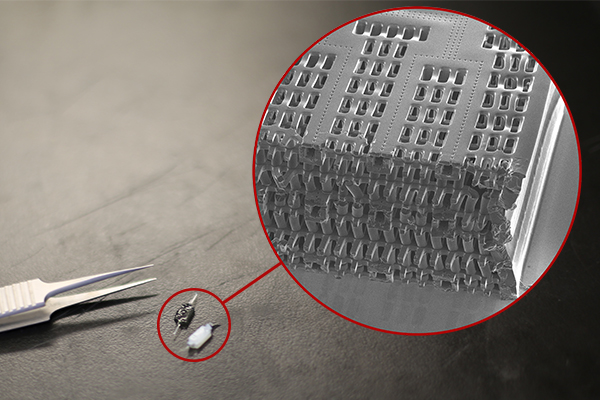
Zhang built the scaffold out of POMaC, a polymer that is both biodegradable and biocompatible. The scaffold is built out of a series of thin layers, stamped with a pattern of channels that are each about 50 to 100 micrometres wide. The layers, which resemble the computer microchips, are then stacked into a 3D structure of synthetic blood vessels. As each layer is added, UV light is used to cross-link the polymer and bond it to the layer below.
When the structure is finished, it is bathed in a liquid containing living cells. The cells quickly attach to the inside and outside of the channels and begin growing just as they would in the human body.
“Previously, people could only do this using devices that squish the cells between sheets of silicone and glass,” says Radisic. “You needed several pumps and vacuum lines to run just one chip. Our system runs in a normal cell culture dish, and there are no pumps; we use pressure heads to perfuse media through the vasculature. The wells are open, so you can easily access the tissue.”
Using the platform, the team has built model versions of both heart and liver tissues that function like the real thing. “Our liver actually produced urea and metabolized drugs,” says Radisic. They can connect the blood vessels of the two artificial organs, thereby modelling not just the organs themselves, but the interactions between them. They’ve even injected white blood cells into the vessels and watched as they squeezed through gaps in the vessel wall to reach the tissue on the other side, just as they do in the human body.
The news release also mentions potential markets and the work that needs to be accomplished before AngioChip is available for purchase,
AngioChip has great potential in the field of pharmaceutical testing. Current drug-testing methods, such as animal testing and controlled clinical trials, are costly and fraught with ethical concerns. Testing on lab-grown human tissues would provide a realistic model at a fraction of the cost, but this area of research is still in its infancy. “In the last few years, it has become possible to order cultures of human cells for testing, but they’re grown on a plate, a two-dimensional environment,” says Radisic. “They don’t capture all the functional hallmarks of a real heart muscle, for example.”
A more realistic platform like AngioChip could enable drug companies to detect dangerous side effects and interactions between organ compartments long before their products reach the market, saving countless lives. It could also be used to understand and validate the effectiveness of current drugs and even to screen libraries of chemical compounds to discover new drugs. Through TARA Biosystems Inc., a spin-off company co-founded by Radisic, the team is already working on commercializing the technology.
In future, Radisic envisions her lab-grown tissues being implanted into the body to repair organs damaged by disease. Because the cells used to seed the platform can come from anyone, the new tissues could be genetically identical to the intended host, reducing the risk of organ rejection. Even in its current form, the team has shown that the AngioChip can be implanted into a living animal, its artificial blood vessels connected to a real circulatory system. The polymer scaffolding itself simply biodegrades after several months.
The team still has much work to do. Each AngioChip is currently made by hand; if the platform is to be used industrially, the team will need to develop high-throughput manufacturing methods to create many copies at once. Still, the potential is obvious. “It really is multifunctional, and solves many problems in the tissue engineering space,” says Radisic. “It’s truly next-generation.”
Here’s a link to and a citation for the paper,
Biodegradable scaffold with built-in vasculature for organ-on-a-chip engineering and direct surgical anastomosis by Boyang Zhang, Miles Montgomery, M. Dean Chamberlain, Shinichiro Ogawa, Anastasia Korolj, Aric Pahnke, Laura A. Wells, Stéphane Massé, Jihye Kim, Lewis Reis, Abdul Momen, Sara S. Nunes, Aaron R. Wheeler, Kumaraswamy Nanthakumar, Gordon Keller, Michael V. Sefton, & Milica Radisic. Nature Materials (2016) doi:10.1038/nmat4570 Published online 07 March 2016
This paper is behind a paywall.
The researchers have made two images illustrating their work available. There’s this still image,
These tiny polymer scaffolds contain channels that are about 100 micrometres wide, about the same diameter as a human hair. When seeded with cells, the channels act as artificial blood vessels. By mimicking tissues in the human heart and other organs, these scaffolds provide a new way to test drugs for potentially dangerous side effects. (Image: Tyler Irving/Boyang Zhang/Kevin Soobrian)
Perhaps more intriguing is this one,
When seeded with heart cells, the flexible polymer scaffold contracts with a regular rhythm, just like real heart tissue. (Image: Boyang Zhang)
I have mentioned ‘human-on-a-chip’ projects many times here and as the news release writer notes, there is an international race. My July 1, 2015 posting (cross-posted from the June 30, 2015 posting [Testing times: the future of animal alternatives] on the International Innovation blog [a CORDIS-listed project dissemination partner for FP7 and H2020 projects]) notes a couple of those projects,
Organ-on-a-chip projects use stem cells to create human tissues that replicate the functions of human organs. Discussions about human-on-a-chip activities – a phrase used to describe 10 interlinked organ chips – were a highlight of the 9th World Congress on Alternatives to Animal Testing held in Prague, Czech Republic, last year. One project highlighted at the event was a joint US National Institutes of Health (NIH), US Food and Drug Administration (FDA) and US Defense Advanced Research Projects Agency (DARPA) project led by Dan Tagle that claimed it would develop functioning human-on-a-chip by 2017. However, he and his team were surprisingly close-mouthed and provided few details making it difficult to assess how close they are to achieving their goal.
By contrast, Uwe Marx – Leader of the ‘Multi-Organ-Chip’ programme in the Institute of Biotechnology at the Technical University of Berlin and Scientific Founder of TissUse, a human-on-a-chip start-up company – claims to have sold two-organ chips. He also claims to have successfully developed a four-organ chip and that he is on his way to building a human-on-a-chip. Though these chips remain to be seen, if they are, they will integrate microfluidics, cultured cells and materials patterned at the nanoscale to mimic various organs, and will allow chemical testing in an environment that somewhat mirrors a human.
As for where the University of Toronto efforts fit into the race, I don’t know for sure. It’s the first time I’ve come across a reference to liver tissue producing urea but I believe there’s at least one other team in China which has achieved a three-dimensional, more lifelike aspect for liver tissue in my Jan. 29, 2016 posting ‘Constructing a liver’.
This is my 3rd annual roundup of Canadian science blogs and the science blogging scene in Canada seems to be getting more lively (see my Dec. 31, 2010 posting and Dec. 29, 2011 posting to compare).
As I did last year, I will start with
Goodbyes
Don’t leave Canada appears to be gone as there hasn’t been posting there since May 4, 2011. I’m sorry to see it go as Rob Annan provided thoughtful commentary on science policy on a regular basis for years. Thank you, Rob. (BTW, he’s now the director of policy, research and evaluation at MITACS.)
Cool Science, John McKay’s blog has been shut down as of Oct. 24, 2012,
Hi everyone. This will mark the final post of the CoolScience.ca site and it will be quietly taken offline in November. I will also be closing down the Twitter and Facebook accounts and moving everything over to my professional accounts that are all focused on communicating science, technology, engineering and medicine.
The Dark Matter science blog by Tom Spears, which I reluctantly (as it was a ‘newspaper blog’ from the Ottawa Citizen)included last year has since disappeared as has NeuroDojo, a blog written by a Canadian scientist in Texas.
Goodbye ish
Marc Leger’s Atoms and Numbers blog’s latest posting is dated Oct. 23, 2012 but the pattern here seems similar to Marie-Claire’s (see the next one) where the posting is erratic but relatively regular (once or twice per month) until October of this year.
Marie-Claire Shanahan is posting less frequently on her Boundary Vision blog with the last posting there on Oct. 9, 2012.
The Bubble Chamber blog from the University of Toronto’s Science Policy Work Group seems to be fading away with only one posting for 2012, Reply to Wayne Myrvold on the Higgs Boson.
Colin Schulz’s CMBR blog hasn’t had a new posting since July 13, 2012’s 11 Things You Didn’t Know About Canada. In any event, it looks like the blog is no longer primarily focused on science.
The Exponential Book blog by Massimo Boninsegni features an Oct. 24, 2012 posting and a similar posting pattern to Marie-Claire & Marc.
exposure/effect which was new last year has gone into a fairly lengthy hiatus as per its last post in January 30, 2012 posting.
Theoretical biologist, Mario Pineda-Krch of Mario’s Entangled Bankblog is also taking a lengthy hiatus as the last posting on that blog was June 11, 2012.
Jeff Sharom’s Science Canada blog highlights links to editorials and articles on Canadian science policy but doesn’t seem to feature original writing by Sharom or anyone else, consequently, it functions more as a reader/aggregator than a blog.
The Black Hole blog which was always more focused on prospect for Canadian science graduates than Canadian science, hence always a bit of a stretch for inclusion here, has moved to the University Affairs website where it focuses more exclusively on the Canadian academic scene with posts such as this, Free journal access for postdocs in between positions from Dec. 12, 2012.
Returning to the roundup:
John Dupuis’ Confessions of a Science Librarian whose Dec. 26, 2012 posting, Best Science (Fiction) Books 2012: io9 seems timely for anyone taking a break at this time of year and looking for some reading material.
Daniel Lemire’s blog is known simply as Daniel Lemire. He’s a computer scientist in Montréal who writes one of the more technical blogs I’ve come across and his focus seems to be databases although his Dec. 10, 2012 posting covers the topic of how to get things accomplished when you’re already busy.
Dave Ng, a professor with the Michael Smith Laboratories at the University of British Columbia, is a very active science communicator who maintain the Popperfont blog. The latest posting (Dec. 24, 2012) features Sciencegeek Advent Calendar Extravaganza! – Day 24.
Eric Michael Johnson continues with his The Primate Diaries blog on the Scientific American blog network. His Dec. 6, 2012 posting is a reposted article but he has kept up a regular (once per month, more or less) posting schedule,
Author’s Note: The following originally appeared at ScienceBlogs.com and was subsequently a finalist in the 3 Quarks Daily Science Prize judged by Richard Dawkins. Fairness is the basis of the social contract. As citizens we expect that when we contribute our fair share we should receive our just reward. When social benefits are handed out …
Rosie Redfield is keeping with both her blogs, RRTeaching (latest posting, Dec. 6, 2012) and RRResearch (Nov. 17, 2012).
Sci/Why is a science blog being written by Canadian children’s writers who discuss science, words, and the eternal question – why?
Mathematician Nassif Ghoussoub’s Piece of Mind blog continues to feature incisive writing about science, science funding, policy and academe.
Canadian science writer Heather Pringle continues to post on the The Last Word on Nothing, a blog shared collectively by a number of well known science writers. Her next posting is scheduled for Jan. 3, 2013, according to the notice on the blog.
A little off my usual beat but I included these last year as they do write about science albeit medical and/or health science:
Susan Baxter’s blog Curmudgeon’s Corner features her insights into various medical matters, for example there’s her Dec. 1, 2012 posting on stress, the immune system, and the French antipathy towards capitalism.
Peter Janiszewski and Travis Saunders co-own two different blogs, Obesity Panacea, which is part of the PLoS (Public Library of Science) blogs network, and Science of Blogging which features very occasional posting but it’s worth a look for nuggets like this Oct. 12, 2012 (?) posting on social media for scientists.
After posting the 2011 roundup,
I had a number of suggestions for more Canadian science blogs such as these four who are part of the Scientific American SA) blogging network (in common with Eric Michael Johnson),
Dr. Carin Bondar posts on the SA blog, PsiVid, along with Joanne Manaster. There’s more than one Canadian science blogger who co-writes a blog. This one is self-described as, A cross section of science on the cyberscreen.
Musicians and Scientists – Why are so many people involved in both music and science? I’m on a mission to find out.
the Node – My day job is managing a community site for developmental biologists around the world. The site is used by equal numbers of postdocs, PhD students, and lab heads.
SciBarCamp/SciBarCamb – I co-instigated SciBarCamp, an unconference for scientists, in Toronto in 2008. Since then I have co-organized five similar events in three countries, and have advised others on how to run science unconferences.
You Learn Something New Every Day – a Tumblr site that automatically aggregates tweets with the hashtag #ylsned, and Flickr photos tagged ylsned, to collect the interesting bits of trivia that people come across on a daily basis.
Lab Waste – During my last months in the lab as a PhD student, I made a mini-documentary (using CC-licensed materials) about the excessive amount of disposable plastics used in research labs. It screened in 2009 in the “Quirky Shorts” program of the Imagine Science Film Festival in New York.
Expression Patterns – In 2007 I was invited to blog on Nature Network. The complete archives from 2007-2012 are now on this site.
easternblot.net – Confusingly, my other science blog was named after this entire domain. It ran from 2005 to 2010, and can be found at science.easternblot.net
I believe Amsen is Canadian and working in the UK but if anyone could confirm, I would be much relieved.
Someone, who according to their About page prefers to remain anonymous but lives in Victoria, BC, and posts (somewhat irregularly, the last posting is dated Nov. 10, 2012) on The Olive Ridley Crawl,
I am an environmental scientist blogging about environmental and development issues that interest me. I prefer to be anonymous(e) because I work with some of the companies I may talk about and I want to avoid conflict of interest issues at work. This gets tricky because I am at the periphery of a lot of events happening in the world of my greatest expertise, persistent organic pollutants, endocrine disrupting compounds, their effects on health and the policy fights around chemicals, their use the controversies! So, I’ve reluctantly moved away from writing about what I know most about, which means this blog suffers severely. I still soldier on, though!
I was born, and grew up in India, so I am interested in all things South Asian and tend to view most all Western government and Western institution actions through a colonialist scratched lens! I am also becoming much more active about my feminism, so who knows what that will do to this blog. I have been meaning to write a monstrous essay about women, the environment and justice, but that’s a task!
I used to live in Chapel Hill, NC with a partner of long vintage (the partnership, that is, not her!) and a crazy cat who thinks he’s a dog. We moved to Victoria, BC in 2008 and I’ve been busy learning about Canadian policy, enjoying this most beautiful town I live in.
Why Olive Ridley? Well, the Olive Ridley sea turtle (Lepidochelys Olivacea) nests on the coasts of Madras, India and I got my start in the wonderful world of conservation working on the Olive Ridley with the Students’ Sea Turtle Conservation Network. So, I do have fond memories for this beautiful creature. And yes, as my dear partner reminds me, I did meet her on the beach when I was doing this work.
Agence Science-Presse (based in Québec and headed by Pascal Lapointe) features three blogs of its own:
genegeek appears to be Canadian (it has a domain in Canada) but the blog owner doesn’t really identify herself (there’s a photo) on the About page but no name and no biographical details. I did receive a tweet last year about genegeek from C. Anderson who I imagine is the blog owner.
There’s also the Canadian BioTechnologist2.0 blog, which is sponsored by Bio-Rad Canada and is written by an employee.
These next ones were added later in the year:
Chuck Black writes two blogs as he noted in June 2012,
I write two blogs which, while they focus more on space than science, do possess strong science components and overlap with some of the other blogs here.
Something About Science is a blog I featured in an Aug. 17, 2012 posting and I’m glad to see blogger, Lynn K, is still blogging.
New to the roundup in 2012:
SSChow, Sarah Chow’s blog, focuses on science events in Vancouver (Canada) and science events at the University of British Columbia and miscellaneous matters pertinent to her many science communication efforts.
The Canadian federal government seems to be trying its hand at science blogging with the Science.gc.ca Blogs (http://www.science.gc.ca/Blogs-WSE6EBB690-1_En.htm). An anemic effort given that boasts a total of six (or perhaps it’s five) posting in two or three years.
The Canadian Science Writers Association (CSWA) currently features a blog roll of its members’ blogs. This is a new initiative from the association and one I’m glad to see. Here’s the list (from the CSWA member blog page),
Anne Steinø (Research Through the Eyes of a Biochemist)
Arielle Duhame-Ross (Salamander Hours)
Bob McDonald (I’m choking on this one since it’s a CBC [Canadian Broadcasting Corporation] blog for its Quirks and Quarks science pr0gram)
Cadell Last (The Ratchet) Edward Willett
Elizabeth Howell (she seems to be blogging again and the easiest way for me to get to her postings was to click on the Archives link [I clicked on December 2012 to get the latest] after doing that I realized that the images on the page link to postings) Heather Maughan Justin Joschko
Kimberly Gerson (Endless Forms Most Beautiful) Mark Green (a CSWA member, he was born and educated in the US where he lives and works; ordinarily I would not include him, even with his CSWA membership status, but he writes a monthly science column for a Cape Breton newspaper, which has made me pause)
Pamela Lincez (For the Love of Science)
Sarah Boon (Watershed Moments) Susan Eaton (she seems to be reposting articles written [presumably by her] for the AAPG [American Association of Petroleum Geologists] Explorer and other organizations in her blog]
Barry Shell’s site (listed as a CSWA member blog) doesn’t match my admittedly foggy notion of a blog. It seems more of an all round Canadian science resource featuring profiles of Canadian scientists, a regularly updated news archive, and more. Science.ca is extraordinary and I’m thankful to have finally stumbled across it but it doesn’t feature dated posts in common with the other blogs listed here, even the most commercial ones.
Tyler Irving (I had no idea he had his own blog when I mentioned him in my Sept. 25, 2012 posting about Canadian chemists and the Canadian Chemical Institute’s publications) posts at the Scientific Canadian.
I choke again, as I do when mentioning blogs that are corporate media blogs, but in the interest of being as complete as possible Julia Belluz writes the Scien-ish blog about health for MacLean’s magazine.
Occam’s Typewriter is an informal network of science bloggers two of whom are Canadian:
Cath Ennis (VWXYNot?) and Richard Wintle (Adventures in Wonderland). Note: The Guardian Science Blogs network seems to have some sort of relationship with Occam’s Typewriter as you will see postings from the Occam’s network featured as part of Occam’s Corner on the Guardian website.
My last blogger in this posting is James Colliander from the University of Toronto’s Mathematics Department. He and Nassif (Piece of Mind blog mentioned previously) seem to share a similar interest in science policy and funding issues.
ETA Jan.2.13: This is a social science oriented blog maintained by a SSHRC- (Social Science and Humanities Research Council) funded network cluster called the Situating Science Cluster and the blog’s official name is: Cluster Blog. This is where you go to find out about Science and Technology Studies (STS) and History of Science Studies, etc. and events associated with those studies.
I probably should have started with this definition of a Canadian blogger, from the Wikipedia entry,
A Canadian blogger is the author of a weblog who lives in Canada, has Canadian citizenship, or writes primarily on Canadian subjects. One could also be considered a Canadian blogger if one has a significant Canadian connection, though this is debatable.
Given how lively the Canadian science blogging scene has become, I’m not sure I can continue with these roundups as they take more time each year. At the very least, I’ll need to define the term Canadian Science blogger, in the hope of reducing the workload, if I decide to continue after this year.
There’s a rather interesting Nov. 26, 2012 article by Stephanie Taylor for McGill Daily about the Canadian public’s science awareness and a dearth of Canadian science communication,
Much of the science media that Canadians consume and have access to is either American or British: both nations have a robust, highly visible science media sector. While most Canadians wouldn’t look primarily to American journalism for political news and analysis, science doesn’t have the same inherent national boundaries that politics does. While the laws of physics don’t change depending on which side of the Atlantic you’re on, there are scientific endeavours that are important to Canadians but have little importance to other nations. It’s unlikely that a British researcher would investigate the state of the Canadian cod fishery, or that the British press would cover it, but that research is critical to a substantial number of Canadians’ livelihoods.
…
On the other hand, as Canadian traditional media struggles to consistently cover science news, there’s been an explosion of scientists of all stripes doing a lot of the necessary big picture, broad context, critical analysis on the internet. The lack of space restrictions and accessibility of the internet (it’s much easier to start a blog than try to break in to traditional media) mean that two of the major barriers to complex discussion of science in the media are gone. Blogs struggle to have the same reach as newspapers and traditional media, though, and many of the most successful science blogs are under the online umbrella of mainstream outlets like Scientific American and Discover. Unfortunately and perhaps unsurprisingly, there is currently no Canadian science blog network like this. [emphasis mine]
Yes, let’s create a Canadian science blog network. I having been talking to various individuals about this over the last year (2012) and while there’s interest, someone offered to help and then changed their mind. Plus, I was hoping to persuade the the Canadian Science Writers Association to take it on but I think they were too far advanced in their planning for a member’s network to consider something more generalized (and far more expensive). So, if anyone out there has ideas about how to do this, please do comment and perhaps we can get something launched in 2013.
You never know where something is going to take you, especially not online. My Aug. 9, 2012 posting about a communications initiative for young scientists in the UK attracted a comment from staff writer/news editor Tyler Irving of the Canadian Chemical News/L’Actualité chimique canadienne. (This is published by the Chemical Institute of Canada, an umbrella organization for three different societies: Canadian Society for Chemistry, Canadian Society for Chemical Engineering, and Canadian Society for Chemical Technology.) He very kindly informed me,
I’m always looking for interesting research by Canadian chemists and chemical engineers to write about in the Chemical News section of ACCN, the Canadian Chemical News. While I do often rely on media releases, I’m trying to spread the word that researchers should feel comfortable contacting me directly; it cuts out the middleman. Moreover, copies of our magazine are sent to the publishers of Macleans, Quirks and Quarks, and other outlets for science-based journalism. So in a way, getting coverage with us acts as a kind of media release in itself.
Exciting, yes? He also gave some indication as to what he’s working on for the next issue,
I’m currently working on the November/December issue of the magazine, and while I have a story about catalysis already, it’s threatening to turn into a full-blown feature rather than a short Chem News article. … please feel free to drop me a note.
Here’s the contact information,
Tyler Irving
News Editor
(ETA Nov. 2, 2012: The contact telephone number was removed. Tyler says it’s easier to contact him via email.)
tirving{at}cheminst{dot}ca
This is a wonderful and generous offer and I would like to suggest that before you race off to contact him about your latest work that you pause and consider how to best present the work to him. Being of a somewhat enthusiastic and impulsive nature myself, I can state uncategorically that contacting someone and sharing ‘stream of consciousness’ excitement about your work does not encourage the kind of result you hope for. Take the time to think about what the editor might want. Here are a few suggestions:
(1) intelligibility
(2) self-introduction (your name, area of expertise, academic institution or business)
(3) the same kind of brief description of your latest work that you would give a fellow chemist who doesn’t know much about your specific area of expertise
(4) the courtesy of using his/her correct name (ETA Nov. 2, 2012: I actually forgot to write his/her the first time.)
(5) if you do already have a news release, send it along with a personal note
The ‘Death of Evidence ‘ rally in Ottawa, Canada on July 10, 2012 (mentioned in my July 10, 2012 posting) attracted 1,500 or perhaps hundreds of scientists according to the various accounts I’ve been reading. Bradley Turcotte provided an estimate of 1,000 in a July 11, 2012 article for Xtra newspaper (Canada’s Gay & Lesbian News),
More than 1,000 scientists and allies marched to Parliament Hill from the Ottawa Conference Centre July 10 to protest the Harper government’s sweeping cuts to scientific programs.
The death-of-evidence rally was modelled after a funeral procession; many protesters were dressed in lab coats, scientific garb or black attire. The marchers were led by a woman dressed as the Grim Reaper, and morose pallbearers carried a coffin symbolizing the death of scientific evidence.
…
Vance Trudeau, a professor at the University of Ottawa and president of the North American Society for Comparative Endocrinology, said the funding cuts will affect the health of all Canadians and compared the actions of the Harper government to those of a totalitarian regime.
“The tendency to use only data and evidence that you like is the misuse of information for alternative purposes. The definition . . . is known as propaganda,” Trudeau said.
Léo Charbonneau at his University Affairs (Association of Universities and Colleges of Canada) Margin Notes blog offers another, higher estimate of how many marched and some additional information about the rally/march in his July 10, 2012 posting (Note: I have removed links),
Like any wake, there were some lighter moments but also an underlying seriousness as roughly 1,500 scientists, students and supporters rallied at noontime today on Parliament Hill in Ottawa to hold a mock funeral to mourn the “death of evidence.” According to the protest organizers’ website, “Until recently, evidence served a prominent role guiding the decisions of Canadian leaders. Its voice was tragically silenced recently after a series of severe injuries.”
…
The rallying cry for the event: “No science, no evidence, no truth, no democracy.”
….
Scientists came to the rally from across Canada. Some were already in town for a conference on evolutionary biology. Among them was Simon Fraser University biologist Felix Breden. “It takes a lot to mobilize scientists who normally concentrate on basic science questions,” said Dr. Breden. “But the Harper government’s blatant disregard for science-based evidence and public consultation in the formation of its polices has motivated this march.”
Charbonneau has included a slideshow of the rally at the end of his posting.
The range of commentary I’ve been able to find online is largely supportive including this July 11, 2012 commentary by Alice Bell for the UK Guardian newspaper (Note: I have removed links),
Scientists seem to be forever complaining they’re marginalised so, it might be tempting to roll your eyes. When a group from the UK drove a coffin down Westminster last May they were described as “childish”. This recent Canadian action might look similar, but it was far from childish.
They weren’t simply sticking up for their pay cheques, they were sticking up for the right to ask difficult questions and provide uncomfortable knowledge, in particular when it comes to the Arctic. They were sticking up for the things they research as well as the right to keep doing their research. They were sticking up for the planet. The Canadian scientists who spoke to the Guardian were keen to stress this is less about research budgets versus the rest of the economy, and more simply evidence versus ideology.
The harshest criticism I’ve been able to find is from Tyler Irving in a July 9, 2012 posting on his Scientific Canadian blog,
So, are the Harper conservatives anti-evidence? Certainly it’s true that in some cases (the long-form census and the gun registry are two good examples) they have ignored certain facts in order to satisfy their electoral base. But that’s their prerogative: the fact is that all governments ignore advice, even scientific advice, when it suits them to do so. And unlike the loonies in some other countries, our government has made no moves to deny the truth of fundamental scientific principles, even controversial ones like climate change.
What’s more worrying to me is the idea that the changes they have made in recent years could impair the ability of future governments to take science-based advice, even if they want to.
As for my take on things, I agree with Irving that the cuts are not the ‘death of evidence-based science in Canada’. Equally, I’m not thrilled with the current trend towards less and less communication about research and science, especially since it’s paid for by taxpayers. As for specific cuts, I am still outraged by the decision to eliminate the obligatory long form census as there was no discernible reason. The loss of the Experimental Lakes Area seems to be another such decision.
Overall, this “Death of Evidence” rally is something I find hard to fathom. I don’t believe there is a precedent in Canadian history for this science protest. In concert with other activity I’ve noted here on FrogHeart (the ‘Don’t leave Canada behind’ protest letter/blog of a few years ago, rising numbers of Canadian science blogs, the advent of the Canadian Science Policy Centre, etc.), it would seem that we are entering a new age for science in Canada. A louder, more vociferous, more politically active science community appears to be emerging.
ETA July 13, 2012 3:30 pm PST: Marie-Claire Shanahan (last name corrected July 16.12) offers a more comprehensive roundup of the Death of Evidence media coverage in her July 13, 2012 posting and offers comments along this line (Note: I have removed some links),
Did I first hear about the protest from the CBC though? No, the first news I read about it was from the The Guardian in the UK, where it was reported a full four and half hours earlier. Similarly during the American Association for the Advancement of Science conference hosted in Vancouver in February 2012 there were panels and gatherings addressing the alleged muzzling of Canadian scientists. Where did I hear about them? From the BBC.
ETA July 16, 2012: David Bruggeman at his Pasco Phronesis blog has weighed in with a July 14, 2012 posting titled, Would U.S. Scientists Stage a Mock Funeral? Should They? where he discusses the British and Canadian protests as well as speculating on possible future US protests,
Over the last two months both Canadian and British scientists staged mock funerals to protest funding decisions by their respective governments. There are some notable differences between the two protests. Two that attracted my attention relate to the people and institutions involved.
The British protest was focused relatively narrowly, on how one of the granting councils prioritizes research. …
It’s a little too soon to know how effective the Canadian protest will be, but it is more broadly focused on the increasing difficulty government scientists are having in communicating with the public.
…
But I don’t have a definitive answer for the title question – would American scientists rent a caisson and casket to march down Pennsylvania Avenue between the White House and the Capitol? The pending ‘fiscal cliff’ in the federal budget could notably impact science funding – the first among equals issue for U.S. science policy. But science advocates in the U.S. have their fiscal pleading strategies and resist most urges to deviate from them. I do not see a mock funeral in our future. But I have been in Washington a long time. …
The 3rd party analysis, which contrasts the British and Canadian protests is quite interesting. Thank you, David.
ETA July 19, 2012: The journal Nature weighs in with an open access July 18, 2012 editorial,
The sight last week of 2,000 scientists marching on Ottawa’s Parliament Hill highlighted a level of unease in the Canadian scientific community that is unprecedented in living memory.
The lab-coated crowd of PhD students, postdocs, senior scientists and their supporters staged a mock funeral for the ‘death of evidence’. They said that the conservative government of prime minister Stephen Harper intends to suppress sources of scientific data that would refute what they see as pro-industry and anti-environment policies. Their list of alleged offences against science and scientific inquiry is lengthy and sobering.
It is important to note that the Harper government has increased science and technology spending every year since it took power in 2006, and has made a serious and successful attempt to attract top researchers to Canada. It has also set its sights on bolstering applied research, an area in which Canada has been relatively weak.
Nonetheless, the critics’ specific complaints do give cause for deep concern — which is borne out by a close look at the specifics of the Harper budget that was passed into law late last month.
…
It is hard to believe that finance is the true reason for these closures. PEARL costs the government about Can$1.5 million a year, and the ELA Can$2 million. The savings from eliminating the NRTEE would come to Can$5 million — all from a total science and technology budget of some Can$11 billion. Critics say that the government is targeting research into the natural environment because it does not like the results being produced.
Instead of issuing a full-throated defence of its policies, and the thinking behind them, the government has resorted to a series of bland statements about its commitment to science and the commercialization of research. Only occasionally does the mask slip — one moment of seeming frankness came on the floor of the House of Commons in May, when foreign-affairs minister John Baird defended the NRTEE’s demise by noting that its members “have tabled more than ten reports encouraging a carbon tax”.
2000 is the largest number I’ve seen as an estimate for the Death of Evidence protestor count. Contrary to my usual practice, I have not included any details about the organizations behind the abbreviations in the excerpt as I think it’s worthwhile to read the Nature editorial’s explanation f these agency cancellations. Frankly, they do better job of explaining than I can.