I received a May 31, 2023 ‘newsletter’ (via email) from Simon Fraser University’s (SFU) Metacreation Lab for Creative Artificial Intelligence and the first item celebrates some current and past work,
International Conference on New Interfaces for Musical Expressions | NIME 2023 May 31 – June 2 | Mexico City, Mexico
We’re excited to be a part of NIME 2023, launching in Mexico City this week!
As part of the NIME Paper Sessions, some of Metacreation’s labs and affiliates will be presenting a study based on case studies of musicians playing with virtual musical agents. Titled eTu{d,b}e, the paper was co-authored by Tommy Davis, Kasey LV Pocius, and Vincent Cusson, developers of the eTube instrument, along with music technology and interface researchers Marcelo Wanderley and Philippe Pasquier. Learn about the project and listen to sessions involving human and non-human musicians.
This research project involved experimenting with Spire Muse, a virtual performance agent co-developed by Metacreation Lab members. The paper introducing the system was awarded the best paper award at the 2021 International Conference on New Interfaces for Musical Expression (NIME).
Learn more about the NIME2023 conference and program at the link below, which will also present a series of online music concerts later this week.
Coming up later this summer and also from the May 31, 2023 newsletter,
Evaluating Human-AI Interaction for MMM-C: a Creative AI System for Music Composition | IJCAI [2023 International Joint Conference on Artificial Intelligence] Preview
For those following the impact of AI on music composition and production, we would like to share a sneak peek of a review of user experiences using an experimental AI-composition tool [Multi-Track Music Machine (MMM)] integrated into the Steinberg Cubase digital audio workstation. Conducted in partnership with Steinberg, this study will be presented at the 2023 International Joint Conference on Artificial Intelligence (IJCAI2023), as part of the Arts and Creativity track of the conference. This year’s IJCAI conference taking place in Macao from August 19th to Aug 25th, 2023.
…
The conference is being held in Macao (or Macau), which is officially (according to its Wikipedia entry) the Macao Special Administrative Region of the People’s Republic of China (MSAR). It has a longstanding reputation as an international gambling and party mecca comparable to Las Vegas.
This information about these events and papers comes courtesy of the Metacreation Lab for Creative AI (artificial intelligence) at Simon Fraser University and, as usual for the lab, the emphasis is on music.
Music + AI Reading Group @ Mila x Vector Institute
Philippe Pasquier, Metacreation Lab director and professor, is giving a presentation on Friday, August 12, 2022 at 11 am PST (2 pm EST). Here’s more from the August 10, 2022 Metacreation Lab announcement (received via email),
Metacreaton Lab director Philippe Pasquier and PhD researcher Jeff Enns will be presenting next week [tomorrow on August 12 ,2022] at the Music + AI Reading Group hosted by Mila. The presentation will be available as a Zoom meeting.
Mila is a community of more than 900 researchers specializing in machine learning and dedicated to scientific excellence and innovation. The institute is recognized for its expertise and significant contributions in areas such as modelling language, machine translation, object recognition and generative models.
Getting back to the Music + AI Reading Group @ Mila x Vector Institute, there is an invitation to join the group which meets every Friday at 2 pm EST, from the Google group page,
…
unread,Feb 24, 2022, 2:47:23 PMto Community Announcements🎹🧠🚨Online Music + AI Reading Group @ Mila x Vector Institute 🎹🧠🚨
Dear members of the ISMIR [International Society for Music Information Retrieval] Community,
Together with fellow researchers at Mila (the Québec AI Institute) in Montréal, canada [sic], we have the pleasure of inviting you to join the Music + AI Reading Group @ Mila x Vector Institute. Our reading group gathers every Friday at 2pm Eastern Time. Our purpose is to build an interdisciplinary forum of researchers, students and professors alike, across industry and academia, working at the intersection of Music and Machine Learning.
During each meeting, a speaker presents a research paper of their choice during 45’, leaving 15 minutes for questions and discussion. The purpose of the reading group is to : – Gather a group of Music+AI/HCI [human-computer interface]/others people to share their research, build collaborations, and meet peer students. We are not constrained to any specific research directions, and all people are welcome to contribute. – People share research ideas and brainstorm with others. – Researchers not actively working on music-related topics but interested in the field can join and keep up with the latest research in the area, sharing their thoughts and bringing in their own backgrounds.
Our topics of interest cover (beware : the list is not exhaustive !) : 🎹 Music Generation 🧠 Music Understanding 📇 Music Recommendation 🗣 Source Separation and Instrument Recognition 🎛 Acoustics 🗿 Digital Humanities … 🙌 … and more (we are waiting for you :]) !
— If you wish to attend one of our upcoming meetings, simply join our Google Group : https://groups.google.com/g/music_reading_group. You will automatically subscribe to our weekly mailing list and be able to contact other members of the group. —
Bravo to the two student organizers for putting this together!
Calliope Composition Environment for music makers
From the August 10, 2022 Metacreation Lab announcement,
Calling all music makers! We’d like to share some exciting news on one of the latest music creation tools from its creators, and .
Calliope is an interactive environment based on MMM for symbolic music generation in computer-assisted composition. Using this environment, the user can generate or regenerate symbolic music from a “seed” MIDI file by using a practical and easy-to-use graphical user interface (GUI). Through MIDI streaming, the system can interface with your favourite DAW (Digital Audio Workstation) such as Ableton Live, allowing creators to combine the possibilities of generative composition with their preferred virtual instruments sound design environments.
The project has now entered an open beta-testing phase, and inviting music creators to try the compositional system on their own! Head to the metacreation website to learn more and register for the beta testing.
You can also listen to a Calliope piece “the synthrider,” an Italo-disco fantasy of a machine, by Philippe Pasquier and Renaud Bougueng Tchemeube for the 2022 AI Song Contest.
3rd Conference on AI Music Creativity (AIMC 2022)
This in an online conference and it’s free but you do have to register. From the August 10, 2022 Metacreation Lab announcement,
Registration has opened for the 3rd Conference on AI Music Creativity (AIMC 2022), which will be held 13-15 September, 2022. The conference features 22 accepted papers, 14 music works, and 2 workshops. Registered participants will get full access to the scientific and artistic program, as well as conference workshops and virtual social events.
The conference theme is “The Sound of Future Past — Colliding AI with Music Tradition” and I noticed that a number of the organizers are based in Japan. Often, the organizers’ home country gets some extra time in the spotlight, which is what makes these international conferences so interesting and valuable.
Autolume Live
This concerns generative adversarial networks (GANs) and a paper proposing “… Autolume-Live, the first GAN-based live VJing-system for controllable video generation.”
Here’s more from the August 10, 2022 Metacreation Lab announcement,
Jonas Kraasch & Phiippe Pasquier recently presented their latest work on the Autolume system at xCoAx, the 10th annual Conference on Computation, Communication, Aesthetics & X. Their paper is an in-depth exploration of the ways that creative artificial intelligence is increasingly used to generate static and animated visuals.
While there are a host of systems to generate images, videos and music videos, there is a lack of real-time video synthesisers for live music performances. To address this gap, Kraasch and Pasquier propose Autolume-Live, the first GAN-based live VJing-system for controllable video generation.
As these things go, the paper is readable even by nonexperts (assuming you have some tolerance for being out of your depth from time to time). Here’s an example of the text and an installation (in Kelowna, BC) from the paper, Autolume-Live: Turning GANsinto a Live VJing tool,
Due to the 2020-2022 situation surrounding COVID-19, we were unable to use our system to accompany live performances. We have used different iterations of Autolume-Live to create two installations. We recorded some curated sessions and displayed them at the Distopya sound art festival in Istanbul 2021 (Dystopia Sound and Art Festival 2021) and Light-Up Kelowna 2022 (ARTSCO 2022) [emphasis mine]. In both iterations, we let the audio mapping automatically generate the video without using any of the additional image manipulations. These installations show that the system on its own is already able to generate interesting and responsive visuals for a musical piece.
For the installation at the Distopya sound art festival we trained a Style-GAN2 (-ada) model on abstract paintings and rendered a video using the de-scribed Latent Space Traversal mapping. For this particular piece we ran a super-resolution model on the final video as the original video output was in 512×512 and the wanted resolution was 4k. For our piece at Light-Up Kelowna [emphasis mine] we ran Autolume-Live with the Latent Space Interpolation mapping. The display included three urban screens, which allowed us to showcase three renders at the same time. We composed a video triptych using a dataset of figure drawings, a dataset of medical sketches and to tie the two videos together a model trained on a mixture of both datasets.
…
I found some additional information about the installation in Kelowna (from a February 7, 2022 article in The Daily Courier),
…
The artwork is called ‘Autolume Acedia’.
“(It) is a hallucinatory meditation on the ancient emotion called acedia. Acedia describes a mixture of contemplative apathy, nervous nostalgia, and paralyzed angst,” the release states. “Greek monks first described this emotion two millennia ago, and it captures the paradoxical state of being simultaneously bored and anxious.”
Algorithms created the set-to-music artwork but a team of humans associated with Simon Fraser University, including Jonas Kraasch and Philippe Pasquier, was behind the project.
…
These are among the artistic images generated by a form of artificial intelligence now showing nightly on the exterior of the Rotary Centre for the Arts in downtown Kelowna. [downloaded from https://www.kelownadailycourier.ca/news/article_6f3cefea-886c-11ec-b239-db72e804c7d6.html]
You can find the videos used in the installation and more information on the Metacreation Lab’s Autolume Acedia webpage.
Movement and the Metacreation Lab
Here’s a walk down memory lane: Tom Calvert, a professor at Simon Fraser University (SFU) and deceased September 28, 2021, laid the groundwork for SFU’s School of Interactive Arts & Technology (SIAT) and, in particular studies in movement. From SFU’s In memory of Tom Calvert webpage,
…
As a researcher, Tom was most interested in computer-based tools for user interaction with multimedia systems, human figure animation, software for dance, and human-computer interaction. He made significant contributions to research in these areas resulting in the Life Forms system for human figure animation and the DanceForms system for dance choreography. These are now developed and marketed by Credo Interactive Inc., a software company of which he was CEO.
…
While the Metacreation Lab is largely focused on music, other fields of creativity are also studied, from the August 10, 2022 Metacreation Lab announcement,
MITACS Accelerate award – partnership with Kinetyx
We are excited to announce that the Metacreation Lab researchers will be expanding their work on motion capture and movement data thanks to a new MITACS Accelerate research award.
The project will focus on body pose estimation using Motion Capture data acquisition through a partnership with Kinetyx, a Calgary-based innovative technology firm that develops in-shoe sensor-based solutions for a broad range of sports and performance applications.
Movement Database – MoDa
On the subject of motion data and its many uses in conjunction with machine learning and AI, we invite you to check out the extensive Movement Database (MoDa), led by transdisciplinary artist and scholar Shannon Cyukendall, and AI Researcher Omid Alemi.
Spanning a wide range of categories such as dance, affect-expressive movements, gestures, eye movements, and more, this database offers a wealth of experiments and captured data available in a variety of formats.
MITACS (originally a federal government mathematics-focused Network Centre for Excellence) is now a funding agency (most of the funds they distribute come from the federal government) for innovation.
As for the Calgary-based company (in the province of Alberta for those unfamiliar with Canadian geography), here they are in their own words (from the Kinetyx About webpage),
Kinetyx® is a diverse group of talented engineers, designers, scientists, biomechanists, communicators, and creators, along with an energy trader, and a medical doctor that all bring a unique perspective to our team. A love of movement and the science within is the norm for the team, and we’re encouraged to put our sensory insoles to good use. We work closely together to make movement mean something.
…
We’re working towards a future where movement is imperceptibly quantified and indispensably communicated with insights that inspire action. We’re developing sensory insoles that collect high-fidelity data where the foot and ground intersect. Capturing laboratory quality data, out in the real world, unlocking entirely new ways to train, study, compete, and play. The insights we provide will unlock unparalleled performance, increase athletic longevity, and provide a clear path to return from injury. We transform lives by empowering our growing community to remain moved.
…
We believe that high quality data is essential for us to have a meaningful place in the Movement Metaverse [1]. Our team of engineers, sport scientists, and developers work incredibly hard to ensure that our insoles and the insights we gather from them will meet or exceed customer expectations. The forces that are created and experienced while standing, walking, running, and jumping are inferred by many wearables, but our sensory insoles allow us to measure, in real-time, what’s happening at the foot-ground intersection. Measurements of force and power in addition to other traditional gait metrics, will provide a clear picture of a part of the Kinesome [2] that has been inaccessible for too long. Our user interface will distill enormous amounts of data into meaningful insights that will lead to positive behavioral change.
[1] The Movement Metaverse is the collection of ever-evolving immersive experiences that seamlessly span both the physical and virtual worlds with unprecedented interoperability.
[2] Kinesome is the dynamic characterization and quantification encoded in an individual’s movement and activity. Broadly; an individual’s unique and dynamic movement profile. View the kinesome nft. [Note: Was not able to successfully open link as of August 11, 2022)
“… make movement mean something … .” Really?
The reference to “… energy trader …” had me puzzled but an August 11, 2022 Google search at 11:53 am PST unearthed this,
An energy trader is a finance professional who manages the sales of valuable energy resources like gas, oil, or petroleum. An energy trader is expected to handle energy production and financial matters in such a fast-paced workplace.May 16, 2022
Vancouver and other Canadian cities are participating in an international culture event, Night of ideas/Nuit des idées, organized by the French Institute (Institut de France), a French Learned society first established in 1795 (during the French Revolution, which ran from 1789 to 1799 [Wikipedia entry]).
Before getting to the Canadian event, here’s more about the Night of Ideas from the event’s About Us page,
Initiated in 2016 during an exceptional evening that brought together in Paris foremost French and international thinkers invited to discuss the major issues of our time, the Night of Ideas has quickly become a fixture of the French and international agenda. Every year, on the last Thursday of January, the French Institute invites all cultural and educational institutions in France and on all five continents to celebrate the free flow of ideas and knowledge by offering, on the same evening, conferences, meetings, forums and round tables, as well as screenings, artistic performances and workshops, around a theme each one of them revisits in its own fashion.
“(Re)building together
For the 7th Night of Ideas, which will take place on 27 January 2022, the theme “(Re)building together” has been chosen to explore the resilience and reconstruction of societies faced with singular challenges, solidarity and cooperation between individuals, groups and states, the mobilisation of civil societies and the challenges of building and making our objects. This Nuit des Idées will also be marked by the beginning of the French Presidency of the Council of the European Union.
According to the About Us page, the 2021 event counted participants in 104 countries/190 cities/with other 200 events.
The French embassy in Canada (Ambassade de France au Canada) has a Night of Ideas/Nuit des idées 2022 webpage listing the Canadian events (Note: The times are local, e.g., 5 pm in Ottawa),
Vancouver: (Re)building together with NFTs [non-fungible tokens]
NFTs, or non-fungible tokens, can be used as blockchain-based proofs of ownership. The new NFT “phenomenon” can be applied to any digital object: photos, videos, music, video game elements, and even tweets or highlights from sporting events.
Millions of dollars can be on the line when it comes to NFTs granting ownership rights to “crypto arts.” In addition to showing the signs of being a new speculative bubble, the market for NFTs could also lead to new experiences in online video gaming or in museums, and could revolutionize the creation and dissemination of works of art.
This evening will be an opportunity to hear from artists and professionals in the arts, technology and academia and to gain a better understanding of the opportunities that NFTs present for access to and the creation and dissemination of art and culture. Jesse McKee, Head of Strategy at 221A, Philippe Pasquier, Professor at School of Interactive Arts & Technology (SFU) and Rhea Myers, artist, hacker and writer will share their experiences in a session moderated by Dorothy Woodend, cultural editor for The Tyee.
One last thing, if you have some French and find puppets interesting, the event in Victoria, British Columbia features both, “Catherine Léger, linguist and professor at the University of Victoria, with whom we will discover and come to accept the diversity of French with the help of marionnettes [puppets]; … .”
Simon Fraser University’s (SFU) Metacreation Lab for Creative AI (artificial intelligence) in Vancouver, Canada, has just sent me (via email) a January 2022 newsletter, which you can find here. There are a two items I found of special interest.
Max Planck Centre for Humans and Machines Seminars
Max Planck Institute Seminar – The rise of Creative AI & its ethics January 11, 2022 at 15:00 pm [sic] CET | 6:00 am PST
Next Monday [sic], Philippe Pasquier, director of the Metacreation Labn will be providing a seminar titled “The rise of Creative AI & its ethics” [Tuesday, January 11, 2022] at the Max Planck Institute’s Centre for Humans and Machine [sic].
The Centre for Humans and Machines invites interested attendees to our public seminars, which feature scientists from our institute and experts from all over the world. Their seminars usually take 1 hour and provide an opportunity to meet the speaker afterwards.
The seminar is openly accessible to the public via Webex Access, and will be a great opportunity to connect with colleagues and friends of the Lab on European and East Coast time. For more information and the link, head to the Centre for Humans and Machines’ Seminars page linked below.
The Centre’s seminar description offers an abstract for the talk and a profile of Philippe Pasquier,
Creative AI is the subfield of artificial intelligence concerned with the partial or complete automation of creative tasks. In turn, creative tasks are those for which the notion of optimality is ill-defined. Unlike car driving, chess moves, jeopardy answers or literal translations, creative tasks are more subjective in nature. Creative AI approaches have been proposed and evaluated in virtually every creative domain: design, visual art, music, poetry, cooking, … These algorithms most often perform at human-competitive or superhuman levels for their precise task. Two main use of these algorithms have emerged that have implications on workflows reminiscent of the industrial revolution:
– Augmentation (a.k.a, computer-assisted creativity or co-creativity): a human operator interacts with the algorithm, often in the context of already existing creative software.
– Automation (computational creativity): the creative task is performed entirely by the algorithms without human intervention in the generation process.
Both usages will have deep implications for education and work in creative fields. Away from the fear of strong – sentient – AI, taking over the world: What are the implications of these ongoing developments for students, educators and professionals? How will Creative AI transform the way we create, as well as what we create?
Philippe Pasquier is a professor at Simon Fraser University’s School for Interactive Arts and Technology, where he directs the Metacreation Lab for Creative AI since 2008. Philippe leads a research-creation program centred around generative systems for creative tasks. As such, he is a scientist specialized in artificial intelligence, a multidisciplinary media artist, an educator, and a community builder. His contributions range from theoretical research on generative systems, computational creativity, multi-agent systems, machine learning, affective computing, and evaluation methodologies. This work is applied in the creative software industry as well as through artistic practice in computer music, interactive and generative art.
Interpreting soundscapes
Folks at the Metacreation Lab have made available an interactive search engine for sounds, from the January 2022 newsletter,
Audio Metaphor is an interactive search engine that transforms users’ queries into soundscapes interpreting them. Using state of the art algorithms for sound retrieval, segmentation, background and foreground classification, AuMe offers a way to explore the vast open source library of sounds available on the freesound.org online community through natural language and its semantic, symbolic, and metaphorical expressions.
…
We’re excited to see Audio Metaphor included among many other innovative projects on Freesound Labs, a directory of projects, hacks, apps, research and other initiatives that use content from Freesound or use the Freesound API. Take a minute to check out the variety of projects applying creative coding, machine learning, and many other techniques towards the exploration of sound and music creation, generative music, and soundscape composition in diverse forms an interfaces.
Audio Metaphor (AuMe) is a research project aimed at designing new methodologies and tools for sound design and composition practices in film, games, and sound art. Through this project, we have identified the processes involved in working with audio recordings in creative environments, addressing these in our research by implementing computational systems that can assist human operations.
We have successfully developed Audio Metaphor for the retrieval of audio file recommendations from natural language texts, and even used phrases generated automatically from Twitter to sonify the current state of Web 2.0. Another significant achievement of the project has been in the segmentation and classification of environmental audio with composition-specific categories, which were then applied in a generative system approach. This allows users to generate sound design simply by entering textual prompts.
As we direct Audio Metaphor further toward perception and cognition, we will continue to contribute to the music information retrieval field through environmental audio classification and segmentation. The project will continue to be instrumental in the design and implementation of new tools for sound designers and artists.
2021 marks the 2nd year for this international event, an artificial intelligence/AI Song Contest 2021. The folks at Simon Fraser University’s (SFU) Metacreation Lab have an entry for the 2021 event, A song about the weekend (and you can do whatever you want). Should you click on the song entry, you will find an audio file, a survey/vote consisting of four questions and, if you keep scrolling down, more information about the creative, team, the song and more,
Driven by collaborations involving scientists, experts in artificial intelligence, cognitive sciences, designers, and artists, the Metacreation Lab for Creative AI is at the forefront of the development of generative systems, whether these are embedded in interactive experiences or automating workflows integrated into cutting-edge creative software.
Team:
Cale Plut (Composer and musician) is a PhD Student in the Metacreation lab, researching AI music applications in video games.
Philippe Pasquier (Producer and supervisor) is an Associate Professor, and leads the Metacreation Lab.
Jeff Ens (AI programmer) is a PhD Candidate in the Metacreation lab, researching AI models for music generation.
Renaud Tchemeube (Producer and interaction designer) is a PhD Student in the Metacreation Lab, researching interaction software design for creativity.
Tara Jadidi (Research Assistant) is an undergraduate student at FUM, Iran, working with the Metacreation lab.
Dimiter Zlatkov (Research Assistant) is an undergraduate student at UBC, working with the Metacreation lab.
ABOUT THE SONG
A song about the weekend (and you can do whatever you want) explores the relationships between AI, humans, labour, and creation in a lighthearted and fun song. It is co-created with the Multi-track Music Machine (MMM).
Through the history of automation and industrialization, the relationship between the labour magnification power of automation and the recipients of the benefits of that magnification have been in contention. While increasing levels of automation are often accompanied by promises of future leisure increases, this rarely materializes for the workers whose labour is multiplied. By primarily using automated methods to create a “fun” song about leisure, we highlight both the promise of AI-human cooperation as well as the disparities in its real-world deployment.
As for the competition itself, here’s more from the FAQs (frequently asked questions),
What is the AI Song Contest?
AI Song Contest is an international creative AI contest. Teams from all over the world try to create a 4-minute pop song with the help of artificial intelligence.
When and where does it take place?
Between June 1, 2021 and July 1, 2021 voting is open for the international public. On July 6 there will be multiple online panel sessions, and the winner of the AI Song Contest 2021 will be announced in an online award ceremony. All sessions on July 6 are organised in collaboration with Wallifornia MusicTech.
How is the winner determined?
Each participating team will be awarded two sets of points: one a public vote by the contest’s international audience, the other the determination of an expert jury.
Anyone can evaluate as many songs as they like: from one, up to all thirty-eight. Every song can be evaluated only once. Even though it won’t count in the grand total, lyrics can be evaluated too; we do like to determine which team wrote the best accoring to the audience.
Can I vote multiple times for the same team?
No, votes are controlled by IP address. So only one of your votes will count.
Is this the first time the contest is organised?
This is the second time the AI Song Contest is organised. The contest was first initiated in 2020 by Dutch public broadcaster VPRO together with NPO Innovation and NPO 3FM. Teams from Europe and Australia tried to create a Eurovision kind of song with the help of AI. Team Uncanny Valley from Australia won the first edition with their song Beautiful the World. The 2021 edition is organised independently.
What is the definition of artificial intelligence in this contest?
Artificial intelligence is a very broad concept. For this contest it will mean that teams can use techniques such as -but not limited to- machine learning, such as deep learning, natural language processing, algorithmic composition or combining rule-based approaches with neural networks for the creation of their songs. Teams can create their own AI tools, or use existing models and algorithms.
What are possible challenges?
Read here about the challenges teams from last year’s contest faced.
…
As an AI researcher, can I collaborate with musicians?
Yes – this is strongly encouraged!
…
For the 2020 edition, all songs had to be Eurovision-style. Is that also the intention for 2021 entries?
Last year, the first year the contest was organized, it was indeed all about Eurovision. For this year’s competition, we are trying to expand geographically, culturally, and musically. Teams from all over the world can compete, and songs in all genres can be submitted.
…
If you’re not familiar with Eurovision-style, you can find a compilation video with brief excerpts from the 26 finalists for Eurovision 2021 here (Bill Young’s May 23, 2021 posting on tellyspotting.kera.org; the video runs under 10 mins.). There’s also the “Eurovision Song Contest: The Story of Fire Saga” 2020 movie starring Rachel McAdams, Will Ferrell, and Dan Stevens. It’s intended as a gentle parody but the style is all there.
ART MACHINES 2: International Symposium on Machine Learning and Art 2021
The symposium, Art Machines 2, started yesterday (June 10, 2021 and runs to June 14, 2021) in Hong Kong and SFU’s Metacreation Lab will be represented (from the Spring 2021 newsletter received via email),
On Sunday, June 13 [2021] at 21:45 Hong Kong Standard Time (UTC +8) as part of the Sound Art Paper Session chaired by Ryo Ikeshiro, the Metacreation Lab’s Mahsoo Salimi and Philippe Pasquier will present their paper, Exploiting Swarm Aesthetics in Sound Art. We’ve included a more detailed preview of the paper in this newsletter below.
Concurrent with ART MACHINES 2 is the launch of two exhibitions – Constructing Contexts and System Dreams. Constructing Contexts, curated by Tobias Klein and Rodrigo Guzman-Serrano, will bring together 27 works with unique approaches to the question of contexts as applied by generative adversarial networks. System Dreams highlights work from the latest MFA talent from the School of Creative Media. While the exhibitions take place in Hong Kong, the participating artists and artwork are well documented online.
Liminal Tones: Swarm Aesthetics in Sound Art
Applications of swarm aesthetics in music composition are not new and have already resulted in volumes of complex soundscapes and musical compositions. Using an experimental approach, Mahsoo Salimi and Philippe Pasquier create a series of sound textures know as Liminal Tones (B/ Rain Dream) based on swarming behaviours
Talk about Creative AI at the University of British Columbia
This is the last item I’m excerpting from the newsletter. (Should you be curious about what else is listed, you can go to the Metacreation Lab’s contact page and sign up for the newsletter there.) On June 22, 2021 at 2:00 PM PDT, there will be this event,
Creative AI: on the partial or complete automation of creative tasks @ CAIDA
Philippe Pasquier will be giving a talk on creative applications of AI at CAIDA: UBC ICICS Centre for Artificial Intelligence Decision-making and Action. Overviewing the state of the art of computer-assisted creativity and embedded systems and their various applications, the talk will survey the design, deployment, and evaluation of generative systems.
Free registration for the talk is available at the link below.
First off, there’s Canada’s annual Science Odyssey (see my April 26, 2021 posting for more about the government initiative or you can go directly to the Science Odyssey website for a listing of the events).
Since posting about Science Odyssey, I have received a number of emails announcing event and not all of them are part of the Odyssey experience.
From the looks of things, May 2021 is going to be a very busy month. Given how early it is in the month I expect to receive another batch of notices and most likely will post another May 2021 events roundup.
At this point, there’s a heavy emphasis on architecture (human and other) and design.
Proximal Spaces on May 3, 2021
This is one of those event within an event notices. There’s a festival: FACTT 20/21 – Improbable Times. Trans-disciplinary & Trans-national Festival of Art & Science in Portugal and within the festival there is Proximal Spaces in Toronto, Canada. Here’s more from the ArtScience Salon (ArtSci Salon) May 1, 2021 announcement (received via email),
Proximal Spaces
May 3, 2021 – 3.00 PM (EST) [12 pm PST]
Join us at this poetry reading by six Canadian artists responding to the work of eight bioartists. Event with be streamed on Facebook Live.
Please note that you don’t need to sign up in order to access the streaming as it is public.
Proximal Spaces’ is a multi-modal exhibition that explores the environment at multiple scales in concentric circles of proximity to the body. Inspired by Edward Hall’s [Edward Twitchell Hall or E. T. Hall] 1961 notation of intimate (1.5ft), personal (4ft), social (12ft) and public (25ft) spaces in his “Proxemics” diagrams, the installation portion presents similar diagrams of his concentric circles affixed to the wall of the gallery space, as well as developed in Augmented Reality around the venue. Each of these diagrams is a montage of microscopic and sub-microscopic images of the everyday environment as experienced by a collaborative team of international bioartists, and arrayed in a fractal form. In addition, an AR-enabled application explores the invisible environments of computer generated bioaerosols suspended in the air of virtual space.
This work visualizes the variegated response of the biological environment to unprecedented levels of physical distancing and self-isolation and recent developments in vaccine design that impact our understanding of interpersonal and interspecies ‘messaging’. What continues to thrive in the 6ft ‘dead spaces’ between us? What invisible particles linger on and create a biological archive through our movements through space? The artwork presents an interesting mode of interspecies engagement through hybrid virtual and physical interaction.
In the spring of 2021, six Canadian poets – Kelley Aitken, nancy viva davis halifax, Maureen Hynes, Anita Lahey, Dilys Leman, & Sheila Stewart – came together to pursue a lyric response to Proximal Spaces. They were challenged and inspired by the virtual exhibition with its combination of art, science, and proxemics. The focus of the artworks – what inhabits and thrives in the spaces and environments where we live, work, and breathe—generated six distinctive poems.
Poets: Kelley Aitken, nancy viva davis halifax, Maureen Hynes, Anita Lahey, Dilys Leman, & Sheila Stewart
Bioartists: Roberta Buiani, Nathalie Dubois Calero, Sarah Choukah, Nicole Clouston, Jess Holtz, Mick Lorusso, Maro Pebo, Felipe Shibuya
This project is part of FACTT-Improbable Times (http://factt.arteinstitute.org/), a project spearheaded and promoted by the Arte Institute we are in or production and conception partners with Cultivamos Cultura and Ectopia (Portugal), InArts Lab@Ionian University (Greece), ArtSci Salon@The Fields Institute and Sensorium@York University (Canada), School of Visual Arts (USA), UNAM [National Autonomous University of Mexico], Arte+Ciência and Bioscénica (Mexico), and Central Academy of Fine Arts (China). Together we will work and bring into being our ideas and actions for this during the year of 2021!
Morphogenesis: Geometry, Physics, and Biology on May 5, 2021
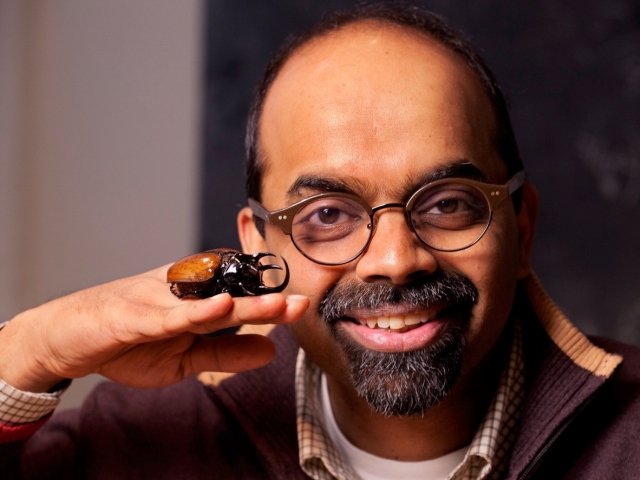
i love this image, he seems so delighted to show off the bug (?),
Harvard professor L. Mahadevan
Here’s more from the Perimeter Institute for Theoretical Physics (PI) April 30, 2021 announcement (received via email),
Earth is home to millions of different species – from simple plants and unicellular organisms to trees and whales and humans. The incredible diversity of life on Earth led Charles Darwin to lament that it is “enough to drive the sanest man mad.”
How can we make sense of this diversity of form, which arises from the process of morphogenesis that links molecular- and cellular-level processes to conspire and lead to the emergence of “endless forms most beautiful,” as Darwin said?
In his May 5 [2021] lecture webcast, Harvard professor L. Mahadevan [Lakshminarayanan Mahadevan] will take viewers on a journey into the mathematical, physical, and biological workings of morphogenesis to demonstrate how scientists are beginning to unlock many of the secrets that have vexed scientists since Darwin.
Possible Worlds: “How Will We Live Together?” on May 6, 2021
For those who are interested in human architecture, there’s this from a May 3, 3021 Berggruen institute announcement (received via email) about a talk by Chilean architect and 2016 Pritzker Prize winner, Alejandro Gastón Aravena Mori (Alejandro Aravena),
Possible Worlds: How Will We Live Together
May 6, 2021
11am — Virtual
Possible Worlds: The UCLA [University of California at Los Angeles] – Berggruen Institute Speaker Series is a new partnership between the UCLA Division of Humanities and the Berggruen Institute.
Please click here to submit a question to Alejandro Aravena
About Alejandro Aravena Alejandro Aravena is an architect, founder and executive director of the firm Elemental. His works include the “Siamese Towers” at the Catholic University of Chile and the Novartis office campus in Shanghai. In 2016, the New York Times named Aravena one of the world’s “creative geniuses” who had helped define culture. He and Elemental have received numerous honors, including the 2016 Pritzker Architecture Prize, the 2015 London Design Museum’s Design of the Year award and the 2011 Index Award. Aravena currently serves as the president of the Pritzker Prize jury. Aravena’s lecture title, “How Will We Live Together?” echoes the theme of the upcoming international architecture exhibition, Biennale Architettura, in which Elemental will be participating.
Featuring a discussion with moderator Dana Cuff
Dana Cuff is Professor of Architecture and Urban Design at UCLA, where she is also Director of cityLAB, an award-winning think tank that advances goals of spatial justice through experimental urbanism and architecture (www.cityLAB.aud.ucla.edu). Since receiving her Ph.D. in Architecture from Berkeley, Cuff has published and lectured widely about affordable housing, the architectural profession, and Los Angeles’ urban history. She is author of several books, including The Provisional City about postwar housing in L.A., and a co-authored book called Urban Humanities: New Practices for Reimagining the City, documenting her collaborative, crossdisciplinary research and teaching at UCLA funded by the Mellon Foundation. Based on cityLAB’s design research, Cuff co-authored landmark legislation that permits “backyard homes” on some 8.1 million single-family properties, doubling the density of suburbs across California (AB 2299, Bloom-2016). In 2019, cityLAB opened a satellite center in the MacArthur Park/Westlake neighborhood where a deep, multi-year exchange with community organizations is already demonstrating ways that humanistic design of the public realm can create more compassionate cities. Cuff recently received three awards that describe her career: Women in Architecture Activist of the Year (2019, Architectural Record); Distinguished Leadership in Architectural Research (2020, ARCC); and Educator of the Year (2021, American Institute of Architects Los Angeles).
About the Series Possible Worlds: The UCLA – Berggruen Institute Speaker Series is a new partnership between the UCLA Division of Humanities and the Berggruen Institute. This semiannual series will bring some of today’s most imaginative intellectual leaders and creators to deliver public talks on the future of humanity. Through the lens of their singular achievements and experiences, these trailblazers in creativity, innovation, philosophy and politics will lecture on provocative topics that explore current challenges and transformations in human progress.
UCLA faculty and students have long been at the forefront of interpreting the world’s legacy of language, literature, art and science. UCLA Humanities serves a vital role in readying future leaders to articulate their thoughts with clarity and imagination, to interpret the world of ideas, and to live as informed citizens in an increasingly complex world. We are proud to be partnering in this lecture series with the Berggruen Institute, whose work addresses the “Great Transformations” taking place in technology and culture, politics and economics, global power arrangements, and even how we perceive ourselves as humans. The Institute seeks to connect deep thought in the human sciences — philosophy and culture — to the pursuit of practical improvements in governance.
A selection committee comprising representatives of UCLA and the Berggruen Institute has been formed to make recommendations for lecturers. The committee includes:
• Ursula Heise, Professor and Chair, Department of English; Professor, UCLA Institute of the Environment and Sustainability; Marcia H. Howard Term Chair in Literary Studies • Pamela Hieronymi, Professor of Philosophy • Anastasia Loukaitou-Sideris, Professor of Urban Planning; Associate Provost for Academic Planning • Todd Presner, Associate Dean, Digital Initiatives; Chair of the Digital Humanities Program; Michael and Irene Ross Endowed Chair of Yiddish Studies; Professor of Germanic Languages and Comparative Literature • Lynn Vavreck, Professor, Department of Political Science; Marvin Hoffenberg Professor of American Politics and Public Policy • David Schaberg, Senior Dean of the UCLA College; Dean of Humanities; Professor, Asian Languages & Cultures • Nils Gilman, Vice President of Programs, the Berggruen Institute
Generative Art and Computational Creativity starts May 7, 2021
A Spring 2021 MetaCreation Lab (Simon Fraser University; SFU) newsletter (received via email on April 23, 2021) highlights a number of festival submissions and papers along with some news about a free introductory course. First, the video introduction to the course,
This first course in the two-part program, Generative Art and Computational Creativity [there’s a fee for part two], proposes an introduction and overview of the history and practice of generative arts and computational creativity with an emphasis on the formal paradigms and algorithms used for generation. The full program will be taught by Associate Professor from the School of Interactive Arts and Technology at Simon Fraser University and multi-disciplinary researcher, Philippe Pasquier.
On the technical side, we will study core techniques from mathematics, artificial intelligence, and artificial life that are used by artists, designers and musicians across the creative industry. We will start with processes involving chance operations, chaos theory and fractals and move on to see how stochastic processes, and rule-based approaches can be used to explore creative spaces. We will study agents and multi-agent systems and delve into cellular automata, and virtual ecosystems to explore their potential to create novel and valuable artifacts and aesthetic experiences.
The presentation is illustrated by numerous examples from past and current productions across creative practices such as visual art, new media, music, poetry, literature, performing arts, design, architecture, games, robot-art, bio-art and net-art. Students get to practice these algorithms first hand and develop new generative pieces through assignments and projects in MAX. Finally, the course addresses relevant philosophical, and societal debates associated with the automation of creative tasks.
Music for this course was composed with the StyleMachineLite Max for Live engine of Metacreative Inc.
Artistic direction: Philippe Pasquier, Programmation: Arne Eigenfeldt, Sound Production: Philippe Bertrand
Schedule
This course is in adaptive mode and is open for enrollment. Learn more about adaptive courses here.
Session 1: Introduction and Typology of Generative Art (May 7, 2021) To start off this course, we define generative art and computational creativity and discuss how these relate through the study of prominent examples. We establish a typology of generative systems based on levels of autonomy and agency.
Session 2: History Of Generative Art, Chance Operations, and Chaos Theory (May 14, 2021) Generative art is nothing new, and this session goes through the history of the field from pre-history to the popularization of computers. We study chance, noise, fractals, chaos theory, and their applications in visual art and music.
Session 3: Rule-Based Systems, Grammars and Markov Chains (May 21, 2021) This session introduces and illustrate the generative potential of rule-based and expert systems. We study generative grammars through the Chomsky hierarchy, and introduce L-systems, shape grammars, and Markov chains. We discuss how these have been applied in visual art, music, design, architecture, and electronic literature.
Session 4: Cognitive Agents And Multiagent Systems (May 28, 2021) This session introduces the concepts underlying the notion of artificial agents. We study the belief, desire, and intention (BDI) cognitive architecture, and message based agent communication resting on the speech act theory. We discuss musical agents, conversational agents, chat bots and twitter bots and their artistic potential.
Session 5: Reactive Agents And Multiagent Systems (June 4, 2021) In this session, we introduce reactive agents and the subsumption architecture. We study boids, and detail how complex behaviors can emerge from a distributed population of simple artificial agents. We look at a myriad of applications from ant painting to swarm music and we discuss artistic approaches to virtual ecosystems.
Session 6: A-Life And Cellular Automaton (June 11, 2021) In this concluding session, we introduce artificial life (A-life). We study cellular automaton, multi-agent ecosystems for music, visual art, non-photorealistic rendering, and gaming. The session also concludes the class by reflecting on the state of the art in the field and its consequences on creative practices.
If you’re interested in the lab and its other projects, go to metacreationlab.net.
Architectural Portraits on May 13, 2021
From the May 2021 Dante Alighieri Society of British Columbia’s newsletter,
ARCHITECTURAL PORTRAITS: EXPLORING THE RELATIONSHIP BETWEEN BODY, DESIGN & THE BUILT ENVIRONMENT A talk by architect & photographer Oliviero Godi (Politecnico di Milano)
Photo by Oliviero Godi – Frantoio Ipogeo nel Salento
THURSDAY, May 13, 2021 IN ENGLISH – ON ZOOM at 5:00 pm (PST)
Admission:
FREE for the Dante Society’s members
$5 MINIMUM DONATION for non-members
Become a member! Annual membership $30.00 – See membership benefits here
The human being – so fragile, so ethereal, speaking a sweet language. A piece of architecture – so physically imminent, so solid, speaking a language of hardness.
Photo by Oliviero Godi – Frantoio Ipogeo nel Salento
Join photographer & architect Oliviero Godi as he explores the relationship between the body & the material, the transient & the permanent, in search of the correct balance where neither element prevails.
To make your donation, please send an e-transfer to info@dantesocietybc.ca. Thank you!
Learn More [about this other upcoming Cultural Events]
Respiration and the Brain on May 25, 2021
Before getting to the April 29, 2021 BrainTalks announcement, here’s a little bit about BrainTalks from their webspace on the University of British Columbia (UBC) website,
BrainTalks is a series of talks inviting you to contemplate emerging research about the brain. Researchers studying the brain, from various disciplines including psychiatry, neuroscience, neuroimaging, and neurology, gather to discuss current leading edge topics on the mind.
As an audience member, you join the discussion at the end of the talk, both in the presence of the entire audience, and with an opportunity afterwards to talk with the speaker more informally in a catered networking session. The talks also serve as a connecting place for those interested in similar topics, potentially launching new endeavours or simply connecting people in discussions on how to approach their research, their knowledge, or their clinical practice.
For the general public, these talks serve as a channel where by knowledge usually sequestered in inaccessible journals or university classrooms, is now available, potentially allowing people to better understand their brains and minds, how they work, and how to optimize brain health.
[UBC School of Medicine Department of Psychiatry]
Onto the April 29, 2021 BrainTalks announcement (received via email),
BrainTalks: Respiration and the Brain
Tuesday, May 25th, 2021 from 6:00 PM – 7:30 PM [PT]
Join us for a series of online talks exploring questions of respiration and the brain. Emerging empirical research will be presented on ventilation-associated brain injury and breathing-based interventions for the treatment of stress and anxiety disorders. We presenters will include Dr. Thiago Bassi, Dr. Lloyd Lalande and Taylor Willi, MSc.
Dr. Thiago Bassi will address the biological connection between the brain and lungs, exploring the potential adverse effects of mechanical ventilation on the brain. Dr. Bassi is a neurosurgeon and neuroscientist, who worked clinically for more than ten years in Brazil. He joined the Lungpacer Medical team and C2B2 lab in 2017, and is currently completing his doctorate in Biomedicine Physiology at Simon Fraser University.
Dr. Lloyd Lalande will describe Guided Respiration Mindfulness Therapy (GRMT), as an emerging clinical breathwork intervention for its effectiveness in reducing depression, anxiety and stress, and in increasing mindfulness and sense of wellbeing. Dr. Lalonde is an Assistant Professor teaching psychology at the Buddhist TzuChi University of Science and Technology, and the developer of GRMT. His current research is based out of the TzuChi Buddhist General Hospital, investigating GRMT as an evidence-based treatment for a variety of outcomes.
Mr. Taylor Willi will present the findings of his dissertation research comparing the effect of performing daily brief relaxation techniques on measures of stress and anxiety. Mr. Willi completed a Masters Degree of Neuroscience at the University of British Columbia, and is currently completing his doctorate in Clinical Psychology at Simon Fraser University.
Each of the speakers will present an overview of their research findings investigating respiration in three unique ways. Following their presentations, the speakers will be available for an audience-drive panel discussion.
They don’t mention COVID-19 but given that seriously ill patients with the disease are routinely placed on ventilators, it is almost certainly going to be mentioned in the presentations.
I have a number of items from Simon Fraser University’s (SFU) Metacreation Lab January 2021 newsletter (received via email on Jan. 5, 2020).
29th International Joint Conference on Artificial Intelligence and the 17th Pacific Rim International Conference on Artificial Intelligence! or IJCAI-PRICAI2020 being held on Jan. 7 – 15, 2021
This first excerpt features a conference that’s currently taking place,,
Musical Metacreation Tutorial at IIJCAI – PRICAI 2020 [Yes, the 29th International Joint Conference on Artificial Intelligence and the 17th Pacific Rim International Conference on Artificial Intelligence or IJCAI-PRICAI2020 is being held in 2021!]
The tutorial will be held this Friday, January 8th, from 9 am to 12:20 pm JST ([JST = Japanese Standard Time] 12 am to 3:20 am UTC [or 4 pm – 7:30 pm PST]) and a full description of the syllabus can be found here. For details about registration for the conference and tutorials, click below.
The conference will be held at a virtual venue created by Virtual Chair on the gather.town platform, which offers the spontaneity of mingling with colleagues from all over the world while in the comfort of your home. The platform will allow attendees to customize avatars to fit their mood, enjoy a virtual traditional Japanese village, take part in plenary talks and more.
Two calls for papers
These two excerpts from SFU’s Metacreation Lab January 2021 newsletter feature one upcoming conference and an upcoming workshop, both with calls for papers,
2nd Conference on AI Music Creativity (MuMe + CSMC)
The second Conference on AI Music Creativity brings together two overlapping research forums: The Computer Simulation of Music Creativity Conference (est. 2016) and The International Workshop on Musical Metacreation (est. 2012). The objective of the conference is to bring together scholars and artists interested in the emulation and extension of musical creativity through computational means and to provide them with an interdisciplinary platform in which to present and discuss their work in scientific and artistic contexts.
The 2021 Conference on AI Music Creativity will be hosted by the Institute of Electronic Music and Acoustics (IEM) of the University of Music and Performing Arts of Graz, Austria and held online. The five-day program will feature paper presentations, concerts, panel discussions, workshops, tutorials, sound installations and two keynotes.
The 3rd IEEE Workshop on Artificial Intelligence for Art Creation (AIART) workshop has been announced for 2021. to bring forward cutting-edge technologies and most recent advances in the area of AI art in terms of enabling creation, analysis and understanding technologies. The theme topic of the workshop will be AI creativity, and will be accompanied by a Special Issue of the renowned SCI journal.
AIART is inviting high-quality papers presenting or addressing issues related to AI art, in a wide range of topics. The submission due date is January 31, 2021, and you can learn about the wide range of topics accepted below:
SFU’s Metacreation Lab January 2021 newsletter also features a kind of musical toy,
MMM : Multi-Track Music Machine
One of the latest projects at the Metacreation Lab is MMM: a generative music generation system based on Transformer architecture, capable of generating multi-track music, developed by Jeff Enns and Philippe Pasquier.
Based on an auto-regressive model, the system is capable of generating music from scratch using a wide range of preset instruments. Inputs from one or several tracks can condition the generation of new tracks, resampling MIDI input from the user or adding further layers of music.
To learn more about the system and see it in action, click below and watch the demonstration video, hear some examples, or try the program yourself through Google Colab.
Finally, for anyone who was wondering what happened at the 2020 International Symposium of Electronic Arts (ISEA 2020) held virtually in Montreal in the fall, here’s some news from SFU’s Metacreation Lab January 2021 newsletter,
ISEA2020 Recap // Why Sentience?
As we look back at one of the most unprecedented years, some of the questions explored at ISEA2020 are more salient now than ever. This recap video highlights some of the most memorable moments from last year’s virtual symposium.
The video is a slick, flashy, and fun 15 minutes or so. In addition to the recap for ISEA 2020, there’s a plug for ISEA 2022 in Barcelona, Spain.
The proceedings took my system a while to download (there are approximately 700 pp.). By the way, here’s another link to the proceedings or rather to the archives for the 2020 and previous years’ ISEA proceedings.
Both of these bits have a music focus but they represent two entirely different science-based approaches to that form of art and one is solely about the music and the other is included as one of the art-making processes being investigated..
Large Interactive Virtual Environment Laboratory (LIVELab) at McMaster University
Laurel Trainor and Dan J. Bosnyak both of McMaster University (Ontario, Canada) have written an October 27, 2019 essay about the LiveLab and their work for The Conversation website (Note: Links have been removed),
The Large Interactive Virtual Environment Laboratory (LIVELab) at McMaster University is a research concert hall. It functions as both a high-tech laboratory and theatre, opening up tremendous opportunities for research and investigation.
As the only facility of its kind in the world, the LIVELab is a 106-seat concert hall equipped with dozens of microphones, speakers and sensors to measure brain responses, physiological responses such as heart rate, breathing rates, perspiration and movements in multiple musicians and audience members at the same time.
Engineers, psychologists and clinician-researchers from many disciplines work alongside musicians, media artists and industry to study performance, perception, neural processing and human interaction.
In the LIVELab, acoustics are digitally controlled so the experience can change instantly from extremely silent with almost no reverberation to a noisy restaurant to a subway platform or to the acoustics of Carnegie Hall.
…
Real-time physiological data such as heart rate can be synchronized with data from other systems such as motion capture, and monitored and recorded from both performers and audience members. The result is that the reams of data that can now be collected in a few hours in the LIVELab used to take weeks or months to collect in a traditional lab. And having measurements of multiple people simultaneously is pushing forward our understanding of real-time human interactions.
Consider the implications of how music might help people with Parkinson’s disease to walk more smoothly or children with dyslexia to read better.
…
[…] area of ongoing research is the effectiveness of hearing aids. By the age of 60, nearly 49 per cent of people will suffer from some hearing loss. People who wear hearing aids are often frustrated when listening to music because the hearing aids distort the sound and cannot deal with the dynamic range of the music.
The LIVELab is working with the Hamilton Philharmonic Orchestra to solve this problem. During a recent concert, researchers evaluated new ways of delivering sound directly to participants’ hearing aids to enhance sounds.
Researchers hope new technologies can not only increase live musical enjoyment but alleviate the social isolation caused by hearing loss.
Imagine the possibilities for understanding music and sound: How it might help to improve cognitive decline, manage social performance anxiety, help children with developmental disorders, aid in treatment of depression or keep the mind focused. Every time we conceive and design a study, we think of new possibilities.
The essay also includes an embedded 12 min. video about LIVELab and details about studies conducted on musicians and live audiences. Apparently, audiences experience live performance differently than recorded performances and musicians use body sway to create cohesive performances. You can find the McMaster Institute for Music & the Mind here and McMaster’s LIVELab here.
Capturing the motions of a string quartet performance. Laurel Trainor, Author provided [McMaster University]
Metacreation Lab at Simon Fraser University (SFU)
I just recently discovered that there’s a Metacreation Lab at Simon Fraser University (Vancouver, Canada), which on its homepage has this ” Metacreation is the idea of endowing machines with creative behavior.” Here’s more from the homepage,
As the contemporary approach to generative art, Metacreation involves using tools and techniques from artificial intelligence, artificial life, and machine learning to develop software that partially or completely automates creative tasks. Through the collaboration between scientists, experts in artificial intelligence, cognitive sciences, designers and artists, the Metacreation Lab for Creative AI is at the forefront of the development of generative systems, be they embedded in interactive experiences or integrated into current creative software. Scientific research in the Metacreation Lab explores how various creative tasks can be automated and enriched. These tasks include music composition [emphasis mine], sound design, video editing, audio/visual effect generation, 3D animation, choreography, and video game design.
Besides scientific research, the team designs interactive and generative artworks that build upon the algorithms and research developed in the Lab. This work often challenges the social and cultural discourse on AI.
Much to my surprise I received the Metacreation Lab’s inaugural email newsletter (received via email on Friday, November 15, 2019),
Greetings,
We decided to start a mailing list for disseminating news, updates, and announcements regarding generative art, creative AI and New Media. In this newsletter:
ISEA 2020: The International Symposium on Electronic Art. ISEA return to Montreal, check the CFP bellow and contribute!
ISEA
2015: A transcription of Sara Diamond’s keynote address “Action Agenda:
Vancouver’s Prescient Media Arts” is now available for download.
Brain
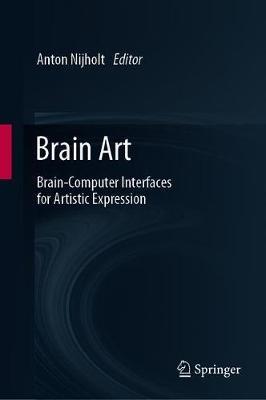
Art, the book: we are happy to announce the release of the first
comprehensive volume on Brain Art. Edited by Anton Nijholt, and
published by Springer.
Here are more details from the newsletter,
ISEA2020 – 26th International Symposium on Electronic Arts
Montreal, September 24, 2019 Montreal Digital Spring (Printemps numérique) is launching a call for participation as part of ISEA2020 / MTL connect to be held from May 19 to 24, 2020 in Montreal, Canada. Founded in 1990, ISEA is one of the world’s most prominent international arts and technology events, bringing together scholarly, artistic, and scientific domains in an interdisciplinary discussion and showcase of creative productions applying new technologies in art, interactivity, and electronic and digital media. For 2020, ISEA Montreal turns towards the theme of sentience.
ISEA2020 will be fully dedicated to examining the resurgence of sentience—feeling-sensing-making sense—in recent art and design, media studies, science and technology studies, philosophy, anthropology, history of science and the natural scientific realm—notably biology, neuroscience and computing. We ask: why sentience? Why and how does sentience matter? Why have artists and scholars become interested in sensing and feeling beyond, with and around our strictly human bodies and selves? Why has this notion been brought to the fore in an array of disciplines in the 21st century?
CALL FOR PARTICIPATION: WHY SENTIENCE? ISEA2020 invites artists, designers, scholars, researchers, innovators and creators to participate in the various activities deployed from May 19 to 24, 2020. To complete an application, please fill in the forms and follow the instructions.
You can apply for several categories. All profiles are welcome. Notifications of acceptance will be sent around January 13, 2020.
Important: please note that the Call for participation for MTL connect is not yet launched, but you can also apply to participate in the programming of the other Pavilions (4 other themes) when registrations are open (coming soon): mtlconnecte.ca/enTICKETS
Registration is now available to assist to ISEA2020 / MTL connect, from May 19 to 24, 2020. Book today your Full Pass and get the early-bird rate!
The first book that surveys how brain activity can be monitored and manipulated for artistic purposes, with contributions by interactive media artists, brain-computer interface researchers, and neuroscientists. View the Book Here
As per the Leonardo review from Cristina Albu:
“Another seminal contribution of the volume is the presentation of multiple taxonomies of “brain art,” which can help art critics develop better criteria for assessing this genre. Mirjana Prpa and Philippe Pasquier’s meticulous classification shows how diverse such works have become as artists consider a whole range of variables of neurofeedback.”Read the Review
Should this kind of information excite and motivate you do start metacreating, you can get in touch with the lab,
Our mailing address is: Metacreation Lab for Creative AI School of Interactive Arts & Technology Simon Fraser University 250-13450 102 Ave. Surrey, BC V3T 0A3 Web: http://metacreation.net/ Email: metacreation_admin (at) sfu (dot) ca
The Electronic Literature Organization (ELO; based at the Massachusetts Institute of Technology [MIT]) is holding its annual conference themed Next Horizons (from an Oct. 12, 2015 post on the ELO blog) at the University of Victoria on Vancouver Island, British Columbia from June 10 – June 12, 2016.
1:45-3:00: Keynote Session
MacLaurin David Lam Auditorium A 144
“Prototyping Resistance: Wargame Narrative and Inclusive Feminist Discourse”
Jon Saklofske, Acadia University
Anastasia Salter, University of Central Florida
Liz Losh, College of William and Mary
Diane Jakacki, Bucknell University
Stephanie Boluk, UC Davis
3:00-3:15: Break
3:15-4:45: Concurrent Session 1
Session 1.1: Best Practices for Archiving E-Lit
MacLaurin D010
Roundtable
Chair: Dene Grigar, Washington State University Vancouver
Dene Grigar, Washington State University Vancouver
Stuart Moulthrop, University of Wisconsin Milwaukee
Matthew Kirschenbaum, University of Maryland College Park
Judy Malloy, Independent Artist
Session 1.2: Medium & Meaning
MacLaurin D110
Chair: Rui Torres, University Fernando Pessoa
“From eLit to pLit,” Heiko Zimmerman, University of Trier
“Generations of Meaning,” Hannah Ackermans, Utrecht University
“Co-Designing DUST,” Kari Kraus, University of Maryland College Park
Session 1.3: A Critical Look at E-Lit
MacLaurin D105
Chair: Philippe Brand, Lewis & Clark College
“Methods of Interrogation,” John Murray, University of California Santa Cruz
“Peering through the Window,” Philippe Brand, Lewis & Clark College
“(E-)re-writing Well-Known Works,” Agnieszka Przybyszewska, University of Lodz
Session 1.4: Literary Games
MacLaurin D109
Chair: Alex Mitchell, National University of Singapore
“Twine Games,” Alanna Bartolini, UC Santa Barbara
“Whose Game Is It Anyway?,” Ryan House, Washington State University Vancouver
“Micronarratives Dynamics in the Structure of an Open-World Action-Adventure Game,” Natalie Funk, Simon Fraser University
Session 1.5: eLit and the (Next) Future of Cinema
MacLaurin D107
Roundtable
Chair: Steven Wingate, South Dakota State University
Steve Wingate, South Dakota State University
Kate Armstrong, Emily Carr University
Samantha Gorman, USC
Session 1.6: Authors & Texts
MacLaurin D101
Chair: Robert Glick, Rochester Institute of Technology
“Generative Poems by Maria Mencia,” Angelica Huizar, Old Dominion University
“Inhabitation: Johanna Drucker: “no file is ever self-identical,” Joel Kateinikoff, University of Alberta
“The Great Monster: Ulises Carrión as E-Lit Theorist,” Élika Ortega, University of Kansas
“Pedagogic Strategies for Electronic Literature,” Mia Zamora, Kean University
3:15-4:45: Action Session Day 1 MacLaurin D111
Digital Preservation, by Nicholas Schiller, Washington State University Vancouver; Zach Coble, NYU
ELMCIP, Scott Rettberg and Álvaro Seiça, University of Bergen; Hannah Ackermans, Utrecht University
Wikipedia-A-Thon, Liz Losh, College of William and Mary
5:00-6:00: Reception and Poster Session University of Victoria Faculty Club
For ELO, DHSI, & INKE Participants, featuring these artists and scholars from the ELO:
“Social Media for E-Lit Authors,” Michael Rabby, Washington State University Vancouver
“– O True Apothecary!, by Kyle Booten,” UC Berkeley, Center for New Media
“Life Experience through Digital Simulation Narratives,” David Núñez Ruiz, Neotipo
“Building Stories,” Kate Palermini, Washington State University Vancouver
“Help Wanted and Skills Offered,” by Deena Larsen, Independent Artist; Julianne Chatelain, U.S. Bureau of Reclamation
“Beyond Original E-Lit: Deconstructing Austen Cybertexts,” Meredith Dabek, Maynooth University
Arabic E-Lit. (AEL) Project, Riham Hosny, Rochester Institute of Technology/Minia University
“Poetic Machines,” Sidse Rubens LeFevre, University of Copenhagen
Session 2.1: Literary Interventions
MacLaurin D101
Brian Ganter, Capilano College
“Glitching the Poem,” Aaron Angello, University of Colorado Boulder
“WALLPAPER,” Alice Bell, Sheffield Hallam University; Astrid Ensslin, University of Alberta
“Unprintable Books,” Kate Pullinger [emphasis mine], Bath Spa University
Session 2.2: Theoretical Underpinnings
MacLaurin D105
Chair: Mia Zamora, Kean University
“Transmediation,” Kedrick James, University of British Columbia; Ernesto Pena, University of British Columbia
“The Closed World, Databased Narrative, and Network Effect,” Mark Sample, Davidson College
“The Cyborg of the House,” Maria Goicoechea, Universidad Complutense de Madrid
Session 2.3: E-Lit in Time and Space
MacLaurin D107
Chair: Andrew Klobucar, New Jersey Institute of Technology
“Electronic Literary Artifacts,” John Barber, Washington State University Vancouver; Alcina Cortez, INET-MD, Instituto de Etnomusicologia, Música e Dança
“The Old in the Arms of the New,” Gary Barwin, Independent Scholar
“Space as a Meaningful Dimension,” Luciane Maria Fadel, Simon Fraser University
Session 2.4: Understanding Bots
MacLaurin D110
Roundtable
Chair: Leonardo Flores, University of Puerto Rico, Mayagüez
Allison Parrish, Fordham University
Matt Schneider, University of Toronto
Tobi Hahn, Paisley Games
Zach Whalen, University of Mary Washington
10:30-12 noon: Action Session Day 2 MacLaurin D111
Digital Preservation, by Nicholas Schiller, Washington State University Vancouver; Zach Coble, NYU
ELMCIP, Allison Parrish, Fordham University; Scott Rettberg, University of Bergen; David Nunez Ruiz, Neotipo; Hannah Ackermans, Utrecht University
Wikipedia-A-Thon, Liz Losh, College of William and Mary
12:15-1:15: Artists Talks & Lunch David Lam Auditorium MacLaurin A144
“The Listeners,” by John Cayley
“The ChessBard and 3D Poetry Project as Translational Ecosystems,” Aaron Tucker, Ryerson University
“News Wheel,” Jody Zellen, Independent Artist
“x-o-x-o-x.com,” Erik Zepka, Independent Artist
1:30-3:00: Concurrent Session 3
Session 3.1: E-Lit Pedagogy in Global Setting
MacLaurin D111
Roundtable
Co-Chairs: Philippe Bootz, Université Paris 8; Riham Hosny, Rochester Institute of Technology/Minia University
Sandy Baldwin, Rochester Institute of Technology
Maria Goicoechea, Universidad Complutense de Madrid
Odile Farge, UNESCO Chair ITEN, Foundation MSH/University of Paris8.
Session 3.2: The Art of Computational Media
MacLaurin D109
Chair: Rui Torres, University Fernando Pessoa
“Creative GREP Works,” Kristopher Purzycki, University of Wisconsin Milwaukee
“Using Theme to Author Hypertext Fiction,” Alex Mitchell, National University at Singapore
Session 3.3: Present Future Past
MacLaurin D110
Chair: David Roh, University of Utah
“Exploring Potentiality,” Daniela Côrtes Maduro, Universität Bremen
“Programming the Kafkaesque Mechanism,” by Kristof Anetta, Slovak Academy of Sciences
“Reapprasing Word Processing,” Matthew Kirschenbaum, University of Maryland College Park
Session 3.4: Beyond Collaborative Horizons
MacLaurin D010
Panel
Chair: Jeremy Douglass, UC Santa Barbara
Jeremy Douglass, UC Santa Barbara
Mark Marino, USC
Jessica Pressman, San Diego State University
Session 3.5: E-Loops: Reshuffling Reading & Writing In Electronic Literature Works
MacLaurin D105
Panel
Chair: Gwen Le Cor, Université Paris 8
“The Plastic Space of E-loops and Loopholes: the Figural Dynamics of Reading,” Gwen Le Cor, Université Paris 8
“Beyond the Cybernetic Loop: Redrawing the Boundaries of E-Lit Translation,” Arnaud Regnauld, Université Paris 8
“E-Loops: The Possible and Variable Figure of a Contemporary Aesthetic,” Ariane Savoie, Université du Québec à Montréal and Université Catholique de Louvain
“Relocating the Digital,” Stéphane Vanderhaeghe, Université Paris 8
“The (Wo)men’s Social Club,” Amber Strother, Washington State University Vancouver
Session 3.7: Embracing Bots
MacLaurin D101
Roundtable
Zach Whalen, Chair
Leonardo Flores, University of Puerto Rico Mayagüez Campus
Chris Rodley, University of Sydney
Élika Ortega, University of Kansas
Katie Rose Pipkin, Carnegie Mellon
1:30-3:30: Workshops MacLaurin D115
“Bots,” Zach Whalen, University of Mary Washington
“Twine”
“AR/VR,” John Murray, UC Santa Cruz
“Unity 3D,” Stefan Muller Arisona, University of Applied Sciences and Arts Northwestern; Simon Schubiger, University of Applied Sciences and Arts Northwestern
“Exploratory Programming,” Nick Montfort, MIT
“Scalar,” Hannah Ackermans, University of Utrecht
The Electronic Poet’s Workbench: Build a Generative Writing Practice, Andrew Koblucar, New Jersey Institute of Technology; David Ayre, Programmer and Independent Artist
3:30-5:00: Keynote
Christine Wilks [emphasis mine], “Interactive Narrative and the Art of Steering Through Possible Worlds”
MacLaurin David Lam Auditorium A144
Wilks is British digital writer, artist and developer of playable stories. Her digital fiction, Underbelly, won the New Media Writing Prize 2010 and the MaMSIE Digital Media Competition 2011. Her work is published in online journals and anthologies, including the Electronic Literature Collection, Volume 2 and the ELMCIP Anthology of European Electronic Literature, and has been presented at international festivals, exhibitions and conferences. She is currently doing a practice-based PhD in Digital Writing at Bath Spa University and is also Creative Director of e-learning specialists, Make It Happen.
Session 4.1: Narratives & Narrativity
MacLaurin D110
Chair: Kendrick James, University of British Columbia
“Narrativity in Virtual Reality,” Illya Szilak, Independent Scholar
“Simulation Studies,” David Ciccoricco, University of Otago
“Future Fiction Storytelling Machines,” Caitlin Fisher, York University
Session 4.2: Historical & Critical Perspectives
MacLaurin D101
Chair: Robert Glick, Rochester Institute of Technology
“The Evolution of E-Lit,” James O’Sullivan, University of Sheffield
“The Logic of Selection,” by Matti Kangaskoski, Helsinki University
Session 4.3: Emergent Media
MacLaurin D107
Alexandra Saum-Pascual, UC Berkeley
“Seasons II: a case study in Ambient Video, Generative Art, and Audiovisual Experience,” Jim Bizzocchi, Simon Fraser University; Arne Eigenfeldt, Simon Fraser University; Philippe Pasquier, Simon Fraser University; Miles Thorogood, Simon Fraser University
“Cinematic Turns,” Liz Losh, College of William and Mary
“Mario Mods and Ludic Seriality,” Shane Denson, Duke University
Session 4.4: The E-Literary Object
MacLaurin D109
Chair: Deena Larsen, Independent Artist
“How E-Literary Is My E-Literature?,” by Leonardo Flores, University of Puerto Rico Mayagüez Campus
“Overcoming the Locative Interface Fallacy,” by Lauren Burr, University of Waterloo
“Interactive Narratives on the Block,” Aynur Kadir, Simon Fraser University
Session 4.5: Next Narrative
MacLaurin D010
Panel
Chair: Marjorie Luesebrink
Marjorie Luesebrink, Independent Artist
Daniel Punday, Independent Artist
Will Luers, Washington State University Vancouver
10:30-12 p.m.: Action Session Day 3 MacLaurin D111
Digital Preservation, by Nicholas Schiller, Washington State University Vancouver; Zach Coble, NYU
ELMCIP, Allison Parrish, Fordham University; Scott Rettberg, University of Bergen; David Nunez Ruiz, Neotipo; Hannah Ackermans, Utrecht University
Wikipedia-A-Thon, Liz Losh, College of William and Mary
12:15-1:30: Artists Talks & Lunch David Lam Auditorium A144
“Just for the Cameras,” Flourish Klink, Independent Artist
“Lulu Sweet,” Deanne Achong and Faith Moosang, Independent Artists
“Drone Pilot,” Ian Hatcher, Independent Artist
“AVATAR/MOCAP,” Alan Sondheim, Independent Artist
1:30-3:00 : Concurrent Session 5
Session 5.1: Subversive Texts
MacLaurin D101
Chair: Michael Rabby, Washington State University Vancouver
“E-Lit Jazz,” Sandy Baldwin, Rochester Institute of Technology; Rui Torres, University Fernando Pessoa
“Pop Subversion in Electronic Literature,” Davin Heckman, Winona State University
“E-Lit in Arabic Universities,” Riham Hosny, Rochester Institute of Technology/Minia University
Session 5.2: Experiments in #NetProv & Participatory Narratives
MacLaurin D109
Roundtable
Chair: Mia Zamora, Kean University
Mark Marino, USC
Rob Wittig, Meanwhile… Netprov Studio
Mia Zamora, Kean University
Session 5.3: Emergent Media
MacLaurin D105
Chair: Andrew Klobucar, New Jersey Institute of Technology
“Migrating Electronic Literature to the Kinect System,” Monika Gorska-Olesinka, University of Opole
“Mobile and Tactile Screens as Venues for the Performing Arts?,” Serge Bouchardon, Sorbonne Universités, Université de Technologie de Compiègne
“The Unquantified Self: Imagining Ethopoiesis in the Cognitive Era,” Andrew Klobucar, New Jersey Institute of Technology
Session 5.4: E-Lit Labs
MacLaurin D010
Chair: Jim Brown, Rutgers University Camden
Jim Brown, Rutgers University Camden
Robert Emmons, Rutgers University Camden
Brian Greenspan, Carleton University
Stephanie Boluk, UC Davis
Patrick LeMieux, UC Davis
Session 5.5: Transmedia Publishing
MacLaurin D107
Roundtable
Chair: Philippe Bootz
Philippe Bootz, Université Paris 8
Lucile Haute, Université Paris 8
Nolwenn Trehondart, Université Paris 8
Steve Wingate, South Dakota State University
Session 5.6: Feminist Horizons
MacLaurin D110
Panel
Moderator: Anastasia Salter, University of Central Florida
Kathi Inman Berens, Portland State University
Jessica Pressman, San Diego State University
Caitlin Fisher, York University
3:30-5:00: Closing Session David Lam Auditorium MacLaurin A144
Chairs: John Cayley, Brown University; Dene Grigar, President, ELO
“Platforms and Genres of Electronic Literature,” Scott Rettberg, University of Bergen
“Emergent Story Structures,” David Meurer. York University
“We Must Go Deeper,” Samantha Gorman, USC; Milan Koerner-Safrata, Recon Instruments
I’ve bolded two names: Christine Wilks, one of two conference keynote speakers, who completed her MA in the same cohort as mine in De Montfort University’s Creative Writing and New Media master’s program. Congratulations on being a keynote speaker, Christine! The other name belongs to Kate Pullinger who was one of two readers for that same MA programme. Since those days, Pullinger has won a Governor General’s award for her fiction, “The Mistress of Nothing,” and become a professor at the University of Bath Spa (UK).
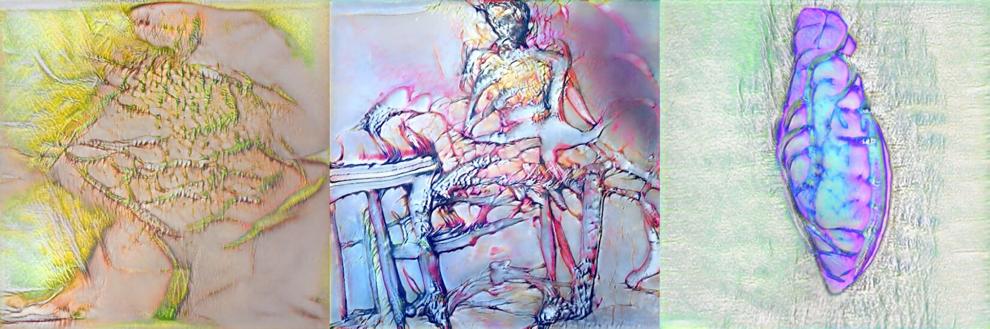
 7 p.m on Zoom (