Tag Archives: Iowa State University

Everyone’s talking about* insects/bugs: InsectNet technology, a park for bugs, and more

I have been stumbling across bug (or insect) research at a greater rate than usual and while the ‘bug-informed’ community is, no doubt, acutely aware of the loss of insect life, the severity of the situation was a revelation to me.

Bugpocalypse (h/t IFLScience for the head)

Caption: Drosophila use multiple mechanisms to adapt to hot, dry desert temperatures. Credit: Sarah Becan for the Gallio Lab/Northwestern University

This work looks at adaptation strategies, from a March 5, 2025 Northwestern University (Chicago, Illinois) news release (also on EurekAlert) by Win Reynolds, Note: Links have been removed,

  • Insect populations, foundational to food chains and pollination, have dramatically declined over the past 20 years due to rapid climate change
  • Scientists identify two ways fly species from different climates (high-altitude forest and hot desert) have adapted to temperature
  • Paper provides evidence that changes in brain wiring and heat sensitivity contributed to shifting preference to hot or cold conditions, respectively
  • Results may help predict the impact of ongoing climate change on insect distribution and behavior

EVANSTON, Ill. — Tiny, cold-blooded animals like flies depend on their environment to regulate body temperature, making them ideal “canaries in the mine” for gauging the impact of climate change on the behavior and distribution of animal species. Yet, scientists know relatively little about how insect sense and respond to temperature.

Using two species of flies from different climates — one from the cool, high-altitude forests of Northern California, the other hailing from the hot, dry deserts of the Southwest (both cousins of the common laboratory fly, drosophila melanogaster) — Northwestern scientists discovered remarkable differences in the way each processes external temperature.

Forest flies showed increased avoidance of heat, potentially explained by higher sensitivity in their antennae’s molecular heat receptors, while desert flies were instead actively attracted to heat, a response that could be tracked to differences in brain wiring  in a region of the fly brain that helps compute the valence (inherent attractiveness or aversiveness) of sensory cues.

The scientists believe these two mechanisms may have accompanied the evolution of each species as it adapted to its distinctive thermal environment, starting from a common ancestor dating back 40 million years (not long after dinosaurs went extinct).

These findings, published today (March 5 [2025]) in the journal Nature, help understand how animals evolve the preferences for specific temperature environments and may help predict the impact of a rapidly changing climate on animal behavior and distribution.

‘Not enough people care about insects’

“Insects are especially threatened by climate change,” said Northwestern neurobiologist Marco Gallio. “Behavior is the first interface between an animal and its environment. Even before the struggle to survive or perish, animals can respond to climate change by migration and by changing their distribution. We are already seeing insect populations declining in many regions, and even insect vectors of disease like the Zika virus and malaria spreading into new areas.”

Gallio, a self-appointed “insect advocate,” is a professor in the neurobiology department and the Soretta and Henry Shapiro Research Professor in Molecular Biology at the Weinberg College of Arts and Sciences. His lab examines fruit flies and their sensing systems. Gallio acknowledged there is limited data because “not enough people care about the insects,” but that available figures record a dramatic decline in insects in the past 20 to 50 years. Though bug haters may rejoice, Gallio said the population decline in the animal group with the most species on Earth is nothing to celebrate.

In addition to their position at the foundation of most terrestrial food chains, insects pollinate 70% of our crops. Gallio said losing insect communities could cause catastrophic damage to ecosystems across the globe and have a direct impact on human wellbeing.

Understanding heat circuits in the brain

Previous work from the Gallio Lab focused on how small insects like laboratory flies respond to sensory cues like harmless and painful temperature changes.

“The common fruit fly is an especially powerful animal to study how the external world is represented and processed within the brain,” Gallio said. “Many years of work on fly genetics and neuroscience have given us a map of the fly brain more detailed than that of any other animal.”

In the present study, Gallio and colleagues wondered how the brain circuits and resulting behaviors compared in fly species that were very similar aside from their choices of thermal habitat.

Using genetic tools, including CRISPR [clustered regularly interspaced short palindromic repeats], to knock out certain genes and gene swaps between species, the team studied both the molecular and brain mechanisms that may explain species-specific differences in temperature preference.

Ph.D. student and lead author Matthew Capek explained that they first found differences in the molecules that detect heat, causing them to activate at different temperatures. And while Capek said the difference in activation could explain the forest flies’ preference for cooler environments, a shift in receptor activation was not enough to explain the behavior of the desert fly.

“The desert fly seemed actively attracted to warmer temperatures — around 90 degrees Fahrenheit compared to the forest fly’s sweet spot just below 70 degrees,” said Capek, who works in the Gallio lab. “In fact, the activation threshold of the antenna heat sensors corresponded to their favorite temperature range, which they will seek, rather than to a temperature they should avoid.”

“In other words, the fly doesn’t behave any longer as though the antennae are telling it to run away from dangerous heat; they seem to be telling it higher temperatures are good, and to approach them.”

High cost, high reward

Gallio was initially puzzled — deserts are hot, so it did not make sense that flies sought out heat — but a lab trip to the Anza Borrego desert of Southern California provided key inspiration.

“Deserts in this region are very hot during the day, but temperatures can drop extremely rapidly when the sun goes down, and night can be downright freezing,” said Alessia Para, also a key author of the study and a research associate professor of neurobiology. “Flies in this climate may need to constantly attend to the rapidly changing temperature and always seek the ideal range, finding shady spots during the day and hiding in cacti for warmth at night.”

Flies from more forgiving environments may instead ignore temperature except when it changes rapidly. Constantly detecting the right temperature is costly from an energy perspective, but for desert flies, it’s life or death.

“This comparative work is useful in a couple of different ways,” Gallio said. “When an animal is born, the brain is already programmed to know if many of the things it will encounter are bad or good for it, and we do not understand how that programming works.

These fly species represent a natural experiment because a stimulus that is good for one species is bad for the other, and we can study the differences that make it so. We also want to learn more about how animals have been able to adapt to different temperatures during evolution, so that we may be able to better understand and even predict how they react to ongoing climate change. Of course we care about the insects, and we hope that what we learn may help us appreciate and protect them better.”

There’s more but first, a citation and a link to the Gallio Lab’s paper,

Evolution of temperature preference in flies of the genus Drosophila by Matthew Capek, Oscar M. Arenas, Michael H. Alpert, Emanuela E. Zaharieva, Iván D. Méndez-González, José Miguel Simões, Hamin Gil, Aldair Acosta, Yuqing Su, Alessia Para & Marco Gallio. Nature (2025) DOI: https://doi.org/10.1038/s41586-025-08682-z Published: 05 March 2025

This paper is behind a paywall.

Bugs Matter

Thanks to buglife.org.uk for the subhead and the report. Here’s more from their April 30, 2025 press release, Note: Links have been removed,

The troubling extent of insect declines across the UK has been highlighted once again by the results of the 2024 Bugs Matter citizen science survey published today. The latest data shows that the number of flying insects sampled on vehicle number plates, across the UK, has fallen by a staggering 63% since 2021.

The Bugs Matter survey, led by Kent Wildlife Trust in partnership with invertebrate charity Buglife, relies on a nationwide network of volunteer citizen scientists who record insect splats on their vehicle number plates after journeys, using the Bugs Matter app built by Natural Apptitude. Analysis of records from more than 25,000 journeys across the UK since 2021 shows an alarming decrease in bug splats but data from 2024 shows this decrease has slowed.

Insects are critical to ecosystem functioning and services. They pollinate crops, provide natural pest control, decompose waste and recycle nutrients, and underpin food chains that support birds, mammals and other wildlife. Without insects, the planet’s ecological systems would collapse.

Dr. Lawrence Ball of Kent Wildlife Trust stated: “This huge decrease in insect splats over such a short time is really alarming. Its most likely that we are seeing the compounding effects of both a background rate of decline as well as a short term cycle of decline, perhaps linked to the extreme climate in the UK in recent years. Bug splats declined 8% from 2023 to 2024, following sharper drops of 44% in 2023 and 28% in 2022. This shows the rate of decline has slowed and it may even flatten or reverse next year. Continued support from citizen scientists is key to revealing the overall trend in insect numbers.”

The new data shows a decrease in insect splat rates across all the UK nations, with the sharpest fall between 2021 and 2024 recorded in Scotland at 65%. In England, the number of insect splats fell by 62%, in Wales by 64%, and in Northern Ireland by 55%, over the same time period.

Andrew Whitehouse, from Buglife added: “The latest Bugs Matter data suggests that the abundance of flying insects in our countryside has fallen again. The consequences are potentially far-reaching, not only impacting the health of the natural world, but affecting so many of the essential services that nature provides for us. Human activities continue to have a huge impact on nature, habitat loss and damage, pesticide use, pollution, and climate change all contribute to the decline in insects. Society must heed the warning signs of ecological collapse, and take urgent action to restore nature.”

Participation in Bugs Matter is growing and the number of journeys recorded in 2024 far exceeded previous years. This is in part thanks to a new partnership with Openreach, owner of the nation’s second largest commercial van fleet.

Peter Stewart, Openreach’s UK Operations Director for Service Delivery said: “We’re excited to participate in the ‘Bugs Matter’ survey for the second year. Our engineers travel millions of miles annually across the UK to build and maintain our network, making it easy for them to measure insect splats on vehicle number plates. We recognise the crucial role pollinators play for all of us to thrive, and as part of our strategy to protect nature, we’re proud to support this campaign again. Last year, we contributed around 10% of the registered journeys, and with our 25,000-strong fleet, we aim to do even better this year.”

Andrew Whitehouse concluded: “Thank you to everyone who participated in the Bugs Matter survey in 2024. Your contribution has provided invaluable insights into the health of our insect populations and wider environment. We are relaunching the survey on May 1 this year [2025], and with our expansion into the Republic of Ireland, we hope to engage even more people in this crucial citizen science effort.”

The 2025 Bugs Matter survey will run from Saturday 1 May to Tuesday 30 September. It is quick, free and easy to get involved – simply download the free mobile phone app and start recording insect splats on vehicle journeys.

Expansion into Republic of Ireland

In response to growing interest and the need for more comprehensive data, the Bugs Matter survey is expanding into the Republic of Ireland for the 2025 season, thanks to the Amazon Web Services (AWS) Imagine Grant ‘Go Further, Faster’ Award received by Bugs Matter at the end of 2024. This grant provides vital resources to non-profit organisations looking to deploy cloud technology as a central tool to achieve their mission goals, and is providing Bugs Matter with a combination of funding, cloud computing credits, and engagement with AWS technical specialists. This marks an important step in building a more complete picture of insect populations across the British Isles, and future expansion of the Bugs Matter survey.

Dr. Lawrence Ball of Kent Wildlife Trust stated,We’re extremely grateful for the financial and technical support from Amazon Web Services, which means we can launch in Ireland this year and in more countries in 2026. If you drive or know someone who drives in Ireland, please download the app, sign up, and take part! The UK results highlight the importance of understanding insect numbers elsewhere.”

The charities caution that continued long-term monitoring is essential to track the precise magnitude of these alarming trends, but stress that the current pace of decline is clearly ecologically unviable. By taking part in the Bugs Matter survey each year, citizen scientists can provide crucial data to better understand insect population patterns and support evidence-based conservation actions.

Zac Sherratt’s April 30, 2025 article for the British Broadcasting Corporation’s (BBC) online news website offers little more information,

A survey tracking the “staggering” decline in insect numbers across the UK and Ireland has begun.

The Bugs Matter survey, led by Kent Wildlife Trust and invertebrate charity Buglife, runs from 1 May to 30 September each year and sees “citizen scientists” record the number of bug splats on their vehicle number plates after a journey.

Dr Ball [Dr. Lawrence Ball of Kent Wildlife Trust ] said: “Without insects, the planet’s ecological systems would collapse so this huge decrease in insect splats over such a short time is really alarming.”

Bug splats declined 8% in 2024, following sharper drops of 44% in 2023 and 28% in 2022.

Dr Ball said the slowing rate of decline shows the curve may flatten or even reverse next year.

More than 25,000 journeys have been analysed as part of the survey since 2021.

You can find the 2024 The Bugs Matter Citizen Science Survey here and the Buglife organization (and signup information for the 2025 survey) here.

IFLScience (and Bugpocalypse)

There’s an interesting back story for IFLScience (which started life as as Facebook page titled, “I Fucking Love Science”). If you want to find out more about IFLScience’s origins and founder, there’s Elise Andrew’s Wikipedia entry.

Returning to the bugs, Dr. Russell Moul’s April 30 (?), 2025 article for IFLScience further highlights the plight of insects around the world, Note: Links have been removed,

Insect populations have been declining across the world at an alarming rate, but no one has been sure why. According to a new study, intense agricultural practices are at the top of the list of causes, but there are multiple interrelated factors that are all contributing to quickly killing off these vital creatures.

“Insects are fundamental to life on earth. They are really important pollinators, decomposers, and prey for birds, bats, reptiles, and other species”, Eliza Grames, Assistant Professor of Biological Sciences, told IFLScience.

“Insects pollinate around 80 percent of wild flowering plants, and 75 percent of agricultural crop species rely on insects for pollination. Without insects as decomposers, the earth would essentially be covered in manure. Cow manure takes 60 percent longer to deteriorate when insects are excluded from an area.”

But despite their importance, insect numbers are declining. In 2017, a devastating study demonstrated that there has been more than a 75 percent decline in insect populations over the last three decades. As a result, scientists have been seeking to identify the likely causes for this decline.

In order to understand which causes the scientific community has found so far, Grames and colleagues from Binghamton University examined some 175 scientific reviews, which contained over 500 hypothesized drivers behind the decline. This information allowed the team to create an interconnected network of 3,000 possible links, known as a meta-synthetic approach, which spanned everything from beekeeping and deforestation to urban sprawl and parasites.

Within this network of information, the team found that intensified agriculture was the most cited driver behind the mass die-off. This was linked to issues such as land-use change and insecticides. However, focusing solely on the most cited drivers is not the way to interpret this information. As the team note in their work, the results show how interconnected the drivers are, highlighting complex issues.

For example, the climate may be an important driver behind the decline, but there are aspects within that, such as extreme precipitation, fire, and temperature rises, which can then contribute to other drivers. It’s an extremely connected and synergistic network.

“The drivers of insect decline are really complex and there are many overlooked stressors that we should be thinking about and researching,” Grames told IFLScience.

If you have a little more time, you can find some interesting tidbits in Moul’s April 30 (?), 2025 article.

Here’s a link to and a citation for the recent meta-analysis/meta-synthesis mentioned in the article,

Meta-synthesis reveals interconnections among apparent drivers of insect biodiversity loss by Christopher A Halsch, Chris S Elphick, Christie A Bahlai, Matthew L Forister, David L Wagner, Jessica L Ware, Eliza M Grames. BioScience, biaf034 DOI: https://doi.org/10.1093/biosci/biaf034 Published: 22 April 2025

This paper is behind a paywall.

InsectNet

A February 6, 2025 news item on ScienceDaily announces an application that uses machine learning for insect identification,

A farmer notices an unfamiliar insect on a leaf.

Is this a pollinator? Or a pest? Good news at harvest time? Or bad? Need to be controlled? Or not?

That farmer can snap a picture, use a smartphone or computer to feed the photo into a web-based application called InsectNet and, with the help of machine learning technology, get back real-time information.

“The app identifies the insect and returns a prediction of its taxonomic classification and role in the ecosystem as a pest, predator, pollinator, parasitoid, decomposer, herbivore, indicator and invasive species,” said a scientific paper describing InsectNet recently published by the journal PNAS Nexus [PNAS stands for Proceedings of the National Academy of Sciences of the US]. Iowa State University’s Baskar Ganapathysubramanian and Arti Singh are the corresponding authors.

..

A February 5, 2025 Iowa State University news release (also on EurekAlert but published February 6, 2025), which originated the news item, delves further into InsectNet,

InsectNet – which is backed by a dataset of 12 million insect images, including many collected by citizen-scientists – provides identification and predictions for more than 2,500 insect species at more than 96% accuracy. When the application isn’t sure about an insect, it says it is uncertain, giving users more confidence when it does provide answers.

And, because the application was built as a global-to-local model, it can be geographically fine-tuned using expert-verified local and regional datasets. That makes it useful to farmers everywhere.

So, beware, armyworms, cutworms, grasshoppers, stink bugs and all the other harmful insects. And, hello, butterflies, bees and all the other pollinators. Good to see you, lady beetles, mantises and all the other pest predators.

“We envision InsectNet to complement existing approaches, and be part of a growing suite of AI technologies for addressing agricultural challenges,” the authors wrote.

A village of researchers

InsectNet’s ability to be fine-tuned for specific regions or countries make it particularly useful, said Singh, an associate professor of agronomy.

In Iowa, for example, Singh said there are about 50 insect species particularly important to the state’s agricultural production. To identify and provide predictions about those insects, Singh said the project used about 500,000 insect images.

That could happen for farmers all over the globe. And wherever there isn’t sufficient data – these sophisticated models often require millions of images – for local fine-tuning, the global dataset is still available for farmers.

InsectNet isn’t just for farmers, though. Singh said it could also help agents at ports or border crossings identify invasive species. Or it could help researchers working on ecological studies.

So, the app is usable and flexible. But is it accessible?

You can’t go to an app store and download a version just yet, said Ganapathysubramanian, the Joseph and Elizabeth Anderlik Professor in Engineering and director of the AI Institute for Resilient Agriculture based at Iowa State. But the app is running on a server at Iowa State. With a QR code (see sidebar) or this URL (insectapp.las.iastate.edu/), users can upload insect pictures and get an identification and prediction.

This works throughout the stages of an insect’s life: from egg to larva to pupa to adult. It works with look-alike species. And it works with diverse image qualities and orientations.

The bottom line for any user is basic information about an insect: “Is this a pest?” Singh said. “Or is it a friend?”

Developers demonstrated the app during last August’s Farm Progress Show in Boone, Iowa. And now the research paper is introducing it to a broader, scientific audience.

But aren’t there already apps that help identify insects?

Yes, said Ganapathysubramanian, but they’re not to the scale of InsectNet and aren’t capable of global-to-local applications. And they’re also not open-source applications with technology that can be shared.

“Making InsectNet open source can encourage broader scientific efforts,” he said. “The scientific community can build on these efforts, rather than starting from scratch.”

The project also answered a lot of technical questions that could be applied to other projects, he said.

How much data is enough? Where can we get that much data? What can we do with noisy data?

How much computer power is necessary? How do we deal with so much data?

“Lastly, it takes a village of expertise to get to this point, right?” said Ganapathysubramanian.

It took agronomists and computer engineers and statisticians and data scientists and artificial intelligence specialists about two years to put InsectNet together and make it work.

“What we learned working with insects can be expanded to include weeds and plant diseases or any other related identification and classification problem in agriculture,” Singh said. “We’re very close to a one-stop shop for identifying all of these.”

Paper co-authors are:

Iowa State University

  • Shivani Chiranjeevi (first author)
  • Mojdeh Saadati
  • Talukder Z. Jubery
  • Daren Mueller
  • Matthew E. O’Neal
  • Asheesh K. Singh
  • Soumik Sarkar
  • Arti Singh (corresponding author)
  • Baskar Ganapathysubramanian (corresponding author)

Carnegie Mellon University

  • Jayanth Koushik
  • Aarti Singh

University of Arizona

  • Zi K. Deng
  • Nirav Merchant

Funding

The InsectNet project was supported by the U.S. Department of Agriculture’s National Institute of Food and Agriculture (through the AI Institute for Resilient Agriculture), the National Science Foundation (through COALESCE: COntext Aware LEarning for Sustainable CybEr-Agricultural Systems), the NSF’s Smart and Connected Communities Program, the USDA’s Current Research Information System Project, and Iowa State’s Plant Sciences Institute.

Here’s a link to and a citation for the paper,

InsectNet: Real-time identification of insects using an end-to-end machine learning pipeline by Shivani Chiranjeevi, Mojdeh Saadati, Zi K Deng, Jayanth Koushik, Talukder Z Jubery, Daren S Mueller, Matthew O’Neal , Nirav Merchant , Aarti Singh , Asheesh K Singh , Soumik Sarkar , Arti Singh , Baskar Ganapathysubramanian. PNAS Nexus, Volume 4, Issue 1, January 2025, pgae575, DOI: https://doi.org/10.1093/pnasnexus/pgae575 Published: 27 December 2024

This paper is open access.

Bugs and kids

The University of Adelaide’s (Australia) March 25, 2025 press release (also on EurekAlert but published March 24, 2025) announces some research on insect-related, school-based citizen science,

Pro-environmental behaviour increases among school students who participate in insect-related citizen science projects, according to new research from the University of Adelaide.

Students who participated in citizen science project Insect Investigators, which engages students in the discovery of new insects, not only expressed an intention to change their personal behaviour but also to encourage others to protect nature.

“As a result of their involvement in this program, students expressed intentions to further engage in insect–science–nature activities,” says the University of Adelaide’s Dr Erinn Fagan-Jeffries, who contributed to the study.

“In addition, teachers reported increased intentions to include insect-related topics in their teaching, which was positively associated with students’ own intentions for pro-environmental behaviour change.

“This suggests students’ response to the project influenced their teacher’s decision to include citizen science in their lessons.”

School-based citizen science projects facilitate authentic scientific interactions between research and educational institutions while exposing students to scientific processes.

“Teachers’ motivations for providing citizen science experiences to students was to create hands-on learning opportunities and to connect students with real science and scientists,” says Professor Patrick O’Connor AM, Director of the University’s School of Economics and Public Policy.

“Teachers reported interactions with researchers as invaluable. These interactions could take the form of in-person visits by team members, or even instructional videos and curriculum-linked teacher lesson plans.”

Incorporating insects into school-based citizen science projects can challenge widespread human misconceptions about insects and their roles in ecosystems, and foster human–insect connections.

“Given global concerns of rapid insect declines and the overarching biodiversity crisis, insect-focused, school-based citizen science projects can ultimately contribute towards equipping students with knowledge of, and actions to promote, insect conservation,” says lead author Dr Andy Howe, from the University of the Sunshine Coast.

“In Australia, approximately 33 per cent of insects are formally described, the remainder exist as ‘dark taxa’, to the detriment of environmental and biodiversity management initiatives.

“Encouraging more young people to engage in science not only engenders positive feelings in them towards the environment, it will also help to build the next generation of scientists who will fill in the vast knowledge gap that exists in the world of insects.”

Before getting to the link and citation, here’s an update on the Australian higher education ecosystem, from the March 24, 2025 version of the press release on EurekAlert ,

The University of Adelaide and the University of South Australia are joining forces to become Australia’s new major university – Adelaide University. Building on the strengths, legacies and resources of two leading universities, Adelaide University will deliver globally relevant research at scale, innovative, industry-informed teaching and an outstanding student experience. Adelaide University will open its doors in January 2026. Find out more on the Adelaide University website.

Here’s a link to and a citation for the study,

Catching ‘the bug’: Investigating insects through school-based citizen science increases intentions for environmental activities in students and teachers by Andy G. Howe, Trang Thi Thu Nguyen, Patrick O’Connor, Alice Woodward, Sylvia Clarke, Nathan Ducker, Kate Dilger, Erinn P. Fagan-Jeffries. Austral Entomology Volume 64, Issue 2 May 2025 e70004 DOI: https://doi.org/10.1111/aen.70004 First published online: 18 March 2025

This paper is open access.

You can find Insect Investigators here. BTW, (from their About US webpage, “Inspired by the Canadian School Malaise Trap Program [hosted by the University of Guelph], we’re working with schools across South Australia, Western Australia and Queensland to collect specimens of invertebrates: butterflies, spiders and more.”)

Bugs and parks

The University of British Columbia (UBC) issued an April 22, 2025 news release (also received via email) by Sachi Wickramasinghe announcing research on ‘parks for bugs’,

As the days get longer and gardeners plan their spring planting, research from the University of British Columbia offers some good news this Earth Day: small, simple changes to urban green spaces can make a big difference for pollinators. The study, published in Ecology Letters, found that reducing lawn mowing and creating pollinator meadows – think of them as ‘parks for bugs’– significantly boosts pollinator diversity, creating healthier and more resilient ecosystems.

A buzzing success

The three-year study, conducted in collaboration with the City of Vancouver’s pollinator meadows program, surveyed pollinators in 18 urban parks across Vancouver, comparing parks where meadows were planted and mowing was restricted with parks that remained as standard turfgrass lawns.

And while the tall grass caused a small stir among some neighbours, the results were striking: parks with meadows saw an immediate increase in pollinator species, with 21 to 47 more wild bee and hoverfly species compared to parks without meadows. The increase persisted over the three-year study period, suggesting that the meadow parks also support pollinators in the long run.

More than 100 species of wild bees and hoverflies were identified, with 35 of them only found in parks with meadows – including the Vancouver and Nevada bumble bee, some miner bees such as the Milwaukee miner bee, the red-faced miner bee and several species of hoverflies.

“Many people think of urban landscapes as poor environments for biodiversity, but our research shows that small actions can have a lasting impact,” said lead author Jens Ulrich, a PhD candidate in the faculty of land and food systems. “You don’t need a lot of space or resources to make a difference.”

Urban landscapes as pollinator havens

Unlike farmland, where large fields with monocrops can limit pollinator movement, urban areas are full of green spaces—gardens, parks, and even roadside boulevards—that can serve as pollinator refuges. The patchwork of small habitats allows species to move freely and settle into restored areas quickly.

The research highlights the importance of maintaining and expanding such efforts. Ongoing management, such as adding more native plants and controlling invasive species, can further strengthen pollinator communities.

The findings also offer practical guidance for city planners and community groups looking to enhance urban green spaces, and have already informed the City of Vancouver’s long-term planning—helping to establish pollinator meadows as a permanent option for parks and shaping future efforts to balance ecological function with aesthetic and cultural values.

“With so much land dedicated to lawns, there’s a major opportunity to rethink how we use these spaces,” said co-author Dr. Risa Sargent, an associate professor in the faculty of land and food systems. “Even small patches of insect-friendly meadows can provide critical resources for pollinators.”

Whether you have a backyard, balcony, or community garden plot, you can support pollinators with these simple steps:

  • Reduce mowing: Pollinators thrive in areas where flowers are allowed to bloom. Consider letting a section of your lawn grow longer or mowing less frequently.
  • Plant native flowering shrubs and trees: Perennial species like native chokecherry, Pacific ninebark, oceanspray, native hawthorn, red flowering currant, salal, red-osier dogwood, snowberry and vine maple are great choices for British Columbia’s Lower Mainland.
  • Create a diverse habitat: Incorporate a variety of plants that bloom at different times of the year to provide food from spring to fall.
  • Avoid pesticides: Many urban areas, including Vancouver, have already restricted pesticide use, but avoiding chemical treatments in your own garden can further protect pollinators.
  • Leave natural nesting sites: Many native bees nest in the ground or in plant stems. Keeping some bare soil or leaving flower stalks through winter can provide valuable shelter.

Here’s a link to and a citation for the paper,

Habitat Restorations in an Urban Landscape Rapidly Assemble Diverse Pollinator Communities That Persist by Jens Ulrich, Risa D. Sargent. Ecology Letters Volume 28, Issue 1 January 2025 e70037 DOI: https://doi.org/10.1111/ele.70037 First published online: 31 December 2024

This paper is open access.

You can find out more about Vancouver’s Pollinator meadows (project) here.

*May 26, 2025 at 3:07 pm PT: ‘abut’ corrected to ‘about’

Printing metal on flowers or gelatin

Martin Thuo and his research group have developed heat-free technology that can print conductive, metallic lines and traces on just about anything, including a rose petal. Photo courtesy of Martin Thuo.

I’m not sure how I feel about an electrified rose but it is strangely fascinating. Here’s more from a July 29, 2019 news item on Nanowerk,

Martin Thuo of Iowa State University and the Ames Laboratory clicked through the photo gallery for one of his research projects.

How about this one? There was a rose with metal traces printed on a delicate petal.

Or this? A curled sheet of paper with a flexible, programmable LED display.

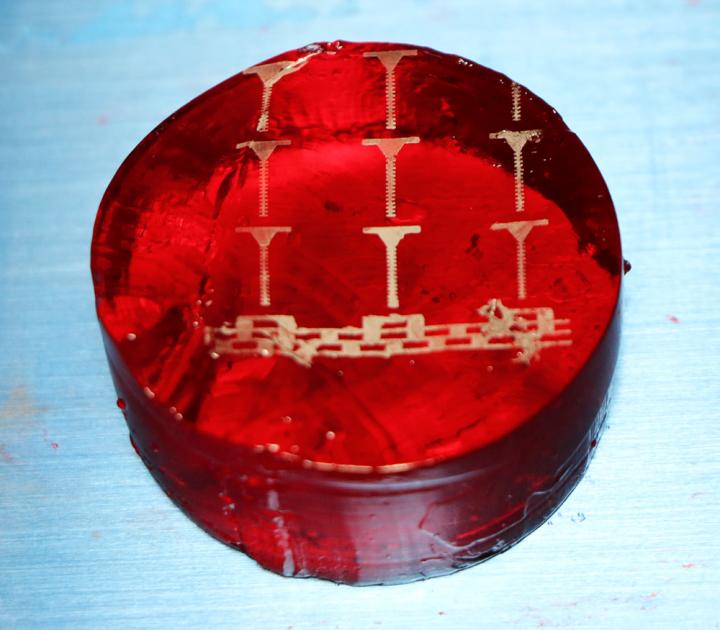
Maybe this? A gelatin cylinder with metal traces printed across the top.

Caption: Martin Thuo and his research group have printed electronic traces on gelatin. Credit: Martin Thuo/Iowa State University

A July 26, 2019 Iowa State University news release (also on EurekAlert but published on July 29, 2019), which originated the news item,

All those photos showed the latest application of undercooled metal technology developed by Thuo and his research group. The technology features liquid metal (in this case Field’s metal, an alloy of bismuth, indium and tin) trapped below its melting point in polished, oxide shells, creating particles about 10 millionths of a meter across.

When the shells are broken – with mechanical pressure or chemical dissolving – the metal inside flows and solidifies, creating a heat-free weld or, in this case, printing conductive, metallic lines and traces on all kinds of materials, everything from a concrete wall to a leaf.

That could have all kinds of applications, including sensors to measure the structural integrity of a building or the growth of crops. The technology was also tested in paper-based remote controls that read changes in electrical currents when the paper is curved. Engineers also tested the technology by making electrical contacts for solar cells and by screen printing conductive lines on gelatin, a model for soft biological tissues, including the brain.

“This work reports heat-free, ambient fabrication of metallic conductive interconnects and traces on all types of substrates,” Thuo and a team of researchers wrote in a paper describing the technology recently published online by the journal Advanced Functional Materials.

Thuo – an assistant professor of materials science and engineering at Iowa State, an associate of the U.S. Department of Energy’s Ames Laboratory and a co-founder of the Ames startup SAFI-Tech Inc. that’s commercializing the liquid-metal particles – is the lead author. Co-authors are Andrew Martin, a former undergraduate in Thuo’s lab and now an Iowa State doctoral student in materials science and engineering; Boyce Chang, a postdoctoral fellow at the University of California, Berkeley, who earned his doctoral degree at Iowa State Zachariah Martin, Dipak Paramanik and Ian Tevis, of SAFI-Tech; Christophe Frankiewicz, a co-founder of Sep-All in Ames and a former Iowa State postdoctoral research associate; and Souvik Kundu, an Iowa State graduate student in electrical and computer engineering.
The project was supported by university startup funds to establish Thuo’s research lab at Iowa State, Thuo’s Black & Veatch faculty fellowship and a National Science Foundation Small Business Innovation Research grant.

Thuo said he launched the project three years ago as a teaching exercise.

“I started this with undergraduate students,” he said. “I thought it would be fun to get students to make something like this. It’s a really beneficial teaching tool because you don’t need to solve 2 million equations to do sophisticated science.”

And once students learned to use a few metal-processing tools, they started solving some of the technical challenges of flexible, metal electronics.

“The students discovered ways of dealing with metal and that blossomed into a million ideas,” Thuo said. “And now we can’t stop.”

And so the researchers have learned how to effectively bond metal traces to everything from water-repelling rose petals to watery gelatin. Based on what they now know, Thuo said it would be easy for them to print metallic traces on ice cubes or biological tissue.

All the experiments “highlight the versatility of this approach,” the researchers wrote in their paper, “allowing a multitude of conductive products to be fabricated without damaging the base material.”

Here’s a link to and a citation for the paper,

Heat‐Free Fabrication of Metallic Interconnects for Flexible/Wearable Devices by Andrew Martin, Boyce S. Chang, Zachariah Martin, Dipak Paramanik, Christophe Frankiewicz, Souvik Kundu, Ian D. Tevis, Martin Thuo. Advanced Functional Materials Online Version of Record before inclusion in an issue 1903687 DOI: https://doi.org/10.1002/adfm.201903687 First published online: 15 July 2019

This paper is behind a paywall.
US Dept. of Agriculture announces its nanotechnology research grants

I don’t always stumble across the US Department of Agriculture’s nanotechnology research grant announcements but I’m always grateful when I do as it’s good to find out about  nanotechnology research taking place in the agricultural sector. From a July 21, 2017 news item on Nanowerk,,

The U.S. Department of Agriculture’s (USDA) National Institute of Food and Agriculture (NIFA) today announced 13 grants totaling $4.6 million for research on the next generation of agricultural technologies and systems to meet the growing demand for food, fuel, and fiber. The grants are funded through NIFA’s Agriculture and Food Research Initiative (AFRI), authorized by the 2014 Farm Bill.

“Nanotechnology is being rapidly implemented in medicine, electronics, energy, and biotechnology, and it has huge potential to enhance the agricultural sector,” said NIFA Director Sonny Ramaswamy. “NIFA research investments can help spur nanotechnology-based improvements to ensure global nutritional security and prosperity in rural communities.”

A July 20, 2017 USDA news release, which originated the news item, lists this year’s grants and provides a brief description of a few of the newly and previously funded projects,

Fiscal year 2016 grants being announced include:

Nanotechnology for Agricultural and Food Systems

  • Kansas State University, Manhattan, Kansas, $450,200
  • Wichita State University, Wichita, Kansas, $340,000
  • University of Massachusetts, Amherst, Massachusetts, $444,550
  • University of Nevada, Las Vegas, Nevada,$150,000
  • North Dakota State University, Fargo, North Dakota, $149,000
  • Cornell University, Ithaca, New York, $455,000
  • Cornell University, Ithaca, New York, $450,200
  • Oregon State University, Corvallis, Oregon, $402,550
  • University of Pennsylvania, Philadelphia, Pennsylvania, $405,055
  • Gordon Research Conferences, West Kingston, Rhode Island, $45,000
  • The University of Tennessee,  Knoxville, Tennessee, $450,200
  • Utah State University, Logan, Utah, $450,200
  • The George Washington University, Washington, D.C., $450,200

Project details can be found at the NIFA website (link is external).

Among the grants, a University of Pennsylvania project will engineer cellulose nanomaterials [emphasis mine] with high toughness for potential use in building materials, automotive components, and consumer products. A University of Nevada-Las Vegas project will develop a rapid, sensitive test to detect Salmonella typhimurium to enhance food supply safety.

Previously funded grants include an Iowa State University project in which a low-cost and disposable biosensor made out of nanoparticle graphene that can detect pesticides in soil was developed. The biosensor also has the potential for use in the biomedical, environmental, and food safety fields. University of Minnesota (link is external) researchers created a sponge that uses nanotechnology to quickly absorb mercury, as well as bacterial and fungal microbes from polluted water. The sponge can be used on tap water, industrial wastewater, and in lakes. It converts contaminants into nontoxic waste that can be disposed in a landfill.

NIFA invests in and advances agricultural research, education, and extension and promotes transformative discoveries that solve societal challenges. NIFA support for the best and brightest scientists and extension personnel has resulted in user-inspired, groundbreaking discoveries that combat childhood obesity, improve and sustain rural economic growth, address water availability issues, increase food production, find new sources of energy, mitigate climate variability and ensure food safety. To learn more about NIFA’s impact on agricultural science, visit www.nifa.usda.gov/impacts, sign up for email updates (link is external) or follow us on Twitter @USDA_NIFA (link is external), #NIFAImpacts (link is external).

Given my interest in nanocellulose materials (Canada was/is a leader in the production of cellulose nanocrystals [CNC] but there has been little news about Canadian research into CNC applications), I used the NIFA link to access the table listing the grants and clicked on ‘brief’ in the View column in the University of Pennsylania row to find this description of the project,

ENGINEERING CELLULOSE NANOMATERIALS WITH HIGH TOUGHNESS

NON-TECHNICAL SUMMARY: Cellulose nanofibrils (CNFs) are natural materials with exceptional mechanical properties that can be obtained from renewable plant-based resources. CNFs are stiff, strong, and lightweight, thus they are ideal for use in structural materials. In particular, there is a significant opportunity to use CNFs to realize polymer composites with improved toughness and resistance to fracture. The overall goal of this project is to establish an understanding of fracture toughness enhancement in polymer composites reinforced with CNFs. A key outcome of this work will be process – structure – fracture property relationships for CNF-reinforced composites. The knowledge developed in this project will enable a new class of tough CNF-reinforced composite materials with applications in areas such as building materials, automotive components, and consumer products.The composite materials that will be investigated are at the convergence of nanotechnology and bio-sourced material trends. Emerging nanocellulose technologies have the potential to move biomass materials into high value-added applications and entirely new markets.

It’s not the only nanocellulose material project being funded in this round, there’s this at North Dakota State University, from the NIFA ‘brief’ project description page,

NOVEL NANOCELLULOSE BASED FIRE RETARDANT FOR POLYMER COMPOSITES

NON-TECHNICAL SUMMARY: Synthetic polymers are quite vulnerable to fire.There are 2.4 million reported fires, resulting in 7.8 billion dollars of direct property loss, an estimated 30 billion dollars of indirect loss, 29,000 civilian injuries, 101,000 firefighter injuries and 6000 civilian fatalities annually in the U.S. There is an urgent need for a safe, potent, and reliable fire retardant (FR) system that can be used in commodity polymers to reduce their flammability and protect lives and properties. The goal of this project is to develop a novel, safe and biobased FR system using agricultural and woody biomass. The project is divided into three major tasks. The first is to manufacture zinc oxide (ZnO) coated cellulose nanoparticles and evaluate their morphological, chemical, structural and thermal characteristics. The second task will be to design and manufacture polymer composites containing nano sized zinc oxide and cellulose crystals. Finally the third task will be to test the fire retardancy and mechanical properties of the composites. Wbelieve that presence of zinc oxide and cellulose nanocrystals in polymers will limit the oxygen supply by charring, shielding the surface and cellulose nanocrystals will make composites strong. The outcome of this project will help in developing a safe, reliable and biobased fire retardant for consumer goods, automotive, building products and will help in saving human lives and property damage due to fire.

One day, I hope to hear about Canadian research into applications for nanocellulose materials. (fingers crossed for good luck)

Treating graphene with lasers for paper-based electronics

Engineers at Iowa State University have found a way they hope will make it easier to commercialize graphene. A Sept. 1, 2016 news item on phys.org describes the research,

The researchers in Jonathan Claussen’s lab at Iowa State University (who like to call themselves nanoengineers) have been looking for ways to use graphene and its amazing properties in their sensors and other technologies.

Graphene is a wonder material: The carbon honeycomb is just an atom thick. It’s great at conducting electricity and heat; it’s strong and stable. But researchers have struggled to move beyond tiny lab samples for studying its material properties to larger pieces for real-world applications.

Recent projects that used inkjet printers to print multi-layer graphene circuits and electrodes had the engineers thinking about using it for flexible, wearable and low-cost electronics. For example, “Could we make graphene at scales large enough for glucose sensors?” asked Suprem Das, an Iowa State postdoctoral research associate in mechanical engineering and an associate of the U.S. Department of Energy’s Ames Laboratory.

But there were problems with the existing technology. Once printed, the graphene had to be treated to improve electrical conductivity and device performance. That usually meant high temperatures or chemicals – both could degrade flexible or disposable printing surfaces such as plastic films or even paper.

Das and Claussen came up with the idea of using lasers to treat the graphene. Claussen, an Iowa State assistant professor of mechanical engineering and an Ames Laboratory associate, worked with Gary Cheng, an associate professor at Purdue University’s School of Industrial Engineering, to develop and test the idea.

A Sept. 1, 2016 Iowa State University news release (also on EurekAlert), which originated the news item, provides more detail about the intellectual property, as well as, the technology,

… They found treating inkjet-printed, multi-layer graphene electric circuits and electrodes with a pulsed-laser process improves electrical conductivity without damaging paper, polymers or other fragile printing surfaces.

“This creates a way to commercialize and scale-up the manufacturing of graphene,” Claussen said.

Two major grants are supporting the project and related research: a three-year grant from the National Institute of Food and Agriculture, U.S. Department of Agriculture, under award number 11901762 and a three-year grant from the Roy J. Carver Charitable Trust. Iowa State’s College of Engineering and department of mechanical engineering are also supporting the research.

The Iowa State Research Foundation Inc. has filed for a patent on the technology.

“The breakthrough of this project is transforming the inkjet-printed graphene into a conductive material capable of being used in new applications,” Claussen said.

Those applications could include sensors with biological applications, energy storage systems, electrical conducting components and even paper-based electronics.

To make all that possible, the engineers developed computer-controlled laser technology that selectively irradiates inkjet-printed graphene oxide. The treatment removes ink binders and reduces graphene oxide to graphene – physically stitching together millions of tiny graphene flakes. The process makes electrical conductivity more than a thousand times better.

“The laser works with a rapid pulse of high-energy photons that do not destroy the graphene or the substrate,” Das said. “They heat locally. They bombard locally. They process locally.”

That localized, laser processing also changes the shape and structure of the printed graphene from a flat surface to one with raised, 3-D nanostructures. The engineers say the 3-D structures are like tiny petals rising from the surface. The rough and ridged structure increases the electrochemical reactivity of the graphene, making it useful for chemical and biological sensors.

All of that, according to Claussen’s team of nanoengineers, could move graphene to commercial applications.

“This work paves the way for not only paper-based electronics with graphene circuits,” the researchers wrote in their paper, “it enables the creation of low-cost and disposable graphene-based electrochemical electrodes for myriad applications including sensors, biosensors, fuel cells and (medical) devices.”

Here’s a link to and a citation for the paper,

3D nanostructured inkjet printed graphene via UV-pulsed laser irradiation enables paper-based electronics and electrochemical devices by Suprem R. Das, Qiong Nian, Allison A. Cargill, John A. Hondred, Shaowei Ding, Mojib Saei, Gary J. Cheng, and   Jonathan C. Claussen. Nanoscale, 2016,8, 15870-15879 DOI: 10.1039/C6NR04310K First published online 12 Jul 2016

This paper is open access but you do need to have registered for your free account to access the material.

$5.2M in nanotechnology grants from the US Department of Agriculture (USDA)

A March 30, 2016 news item on Nanowerk announces the 2016 nanotechnology grants from the US Dept. of Agriculture (USDA),

Agriculture Secretary Tom Vilsack today [March 30, 2016] announced an investment of more than $5.2 million to support nanotechnology research at 11 universities. The universities will research ways nanotechnology can be used to improve food safety, enhance renewable fuels, increase crop yields, manage agricultural pests, and more. The awards were made through the Agriculture and Food Research Initiative (AFRI), the nation’s premier competitive, peer-reviewed grants program for fundamental and applied agricultural sciences.

A March 30, 2016 USDA news release provides more detail,

“In the seven years since the Agriculture and Food Research Initiative was established, the program has led to true innovations and ground-breaking discoveries in agriculture to combat childhood obesity, improve and sustain rural economic growth, address water availability issues, increase food production, find new sources of energy, mitigate the impacts of climate variability and enhance resiliency of our food systems, and ensure food safety. Nanoscale science, engineering, and technology are key pieces of our investment in innovation to ensure an adequate and safe food supply for a growing global population,” said Vilsack. “The President’s 2017 Budget calls for full funding of the Agriculture and Food Research Initiative so that USDA can continue to support important projects like these.”

Universities receiving funding include Auburn University in Auburn, Ala.; Connecticut Agricultural Experiment Station in New Haven, Conn.; University of Central Florida in Orlando, Fla; University of Georgia in Athens, Ga.; Iowa State University in Ames, Iowa; University of Massachusetts in Amherst, Mass.; Mississippi State University in Starkville, Miss.; Lincoln University in Jefferson City, Mo.; Clemson University in Clemson, S.C.; Virginia Polytechnic Institute and State University in Blacksburg, Va.; and University of Wisconsin in Madison, Wis.

With this funding, Auburn University proposes to improve pathogen monitoring throughout the food supply chain by creating a user-friendly system that can detect multiple foodborne pathogens simultaneously, accurately, cost effectively, and rapidly. Mississippi State University will research ways nanochitosan can be used as a combined fire-retardant and antifungal wood treatment that is also environmentally safe. Experts in nanotechnology, molecular biology, vaccines and poultry diseases at the University of Wisconsin will work to develop nanoparticle-based poultry vaccines to prevent emerging poultry infections. USDA has a full list of projects and longer descriptions available online.

Past projects include a University of Georgia project developing a bio-nanocomposites-based, disease-specific, electrochemical sensors for detecting fungal pathogen induced volatiles in selected crops; and a University of Massachusetts project creating a platform for pathogen detection in foods that is superior to the current detection method in terms of analytical time, sensitivity, and accuracy using a novel, label-free, surface-enhanced Raman scattering (SERS) mapping technique.

The purpose of AFRI is to support research, education, and extension work by awarding grants that address key problems of national, regional, and multi-state importance in sustaining all components of food and agriculture. AFRI is the flagship competitive grant program administered by USDA’s National Institute of Food and Agriculture [NIFA]. Established under the 2008 Farm Bill, AFRI supports work in six priority areas: plant health and production and plant products; animal health and production and animal products; food safety, nutrition and health; bioenergy, natural resources and environment; agriculture systems and technology; and agriculture economics and rural communities. Since AFRI’s creation, NIFA has awarded more than $89 million to solve challenges related to plant health and production; $22 million of this has been dedicated to nanotechnology research. The President’s 2017 budget request proposes to fully fund AFRI for $700 million; this amount is the full funding level authorized by Congress when it established AFRI in the 2008 Farm Bill.

Each day, the work of USDA scientists and researchers touches the lives of all Americans: from the farm field to the kitchen table and from the air we breathe to the energy that powers our country. USDA science is on the cutting edge, helping to protect, secure, and improve our food, agricultural and natural resources systems. USDA research develops and transfers solutions to agricultural problems, supporting America’s farmers and ranchers in their work to produce a safe and abundant food supply for more than 100 years. This work has helped feed the nation and sustain an agricultural trade surplus since the 1960s. Since 2009, USDA has invested $4.32 billion in research and development grants. Studies have shown that every dollar invested in agricultural research now returns over $20 to our economy.

Since 2009, NIFA has invested in and advanced innovative and transformative initiatives to solve societal challenges and ensure the long-term viability of agriculture. NIFA’s integrated research, education, and extension programs, supporting the best and brightest scientists and extension personnel, have resulted in user-inspired, groundbreaking discoveries that are combating childhood obesity, improving and sustaining rural economic growth, addressing water availability issues, increasing food production, finding new sources of energy, mitigating climate variability, and ensuring food safety.

2013 International Science & Engineering Visualization Challenge Winners

Thanks to a RT from @coreyspowell I stumbled across a Feb. 7, 2014 article in Science (magazine) describing the 2013 International Science & Engineering Visualization Challenge Winners. I am highlighting a few of the entries here but there are more images in the article and a slideshow.

First Place: Illustration

Credit: Greg Dunn and Brian Edwards, Greg Dunn Design, Philadelphia, Pennsylvania; Marty Saggese, Society for Neuroscience, Washington, D.C.; Tracy Bale, University of Pennsylvania, Philadelphia; Rick Huganir, Johns Hopkins University, Baltimore, Maryland

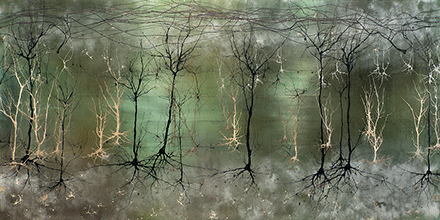
Cortex in Metallic Pastels. Credit: Greg Dunn and Brian Edwards, Greg Dunn Design, Philadelphia, Pennsylvania; Marty Saggese, Society for Neuroscience, Washington, D.C.; Tracy Bale, University of Pennsylvania, Philadelphia; Rick Huganir, Johns Hopkins University, Baltimore, Maryland

From the article, a description of Greg Dunn and his work,

With a Ph.D. in neuroscience and a love of Asian art, it may have been inevitable that Greg Dunn would combine them to create sparse, striking illustrations of the brain. “It was a perfect synthesis of my interests,” Dunn says.

Cortex in Metallic Pastels represents a stylized section of the cerebral cortex, in which axons, dendrites, and other features create a scene reminiscent of a copse of silver birch at twilight. An accurate depiction of a slice of cerebral cortex would be a confusing mess, Dunn says, so he thins out the forest of cells, revealing the delicate branching structure of each neuron.

Dunn blows pigments across the canvas to create the neurons and highlights some of them in gold leaf and palladium, a technique he is keen to develop further.

“My eventual goal is to start an art-science lab,” he says. It would bring students of art and science together to develop new artistic techniques. He is already using lithography to give each neuron in his paintings a different angle of reflectance. “As you walk around, different neurons appear and disappear, so you can pack it with information,” he says.

People’s Choice:  Games & Apps

Meta!Blast: The Leaf. Credit: Eve Syrkin Wurtele, William Schneller, Paul Klippel, Greg Hanes, Andrew Navratil, and Diane Bassham, Iowa State University, Ames

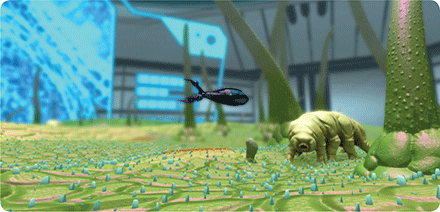
Meta!Blast: The Leaf. Credit: Eve Syrkin Wurtele, William Schneller, Paul Klippel, Greg Hanes, Andrew Navratil, and Diane Bassham, Iowa State University, Ames

More from the article,

“Most people don’t expect a whole ecosystem right on the leaf surface,” says Eve Syrkin Wurtele, a plant biologist at Iowa State University. Meta!Blast: The Leaf, the game that Wurtele and her team created, lets high school students pilot a miniature bioship across this strange landscape, which features nematodes and a lumbering tardigrade. They can dive into individual cells and zoom around a chloroplast, activating photosynthesis with their ship’s search lamp. Pilots can also scan each organelle they encounter to bring up more information about it from the ship’s BioLog—a neat way to put plant biology at the heart of an interactive gaming environment.

This is a second recognition for Meta!Blast, which won an Honorable Mention in the 2011 visualization challenge for a version limited to the inside of a plant cell.

The Metablast website homepage describes the game,

The last remaining plant cell in existence is dying. An expert team of plant scientists have inexplicably disappeared. Can you rescue the lost team, discover what is killing the plant, and save the world?

Meta!Blast is a real-time 3D action-adventure game that puts you in the pilot’s seat. Shrink down to microscopic size and explore the vivid, dynamic world of a soybean plant cell spinning out of control. Interact with numerous characters, fight off plant pathogens, and discover how important plants are to the survival of the human race.

Enjoy!

What is a diamond worth?

A couple of diamond-related news items have crossed my path lately causing me to consider diamonds and their social implications. I’ll start first with the news items, according to an April 4, 2012 news item on physorg.com a quantum computer has been built inside a diamond (from the news item),

Diamonds are forever – or, at least, the effects of this diamond on quantum computing may be. A team that includes scientists from USC has built a quantum computer in a diamond, the first of its kind to include protection against “decoherence” – noise that prevents the computer from functioning properly.

I last mentioned decoherence in my July 21, 2011 posting about a joint (University of British Columbia, University of California at Santa Barbara and the University of Southern California) project on quantum computing.

According to the April 5, 2012 news item by Robert Perkins for the University of Southern California (USC),

The multinational team included USC professor Daniel Lidar and USC postdoctoral researcher Zhihui Wang, as well as researchers from the Delft University of Technology in the Netherlands, Iowa State University and the University of California, Santa Barbara. The findings were published today in Nature.

The team’s diamond quantum computer system featured two quantum bits, or qubits, made of subatomic particles.

As opposed to traditional computer bits, which can encode distinctly either a one or a zero, qubits can encode a one and a zero at the same time. This property, called superposition, along with the ability of quantum states to “tunnel” through energy barriers, some day will allow quantum computers to perform optimization calculations much faster than traditional computers.

Like all diamonds, the diamond used by the researchers has impurities – things other than carbon. The more impurities in a diamond, the less attractive it is as a piece of jewelry because it makes the crystal appear cloudy.

The team, however, utilized the impurities themselves.

A rogue nitrogen nucleus became the first qubit. In a second flaw sat an electron, which became the second qubit. (Though put more accurately, the “spin” of each of these subatomic particles was used as the qubit.)

Electrons are smaller than nuclei and perform computations much more quickly, but they also fall victim more quickly to decoherence. A qubit based on a nucleus, which is large, is much more stable but slower.

“A nucleus has a long decoherence time – in the milliseconds. You can think of it as very sluggish,” said Lidar, who holds appointments at the USC Viterbi School of Engineering and the USC Dornsife College of Letters, Arts and Sciences.

Though solid-state computing systems have existed before, this was the first to incorporate decoherence protection – using microwave pulses to continually switch the direction of the electron spin rotation.

“It’s a little like time travel,” Lidar said, because switching the direction of rotation time-reverses the inconsistencies in motion as the qubits move back to their original position.

Here’s an image I downloaded from the USC webpage hosting Perkins’s news item,

The diamond in the center measures 1 mm X 1 mm. Photo/Courtesy of Delft University of Technolgy/UC Santa Barbara

I’m not sure what they were trying to illustrate with the image but I thought it would provide an interesting contrast to the video which follows about the world’s first purely diamond ring,

I first came across this ring in Laura Hibberd’s March 22, 2012 piece for Huffington Post. For anyone who feels compelled to find out more about it, here’s the jeweller’s (Shawish) website.

What with the posting about Neal Stephenson and Diamond Age (aka, The Diamond Age Or A Young Lady’s Illustrated Primer; a novel that integrates nanotechnology into a story about the future and ubiquitous diamonds), a quantum computer in a diamond, and this ring, I’ve started to wonder about role diamonds will have in society. Will they be integrated into everyday objects or will they remain objects of desire? My guess is that the diamonds we create by manipulating carbon atoms will be considered everyday items while the ones which have been formed in the bowels of the earth will retain their status.

Learn to love spiders and their silk as they may help you beat global warming

Most of the research I’ve seen on spider silk has focused on its strength not its thermal conductivity. From the March 5, 2012 news item on Nanowerk,

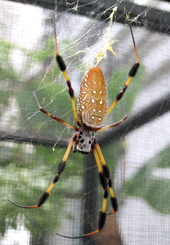
Xinwei Wang had a hunch that spider webs were worth a much closer look. So he ordered eight spiders – Nephila clavipes, golden silk orbweavers – and put them to work eating crickets and spinning webs in the cages he set up in an Iowa State University greenhouse.

Wang, an associate professor of mechanical engineering at Iowa State, studies thermal conductivity, the ability of materials to conduct heat. He’s been looking for organic materials that can effectively transfer heat. It’s something diamonds, copper and aluminum are very good at; most materials from living things aren’t very good at all. …

What Wang and his research team found was that spider silks – particularly the draglines that anchor webs in place – conduct heat better than most materials, including very good conductors such as silicon, aluminum and pure iron. Spider silk also conducts heat 1,000 times better than woven silkworm silk and 800 times better than other organic tissues.

The March 5, 2012 news release from Iowa State University provides this detail,

The paper [about the discovery,  “New Secrets of Spider Silk: Exceptionally High Thermal Conductivity and its Abnormal Change under Stretching” – has just been published online by the journal Advanced Materials] reports that using laboratory techniques developed by Wang – “this takes time and patience” – spider silk conducts heat at the rate of 416 watts per meter Kelvin. Copper measures 401. And skin tissues measure .6.

“This is very surprising because spider silk is organic material,” Wang said. “For organic material, this is the highest ever. There are only a few materials higher – silver and diamond.”

Even more surprising, he said, is when spider silk is stretched, thermal conductivity also goes up. Wang said stretching spider silk to its 20 percent limit also increases conductivity by 20 percent. Most materials lose thermal conductivity when they’re stretched.

That discovery “opens a door for soft materials to be another option for thermal conductivity tuning,” Wang wrote in the paper.

And that could lead to spider silk helping to create flexible, heat-dissipating parts for electronics, better clothes for hot weather, bandages that don’t trap heat and many other everyday applications.

Here’s a look at one of Wang’s Golden Silk Orbweavers,

Photo courtesy of the Xinwei Wang research group.

Given that global warming is increasingly described as a certainty, (Simon Fraser University [located in Vancouver, Canada] March 4, 2012 news release,

Warming of 2 degrees inevitable over Canada

Even if zero emissions of greenhouse gases were to be achieved, the world’s temperature would continue to rise by about a quarter of a degree over a decade. That’s a best-case scenario, according to a paper co-written by a Simon Fraser University researcher.

New climate change research – Climate response to zeroed emissions of greenhouse gases and aerosols — published in Nature’s online journal, urges the public, governments and industries to wake up to a harsh new reality.

“Let’s be honest, it’s totally unrealistic to believe that we can stop all emissions now,” says Kirsten Zickfeld, an assistant professor of geography at SFU. “Even with aggressive greenhouse gas mitigation, it will be a challenge to keep the projected global rise in temperature under 2 degrees Celsius,” emphasizes Zickfeld.

The geographer wrote the paper with Damon Matthews, a University of Concordia associate professor at the Department of Geography, Planning and Environment.

This discovery about spider silk and its possible applications is very welcome.