The latest Quantum Studio artist-in-residence, Nadia Lichtig, has recently been announced in the University of British Columbia’s (Vancouver, Canada) Morris and Helen Belkin Gallery October 7, 2025 newsletter (also received via email),
ARS SCIENTIA – BRIDGING ART AND SCIENCE AT UBC
Building on exhibitions like The Beautiful Brain and Drift, the Ars Scientia research project connects artists with physicists to explore the intersections between the disciplines of art and science. A collaboration between the Belkin, the Department of Physics and Astronomy and the Stewart Blusson Quantum Matter Institute, with project support from the Institut Français du Canada and the Department of Art History, Visual Art and Theory, we’re pleased to share news of Ars Scientia‘s latest initiatives.
Quantum Studio Artist Residency with Nadia Lichtig
We are happy to welcome French-German artist Nadia Lichtig as this year’s Quantum Studio Artist-in-Residence, a collaboration between the Institut Français du Canada and UBC’s Stewart Blusson Quantum Matter Institute and the Belkin through Quantum Studio, which is part of the larger West-West residency program supported by Institut Français du Canada. Nadia Lichtig’s multidisciplinary practice explores the intersections between pictorial and musical composition. Her works emerge from a continuous process of translation, where each medium reconfigures the other. She creates immersive installations, shaped by multilingualism, embodied listening and the notion of the “ghost image.” Her work unfolds across both artistic and musical scenes, in France and internationally, under her own name or various pseudonyms. Nadia Lichtig’s one-month residency (October 8 to November 7 [2025]) will conclude with a presentation of her research – a score and live performance – in the final week of her residency, details to follow!
Brains, Poems, AI and Forensics: Inside Ars Scientia’s Prize for Artful Science Writing
This past academic year, we invited UBC students to contribute an essay exploring the profound and often catalyzing connections between the two fields of art and science. We are pleased to share the winning essay by Dalmar Yusuf, alongside writing by three distinguished runners-up, Ever Roberts, Robin Lei and Wendy Yang! Their writing offered fresh insights, compelling examples and bold reflections on how creative and scientific thinking can inform and enrich one another.
Since its launch, the Quantum Studio residency has been made possible through a vital partnership between the French Consulate and UBC’s leading arts and science institutions. The program supports meaningful collaboration between artists and researchers across quantum physics, quantum computing, materials science, and beyond—creating a fertile space for cross-disciplinary inquiry.
Nadia Lichtig’s work bridges pictorial and musical forms through a process of continuous translation—her installations imbue painting with sound, visual imagery with sonic texture, and engage concepts like multilingualism, embodied listening, and the “ghost image.” During her residency, she will produce Event Horizon, a monumental painting paired with a sound composition inspired by quantum theory and the philosophy of Karen Barad. Developed through dialogue with the QMI research community, the piece aims to probe the fragile thresholds between visibility and disappearance, memory and perception, presence and absence.
Although specific collaborations remain to be shaped once Nadia arrives, researchers, students, and artists interested in exploring possibilities are warmly invited to engage with her during the residency. As in previous editions, these spontaneous encounters often yield rich creative and intellectual fruit.
Public programming—including artist talks and open discussions—will be organized throughout her stay. These will offer glimpses into the evolving creative process and foster connections between disciplines.
…
All about Nadia Lichtig
If you click on the READ MORE… link in the newsletter, you’ll be directed to the Quantum Studio Artist Residency 2025: Nadia Lichtig webpage where you’ll see Nadia Lichtig (right side of screen) and can click on a second READ MORE instruction to find more detail about her work,
Nadia Lichtig is an artist currently living in the South of France. In her multilayered work, voice is transposed into various media including painting, print, sculpture, photography, performance, soundscape and song—each medium approached not as a field to be mastered, but as a source of possibilities to question our ability to decipher the present. Visual and aural aspects entangle in her performances. Lichtig studied linguistics at the LMU Munich in Germany and at the Ecole des Beaux-Arts de Paris, France with Jean-Luc Vilmouth, where she graduated with honours in 2001, before assisting Mike Kelley in Los Angeles the same year. She is currently pursuing a PhD in artistic research. Lichtig taught at the Shrishti School of Art and Technology, Bangalore, India as a visiting professor in 2006, at the Ecole des Beaux-Arts of Valence in 2007 and is professor of Fine Arts at the Ecole Supérieure des Beaux-arts of Montpellier (MOCO-ESBA), France since 2009. She has collaborated with musicians who are also visual artists, such as Bertrand Georges (Audible), Christian Bouyjou (Popopfalse), Nicolu (La Chatte), Nina Canal (Ut) and Michael Moorley (The dead C). Lichtig worked and works under several group names and pseudonyms (until 2009: EchoparK, Falseparklocation, Skrietch, Ghosttrap and Nanana).
Nadia Lichtig is a French-German artist, based in Montpellier, France.
She is the new recipient of the Arts & Sciences residency program “Quantum Studio, Vancouver” a program created by the French Institute of Canada in 2023, in partnership with the Stewart Blusson Quantum Matter Institute (QMI) and the Morris and Helen Belkin Art Gallery at the University of British Columbia (UBC).
Nadia Lichtig succeeds Caroline Delétoille (2024) and Javiera Tejerina Risso (2023). The artist will be in residence in Vancouver from October 8 to November 7 2025.
Nadia Lichtig is an artist whose multidisciplinary practice explores the intersections between pictorial and musical composition. Her works emerge from a continuous process of translation, where each medium reconfigures the other. She creates immersive installations, shaped by multilingualism, embodied listening, and the notion of the “ghost image.” Her work unfolds across both artistic and musical scenes, in France and internationally, under her own name or various pseudonyms. She also teaches at MO.CO. ESBA in Montpellier and is currently pursuing a PhD in artistic research.
Special note: Lichtig’s work was last here in Vancouver as part of the Drift exhibition at the Belkin Gallery.
Not quite related (mushroom music)
The talk of music, visual art, physics, and “… a continuous process of translation, where each medium reconfigures the other” reminded me of Tarun Nayar (Modern Biology) and his work as described in my May 27, 2022 posting “The sound of the mushroom,” where he sonifies data he collects from mushrooms and other plants,
…
A May 13, 2022 article by Philip Drost for the Canadian Broadcasting Corporation’s (CBC) As It Happens radio programme highlights the “From funky fungi to melodious mangos, this artist makes music out of nature” segment of the show, Note: Links have been removed,
At the intersection of biology and electronic music, you can find Tarun Nayar plugging his synthesizer equipment into mushrooms and other forms of plant life, hoping to capture their invisible bioelectric rhythms and build them into tranquil soundscapes.
“What I’m really doing is trying to stimulate joy and wonder and create these little sketches or vignettes using the plants themselves, so I like to think of it as definitely a collaboration,” Nayar told As It Happens guest host Helen Mann.
Nayar is an electronic musician and former biologist in Vancouver who uses his TikTok account and Youtube page, Modern Biology, to show off his serenading spores. And his videos have millions of views.
To make his fungi sing, Nayar uses little jumper cables to connect the vegetation with his synthesizer and measure their biological energy, or bioelectricity, which has an effect on the notes.
“The mushroom is contributing the pitch changes and the rhythm, and the synthesizer, which I have the mushroom plugged into, is contributing the timbre or the quality of the sound,” Nayar said.
…
I have a Modern Biology update, which takes the music to an unexpected place, from a June 23, 2025 article by Barb Sligl for MONTECRISTO magazine, (Vancouver, Canada-based)
In the cocoon-like interior of the restaurant Burdock & Co, [emphasis mine] headphone-clad diners focus intently on the plates before them. Forks pause midair between bites as people don’t just taste, they also listen to the food. I watch the gleam of neon-illuminated earcups—like blips on an amplifier—and tune in to the warbles emitting from a DJ setup, where a tangle of cables is plugged into a Buddha’s hand citron.
Behind the deck is Tarun Nayar, the Vancouver-based musician known as Modern Biology. He’s performing here for the first of a new series of Taste Sound dinners. Tonight, the theme is “Citrus-Scented Rain Under a Snow Moon,” a sensory meld of electronic and organic that’s a collaboration between Nayar and Andrea Carlson, the chef-owner of the Michelin-starred restaurant.
As I sample each dish, Nayar plays ambient music that is textural, moody, atmospheric—a trippy translation of the plant ingredients’ bioelectricity. The Buddha’s hand is murmuring. The Japanese sudachi fruit [a citrus found in Japan] is singing. Kind of. Nayar is channelling their fluctuations of energy—via electrodes and clips attached to the fruit—into a sonic composition at the intersection of music and biology.
The latent life force of the diminutive sudachi sphere is literally amplified in Nayar’s interpretation of its electrical currents. And its yuzu-like flavour intensifies in my mouth. This link between the senses goes back to the memory-inducing smell and taste famously wrought by Proust’s madeleine taken with tea, but recent research reveals that sound also affects taste. The work of Charles Spence, an experimental psychologist and author of Gastrophysics: The New Science of Eating, shows how different frequencies and volume influence taste—findings demonstrated tonight by Nayar and the sudachi’s twang and tang.
After the citrus soundscape at Burdock & Co, I meet Nayar in the Bloedel Conservatory, where he’s planning a live recording that includes the renowned Vancouver jazz multi-keyboardist Chris Gestrin. We sit on a bench amid the lush, teeming life and cacophony—including a pair of green-winged macaws perched behind us. Their squawks and trills punctuate our conversation as my glasses fog up in the humid environment of 500 plant varieties that include rare cycads and a corpse flower.
…
The biosonification device used to do this is akin to a modified polygraph machine, Nayar says. “It’s like a Grade 6 science project. It’s not crazy science like splitting atoms,” but it’s also on the frontier of fascinating research in botany and mycology. He cites SPUN (Society for the Protection of Underground Networks) and Michael Levin (a leading researcher in the “cognitive glue” of bioelectricity), as well as John Cage and Brian Eno (pioneers of generative music) and Sam Cusumano (an engineer and the creator of the first commercial biosonification device in 2012). Even a century ago, Sir Jagadish Chandra Bose, who Nayar calls India’s Einstein, laid the groundwork for plant neurobiology and invented instruments to detect plant signals.
Educated as a biologist himself, Nayar moved to Vancouver about 25 years ago to pursue a master’s degree in oceanography. But his career morphed into professional music from performing as a DJ to co-founding the popular band Delhi 2 Dublin and playing high-profile venues including Glastonbury and Burning Man. Now biosonification has reconnected Nayar to his academic roots. “It’s kind of a dream come true,” he says. “I can approach it as an artist, but I understand the science.”
…
… Through immersive events—from the botanically themed Taste Sound dinner at Burdock & Co to a Mushroom Church performance in the historic De Duif church in Amsterdam—he prods humans to commune with plants. He’s brought together people in parks on “field trips” and in concerts from Berlin to Bangalore and performed at Art Basel Miami and the Nobel Prize Museum in Stockholm.
Three UBC/Belkin Gallery art/science events are being highlighted here. Only the first one is ‘made-in-Vancouver’.
I covered the Quantum Studio artist-in-residency of Caroline Delétoille in some detail in my October 7, 2024 posting. I have news about her then upcoming artist talk, along with more information about the Quantum Studio artist-in-residence programme.
Drift
This show was originally developed bythe Arthur B. McDonald Canadian Astroparticle Physics Research Institute and SNOLAB (science facility located deep underground in the operational Vale Creighton nickel mine), both in Ontario. The exhibition along with the Ars Scientia initiative were highlighted in my September 6, 2021 posting.
The Beautiful Brain
This was not simply an exhibition, it was part of a series of events in Vancouver being hosted by the neuroscience community. Santiago Ramón y Cajal’s ‘beautiful brain’ show, developed by the Frederick R. Weisman Art Museum, University of Minnesota with the Instituto Cajal, remains on of my favourites; it’s mentioned here in my September 11, 2017 posting and, again, in my May 9, 2018 posting as it made its way from New York to Boston’s Harvard University.
Finally, I look forward to getting details about Lichtig’s presentation of her research (a score and live performance) in the final week of her residency sometime between November 1 – 7, 2025.
I thought it best to break this up a bit. There are a couple of ‘objects’ still to be discussed but this is mostly the commentary part of this letter to you. (Here’s a link for anyone who stumbled here but missed Part 1.)
Ethics, the natural world, social justice, eeek, and AI
Dorothy Woodend in her March 10, 2022 review for The Tyee) suggests some ethical issues in her critique of the ‘bee/AI collaboration’ and she’s not the only one with concerns. UNESCO (United Nations Educational, Scientific and Cultural Organization) has produced global recommendations for ethical AI (see my March 18, 2022 posting). More recently, there’s “Racist and sexist robots have flawed AI,” a June 23, 2022 posting, where researchers prepared a conference presentation and paper about deeply flawed AI still being used in robots.
Ultimately, the focus is always on humans and Woodend has extended the ethical AI conversation to include insects and the natural world. In short, something less human-centric.
My friend, this reference to the de Young exhibit may seem off topic but I promise it isn’t in more ways than one. The de Young Museum in San Francisco (February 22, 2020 – June 27, 2021) also held and AI and art show called, “Uncanny Valley: Being Human in the Age of AI”), from the exhibitions page,
In today’s AI-driven world, increasingly organized and shaped by algorithms that track, collect, and evaluate our data, the question of what it means to be human [emphasis mine] has shifted. Uncanny Valley is the first major exhibition to unpack this question through a lens of contemporary art and propose new ways of thinking about intelligence, nature, and artifice. [emphasis mine]
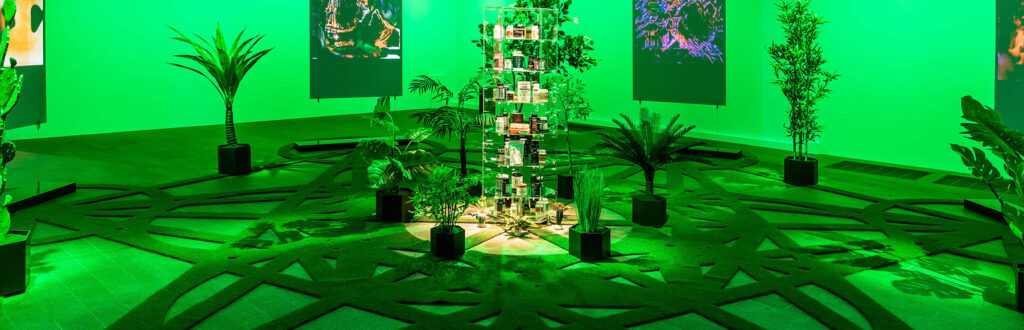
Courtesy: de Young Museum [downloaded from https://deyoung.famsf.org/exhibitions/uncanny-valley]
As you can see, it hinted (perhaps?) at an attempt to see beyond human-centric AI. (BTW, I featured this ‘Uncanny Valley’ show in my February 25, 2020 posting where I mentioned Stephanie Dinkins [featured below] and other artists.)
Social justice
While the VAG show doesn’t see much past humans and AI, it does touch on social justice. In particular there’s Pod 15 featuring the Algorithmic Justice League (AJL). The group “combine[s] art and research to illuminate the social implications and harms of AI” as per their website’s homepage.
In Pod 9, Stephanie Dinkins’ video work with a robot (Bina48), which was also part of the de Young Museum ‘Uncanny Valley’ show, addresses some of the same issues.
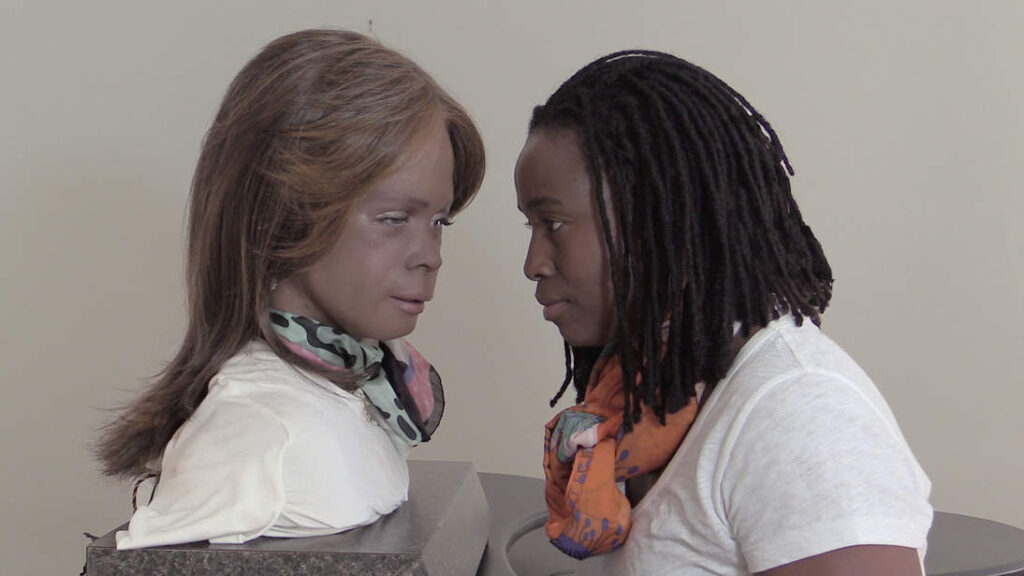
Still of Stephanie Dinkins, “Conversations with Bina48,” 2014–present. Courtesy of the artist [downloaded from https://deyoung.famsf.org/stephanie-dinkins-conversations-bina48-0]
From the the de Young Museum’s Stephanie Dinkins “Conversations with Bina48” April 23, 2020 article by Janna Keegan (Dinkins submitted the same work you see at the VAG show), Note: Links have been removed,
Transdisciplinary artist and educator Stephanie Dinkins is concerned with fostering AI literacy. The central thesis of her social practice is that AI, the internet, and other data-based technologies disproportionately impact people of color, LGBTQ+ people, women, and disabled and economically disadvantaged communities—groups rarely given a voice in tech’s creation. Dinkins strives to forge a more equitable techno-future by generating AI that includes the voices of multiple constituencies …
The artist’s ongoing Conversations with Bina48 takes the form of a series of interactions with the social robot Bina48 (Breakthrough Intelligence via Neural Architecture, 48 exaflops per second). The machine is the brainchild of Martine Rothblatt, an entrepreneur in the field of biopharmaceuticals who, with her wife, Bina, cofounded the Terasem Movement, an organization that seeks to extend human life through cybernetic means. In 2007 Martine commissioned Hanson Robotics to create a robot whose appearance and consciousness simulate Bina’s. The robot was released in 2010, and Dinkins began her work with it in 2014.
…
Part psychoanalytical discourse, part Turing test, Conversations with Bina48 also participates in a larger dialogue regarding bias and representation in technology. Although Bina Rothblatt is a Black woman, Bina48 was not programmed with an understanding of its Black female identity or with knowledge of Black history. Dinkins’s work situates this omission amid the larger tech industry’s lack of diversity, drawing attention to the problems that arise when a roughly homogenous population creates technologies deployed globally. When this occurs, writes art critic Tess Thackara, “the unconscious biases of white developers proliferate on the internet, mapping our social structures and behaviors onto code and repeating imbalances and injustices that exist in the real world.” One of the most appalling and public of these instances occurred when a Google Photos image-recognition algorithm mislabeled the faces of Black people as “gorillas.”
…
Eeek
You will find as you go through the ‘imitation game’ a pod with a screen showing your movements through the rooms in realtime on a screen. The installation is called “Creepers” (2021-22). The student team from Vancouver’s Centre for Digital Media (CDM) describes their project this way, from the CDM’s AI-driven Installation Piece for the Vancouver Art Gallery webpage,
Project Description
Kaleidoscope [team name] is designing an installation piece that harnesses AI to collect and visualize exhibit visitor behaviours, and interactions with art, in an impactful and thought-provoking way.
There’s no warning that you’re being tracked and you can see they’ve used facial recognition software to track your movements through the show. It’s claimed on the pod’s signage that they are deleting the data once you’ve left.
‘Creepers’ is an interesting approach to the ethics of AI. The name suggests that even the student designers were aware it was problematic.
In recovery from an existential crisis (meditations)
There’s something greatly ambitious about “The Imitation Game: Visual Culture in the Age of Artificial Intelligence” and walking up the VAG’s grand staircase affirms that ambition. Bravo to the two curators, Grenville and Entis for an exhibition.that presents a survey (or overview) of artificial intelligence, and its use in and impact on creative visual culture.
I’ve already enthused over the history (specifically Turing, Lovelace, Ovid), admitted to being mesmerized by Scott Eaton’s sculpture/AI videos, and confessed to a fascination (and mild repulsion) regarding Oxman’s honeycombs.
It’s hard to remember all of the ‘objects’ as the curators have offered a jumble of work, almost all of them on screens. Already noted, there’s Norbert Wiener’s The Moth (1949) and there are also a number of other computer-based artworks from the 1960s and 1970s. Plus, you’ll find works utilizing a GAN (generative adversarial network), an AI agent that is explained in the exhibit.
It’s worth going more than once to the show as there is so much to experience.
Why did they do that?
Dear friend, I’ve already commented on the poor flow through the show and It’s hard to tell if the curators intended the experience to be disorienting but this is to the point of chaos, especially when the exhibition is crowded.
I’ve seen Grenville’s shows before. In particular there was “MashUp: The Birth of Modern Culture, a massive survey documenting the emergence of a mode of creativity that materialized in the late 1800s and has grown to become the dominant model of cultural production in the 21st century” and there was “KRAZY! The Delirious World of Anime + Manga + Video Games + Art.” As you can see from the description, he pulls together disparate works and ideas into a show for you to ‘make sense’ of them.
One of the differences between those shows and the “imitation Game: …” is that most of us have some familiarity, whether we like it or not, with modern art/culture and anime/manga/etc. and can try to ‘make sense’ of it.
By contrast, artificial intelligence (which even experts have difficulty defining) occupies an entirely different set of categories; all of them associated with science/technology. This makes for a different kind of show so the curators cannot rely on the audience’s understanding of basics. It’s effectively an art/sci or art/tech show and, I believe, the first of its kind at the Vancouver Art Gallery. Unfortunately, the curators don’t seem to have changed their approach to accommodate that difference.
AI is also at the centre of a current panic over job loss, loss of personal agency, automated racism and sexism, etc. which makes the experience of viewing the show a little tense. In this context, their decision to commission and use ‘Creepers’ seems odd.
Where were Ai-Da and Dall-E-2 and the others?
Oh friend, I was hoping for a robot. Those roomba paintbots didn’t do much for me. All they did was lie there on the floor
To be blunt I wanted some fun and perhaps a bit of wonder and maybe a little vitality. I wasn’t necessarily expecting Ai-Da, an artisitic robot, but something three dimensional and fun in this very flat, screen-oriented show would have been nice.
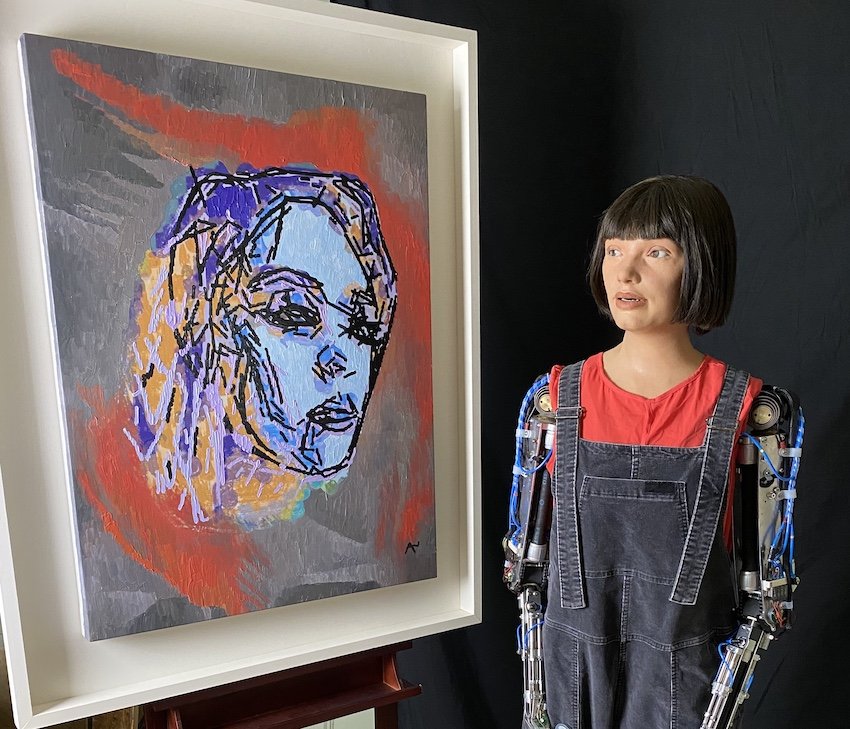
Ai-Da was at the Glastonbury Festival in the U from 23-26th June 2022. Here’s Ai-Da and her Billie Eilish (one of the Glastonbury 2022 headliners) portrait. [downloaded from https://www.ai-darobot.com/exhibition]
Ai-Da was first featured here in a December 17, 2021 posting about performing poetry that she had written in honour of the 700th anniversary of poet Dante Alighieri’s death.
Named in honour of Ada Lovelace, Ai-Da visited the 2022 Venice Biennale as Leah Henrickson and Simone Natale describe in their May 12, 2022 article for Fast Company (Note: Links have been removed),
Ai-Da sits behind a desk, paintbrush in hand. She looks up at the person posing for her, and then back down as she dabs another blob of paint onto the canvas. A lifelike portrait is taking shape. If you didn’t know a robot produced it, this portrait could pass as the work of a human artist.
Ai-Da is touted as the “first robot to paint like an artist,” and an exhibition of her work, called Leaping into the Metaverse, opened at the Venice Biennale.
Ai-Da produces portraits of sitting subjects using a robotic hand attached to her lifelike feminine figure. She’s also able to talk, giving detailed answers to questions about her artistic process and attitudes toward technology. She even gave a TEDx talk about “The Intersection of Art and AI” in Oxford a few years ago. While the words she speaks are programmed, Ai-Da’s creators have also been experimenting with having her write and perform her own poetry.
DALL-E 2 is a new neural network [AI] algorithm that creates a picture from a short phrase or sentence that you provide. The program, which was announced by the artificial intelligence research laboratory OpenAI in April 2022, hasn’t been released to the public. But a small and growing number of people – myself included – have been given access to experiment with it.
As a researcher studying the nexus of technology and art, I was keen to see how well the program worked. After hours of experimentation, it’s clear that DALL-E – while not without shortcomings – is leaps and bounds ahead of existing image generation technology. It raises immediate questions about how these technologies will change how art is made and consumed. It also raises questions about what it means to be creative when DALL-E 2 seems to automate so much of the creative process itself.
…
A July 4, 2022 article “DALL-E, Make Me Another Picasso, Please” by Laura Lane for The New Yorker has a rebuttal to Ada Lovelace’s contention that creativity is uniquely human (Note: A link has been removed),
…
“There was this belief that creativity is this deeply special, only-human thing,” Sam Altman, OpenAI’s C.E.O., explained the other day. Maybe not so true anymore, he said. Altman, who wore a gray sweater and had tousled brown hair, was videoconferencing from the company’s headquarters, in San Francisco. DALL-E is still in a testing phase. So far, OpenAI has granted access to a select group of people—researchers, artists, developers—who have used it to produce a wide array of images: photorealistic animals, bizarre mashups, punny collages. Asked by a user to generate “a plate of various alien fruits from another planet photograph,” DALL-E returned something kind of like rambutans. “The rest of mona lisa” is, according to DALL-E, mostly just one big cliff. Altman described DALL-E as “an extension of your own creativity.”
AI artists first hit my radar in August 2018 when Christie’s Auction House advertised an art auction of a ‘painting’ by an algorithm (artificial intelligence). There’s more in my August 31, 2018 posting but, briefly, a French art collective, Obvious, submitted a painting, “Portrait of Edmond de Belamy,” that was created by an artificial intelligence agent to be sold for an estimated to $7000 – $10,000. They weren’t even close. According to Ian Bogost’s March 6, 2019 article for The Atlantic, the painting sold for $432,500 In October 2018.
…
That posting also included AI artist, AICAN. Both artist-AI agents (Obvious and AICAN) are based on GANs (generative adversarial networks) for learning and eventual output. Both artist-AI agents work independently or with human collaborators on art works that are available for purchase.
As might be expected not everyone is excited about AI and visual art. Sonja Drimmer, Professor of Medieval Art, University of Massachusetts at Amherst, provides another perspective on AI, visual art, and, her specialty, art history in her November 1, 2021 essay for The Conversation (Note: Links have been removed),
Over the past year alone, I’ve come across articles highlighting how artificial intelligence recovered a “secret” painting of a “lost lover” of Italian painter Modigliani, “brought to life” a “hidden Picasso nude”, “resurrected” Austrian painter Gustav Klimt’s destroyed works and “restored” portions of Rembrandt’s 1642 painting “The Night Watch.” The list goes on.
As an art historian, I’ve become increasingly concerned about the coverage and circulation of these projects.
They have not, in actuality, revealed one secret or solved a single mystery.
What they have done is generate feel-good stories about AI.
…
Take the reports about the Modigliani and Picasso paintings.
These were projects executed by the same company, Oxia Palus, which was founded not by art historians but by doctoral students in machine learning.
In both cases, Oxia Palus relied upon traditional X-rays, X-ray fluorescence and infrared imaging that had already been carried out and published years prior – work that had revealed preliminary paintings beneath the visible layer on the artists’ canvases.
The company edited these X-rays and reconstituted them as new works of art by applying a technique called “neural style transfer.” This is a sophisticated-sounding term for a program that breaks works of art down into extremely small units, extrapolates a style from them and then promises to recreate images of other content in that same style.
…
As you can ‘see’ my friend, the topic of AI and visual art is a juicy one. In fact, I have another example in my June 27, 2022 posting, which is titled, “Art appraised by algorithm.” So, Grenville’s and Entis’ decision to focus on AI and its impact on visual culture is quite timely.
Visual culture: seeing into the future
The VAG Imitation Game webpage lists these categories of visual culture “animation, architecture, art, fashion, graphic design, urban design and video games …” as being represented in the show. Movies and visual art, not mentioned in the write up, are represented while theatre and other performing arts are not mentioned or represented. That’ s not a surprise.
In addition to an area of science/technology that’s not well understood even by experts, the curators took on the truly amorphous (and overwhelming) topic of visual culture. Given that even writing this commentary has been a challenge, I imagine pulling the show together was quite the task.
Grenville often grounds his shows in a history of the subject and, this time, it seems especially striking. You’re in a building that is effectively a 19th century construct and in galleries that reflect a 20th century ‘white cube’ aesthetic, while looking for clues into the 21st century future of visual culture employing technology that has its roots in the 19th century and, to some extent, began to flower in the mid-20th century.
Chung’s collaboration is one of the only ‘optimistic’ notes about the future and, as noted earlier, it bears a resemblance to Wiener’s 1949 ‘Moth’
Overall, it seems we are being cautioned about the future. For example, Oxman’s work seems bleak (bees with no flowers to pollinate and living in an eternal spring). Adding in ‘Creepers’ and surveillance along with issues of bias and social injustice reflects hesitation and concern about what we will see, who sees it, and how it will be represented visually.
Learning about robots, automatons, artificial intelligence, and more
I wish the Vancouver Art Gallery (and Vancouver’s other art galleries) would invest a little more in audience education. A couple of tours, by someone who may or may not know what they’re talking, about during the week do not suffice. The extra material about Stephanie Dinkins and her work (“Conversations with Bina48,” 2014–present) came from the de Young Museum’s website. In my July 26, 2021 commentary on North Vancouver’s Polygon Gallery 2021 show “Interior Infinite,” I found background information for artist Zanele Muholi on the Tate Modern’s website. There is nothing on the VAG website that helps you to gain some perspective on the artists’ works.
It seems to me that if the VAG wants to be considered world class, it should conduct itself accordingly and beefing up its website with background information about their current shows would be a good place to start.
Robots, automata, and artificial intelligence
Prior to 1921, robots were known exclusively as automatons. These days, the word ‘automaton’ (or ‘automata’ in the plural) seems to be used to describe purely mechanical representations of humans from over 100 years ago whereas the word ‘robot’ can be either ‘humanlike’ or purely machine, e.g. a mechanical arm that performs the same function over and over. I have a good February 24, 2017 essay on automatons by Miguel Barral for OpenMind BBVA*, which provides some insight into the matter,
The concept of robot is relatively recent. The idea was introduced in 1921 by the Czech writer Karel Capek in his work R.U.R to designate a machine that performs tasks in place of man. But their predecessors, the automatons (from the Greek automata, or “mechanical device that works by itself”), have been the object of desire and fascination since antiquity. Some of the greatest inventors in history, such as Leonardo Da Vinci, have contributed to our fascination with these fabulous creations:
The Al-Jazari automatons
The earliest examples of known automatons appeared in the Islamic world in the 12th and 13th centuries. In 1206, the Arab polymath Al-Jazari, whose creations were known for their sophistication, described some of his most notable automatons: an automatic wine dispenser, a soap and towels dispenser and an orchestra-automaton that operated by the force of water. This latter invention was meant to liven up parties and banquets with music while floating on a pond, lake or fountain.
As the water flowed, it started a rotating drum with pegs that, in turn, moved levers whose movement produced different sounds and movements. As the pegs responsible for the musical notes could be exchanged for different ones in order to interpret another melody, it is considered one of the first programmable machines in history.
…
If you’re curious about automata, my friend, I found this Sept. 26, 2016 ABC news radio news item about singer Roger Daltrey’s and his wife, Heather’s auction of their collection of 19th century French automata (there’s an embedded video showcasing these extraordinary works of art). For more about automata, robots, and androids, there’s an excellent May 4, 2022 article by James Vincent, ‘A visit to the human factory; How to build the world’s most realistic robot‘ for The Verge; Vincent’s article is about Engineered Arts, the UK-based company that built Ai-Da.
AI is often used interchangeably with ‘robot’ but they aren’t the same. Not all robots have AI integrated into their processes. At its simplest AI is an algorithm or set of algorithms, which may ‘live’ in a CPU and be effectively invisible or ‘live’ in or make use of some kind of machine and/or humanlike body. As the experts have noted, the concept of artificial intelligence is a slippery concept.
*OpenMind BBVA is a Spanish multinational financial services company, Banco Bilbao Vizcaya Argentaria (BBVA), which runs the non-profit project, OpenMind (About us page) to disseminate information on robotics and so much more.*
You can’t always get what you want
My friend,
I expect many of the show’s shortcomings (as perceived by me) are due to money and/or scheduling issues. For example, Ai-Da was at the Venice Biennale and if there was a choice between the VAG and Biennale, I know where I’d be.
Even with those caveats in mind, It is a bit surprising that there were no examples of wearable technology. For example, Toronto’s Tapestry Opera recently performed R.U.R. A Torrent of Light (based on the word ‘robot’ from Karel Čapek’s play, R.U.R., ‘Rossumovi Univerzální Roboti’), from my May 24, 2022 posting,
I have more about tickets prices, dates, and location later in this post but first, here’s more about the opera and the people who’ve created it from the Tapestry Opera’s ‘R.U.R. A Torrent of Light’ performance webpage,
“This stunning new opera combines dance, beautiful multimedia design, a chamber orchestra including 100 instruments creating a unique electronica-classical sound, and wearable technology [emphasis mine] created with OCAD University’s Social Body Lab, to create an immersive and unforgettable science-fiction experience.”
And, from later in my posting,
“Despite current stereotypes, opera was historically a launchpad for all kinds of applied design technologies. [emphasis mine] Having the opportunity to collaborate with OCAD U faculty is an invigorating way to reconnect to that tradition and foster connections between art, music and design, [emphasis mine]” comments the production’s Director Michael Hidetoshi Mori, who is also Tapestry Opera’s Artistic Director.
That last quote brings me back to the my comment about theatre and performing arts not being part of the show. Of course, the curators couldn’t do it all but a website with my hoped for background and additional information could have helped to solve the problem.
The absence of the theatrical and performing arts in the VAG’s ‘Imitation Game’ is a bit surprising as the Council of Canadian Academies (CCA) in their third assessment, “Competing in a Global Innovation Economy: The Current State of R&D in Canada” released in 2018 noted this (from my April 12, 2018 posting),
Canada, relative to the world, specializes in subjects generally referred to as the humanities and social sciences (plus health and the environment), and does not specialize as much as others in areas traditionally referred to as the physical sciences and engineering. Specifically, Canada has comparatively high levels of research output in Psychology and Cognitive Sciences, Public Health and Health Services, Philosophy and Theology, Earth and Environmental Sciences, and Visual and Performing Arts. [emphasis mine] It accounts for more than 5% of world research in these fields. Conversely, Canada has lower research output than expected in Chemistry, Physics and Astronomy, Enabling and Strategic Technologies, Engineering, and Mathematics and Statistics. The comparatively low research output in core areas of the natural sciences and engineering is concerning, and could impair the flexibility of Canada’s research base, preventing research institutions and researchers from being able to pivot to tomorrow’s emerging research areas. [p. xix Print; p. 21 PDF]
US-centric
My friend,
I was a little surprised that the show was so centered on work from the US given that Grenville has curated ate least one show where there was significant input from artists based in Asia. Both Japan and Korea are very active with regard to artificial intelligence and it’s hard to believe that their artists haven’t kept pace. (I’m not as familiar with China and its AI efforts, other than in the field of facial recognition, but it’s hard to believe their artists aren’t experimenting.)
The Americans, of course, are very important developers in the field of AI but they are not alone and it would have been nice to have seen something from Asia and/or Africa and/or something from one of the other Americas. In fact, anything which takes us out of the same old, same old. (Luba Elliott wrote this (2019/2020/2021?) essay, “Artificial Intelligence Art from Africa and Black Communities Worldwide” on Aya Data if you want to get a sense of some of the activity on the African continent. Elliott does seem to conflate Africa and Black Communities, for some clarity you may want to check out the Wikipedia entry on Africanfuturism, which contrasts with this August 12, 2020 essay by Donald Maloba, “What is Afrofuturism? A Beginner’s Guide.” Maloba also conflates the two.)
As it turns out, Luba Elliott presented at the 2019 Montréal Digital Spring event, which brings me to Canada’s artificial intelligence and arts scene.
I promise I haven’t turned into a flag waving zealot, my friend. It’s just odd there isn’t a bit more given that machine learning was pioneered at the University of Toronto. Here’s more about that (from Wikipedia entry for Geoffrey Hinston),
Geoffrey Everest HintonCCFRSFRSC[11] (born 6 December 1947) is a British-Canadian cognitive psychologist and computer scientist, most noted for his work on artificial neural networks.
…
Hinton received the 2018 Turing Award, together with Yoshua Bengio [Canadian scientist] and Yann LeCun, for their work on deep learning.[24] They are sometimes referred to as the “Godfathers of AI” and “Godfathers of Deep Learning“,[25][26] and have continued to give public talks together.[27][28]
…
Some of Hinton’s work was started in the US but since 1987, he has pursued his interests at the University of Toronto. He wasn’t proven right until 2012. Katrina Onstad’s February 29, 2018 article (Mr. Robot) for Toronto Life is a gripping read about Hinton and his work on neural networks. BTW, Yoshua Bengio (co-Godfather) is a Canadian scientist at the Université de Montréal and Yann LeCun (co-Godfather) is a French scientist at New York University.
Then, there’s another contribution, our government was the first in the world to develop a national artificial intelligence strategy. Adding those developments to the CCA ‘State of Science’ report findings about visual arts and performing arts, is there another word besides ‘odd’ to describe the lack of Canadian voices?
You’re going to point out the installation by Ben Bogart (a member of Simon Fraser University’s Metacreation Lab for Creative AI and instructor at the Emily Carr University of Art + Design (ECU)) but it’s based on the iconic US scifi film, 2001: A Space Odyssey. As for the other Canadian, Sougwen Chung, she left Canada pretty quickly to get her undergraduate degree in the US and has since moved to the UK. (You could describe hers as the quintessential success story, i.e., moving from Canada only to get noticed here after success elsewhere.)
In 2019, Bruce Grenville, Senior Curator at Vancouver Art Gallery, approached [the] Centre for Digital Media to collaborate on several industry projects for the forthcoming exhibition. Four student teams tackled the project briefs over the course of the next two years and produced award-winning installations that are on display until October 23 [2022].
…
Basically, my friend, it would have been nice to see other voices or, at the least, an attempt at representing other voices and visual cultures informed by AI. As for Canadian contributions, maybe put something on the VAG website?
Playing well with others
it’s always a mystery to me why the Vancouver cultural scene seems comprised of a set of silos or closely guarded kingdoms. Reaching out to the public library and other institutions such as Science World might have cost time but could have enhanced the show
For example, one of the branches of the New York Public Library ran a programme called, “We are AI” in March 2022 (see my March 23, 2022 posting about the five-week course, which was run as a learning circle). The course materials are available for free (We are AI webpage) and I imagine that adding a ‘visual culture module’ wouldn’t be that difficult.
There is one (rare) example of some Vancouver cultural institutions getting together to offer an art/science programme and that was in 2017 when the Morris and Helen Belkin Gallery (at the University of British Columbia; UBC) hosted an exhibition of Santiago Ramon y Cajal’s work (see my Sept. 11, 2017 posting about the gallery show) along with that show was an ancillary event held by the folks at Café Scientifique at Science World and featuring a panel of professionals from UBC’s Faculty of Medicine and Dept. of Psychology, discussing Cajal’s work.
In fact, where were the science and technology communities for this show?
On a related note, the 2022 ACM SIGGRAPH conference (August 7 – 11, 2022) is being held in Vancouver. (ACM is the Association for Computing Machinery; SIGGRAPH is for Special Interest Group on Computer Graphics and Interactive Techniques.) SIGGRAPH has been holding conferences in Vancouver every few years since at least 2011.
This is both an international conference and an exhibition (of art) and the whole thing seems to have kicked off on July 25, 2022. If you’re interested, the programme can be found here and registration here.
Last time SIGGRAPH was here the organizers seemed interested in outreach and they offered some free events.
In the end
It was good to see the show. The curators brought together some exciting material. As is always the case, there were some missed opportunities and a few blind spots. But all is not lost.
July 27, 2022, the VAG held a virtual event with an artist,
… Gwenyth Chao to learn more about what happened to the honeybees and hives in Oxman’s Synthetic Apiary project. As a transdisciplinary artist herself, Chao will also discuss the relationship between art, science, technology and design. She will then guide participants to create a space (of any scale, from insect to human) inspired by patterns found in nature.
Hopefully there will be more more events inspired by specific ‘objects’. Meanwhile, August 12, 2022, the VAG is hosting,
… in partnership with the Canadian Music Centre BC, New Music at the Gallery is a live concert series hosted by the Vancouver Art Gallery that features an array of musicians and composers who draw on contemporary art themes.
Highlighting a selection of twentieth- and twenty-first-century music compositions, this second concert, inspired by the exhibition The Imitation Game: Visual Culture in the Age of Artificial Intelligence, will spotlight The Iliac Suite (1957), the first piece ever written using only a computer, and Kaija Saariaho’s Terra Memoria (2006), which is in a large part dependent on a computer-generated musical process.
…
It would be lovely if they could include an Ada Lovelace Day event. This is an international celebration held on October 11, 2022.
Part 1 covered some of the more formal aspects science culture in Canada, such as science communication education programmes, mainstream media, children’s science magazines, music, etc. Part 2 covered science festivals, art/sci or sciart (depending on who’s talking, informal science get togethers such ‘Cafe Sccientifque’, etc.
This became a much bigger enterprise than I anticipated and so part 3 is stuffed with the do-it-yourself (DIY) biology movement in Canada, individual art/sci or lit/sci projects, a look at what the mathematicians have done and are doing, etc. But first there’s the comedy.
Comedy, humour, and science
Weirdly, Canadians like to mix their science fiction (scifi) movies with humour. (I will touch on more scifi later in this post but it’s too big a topic to cover inadequately, let alone adequately, in this review.) I post as my evidence of the popularity of comedy science fiction films, this from the Category: Canadian science fiction films Wikipedia webpage,
As you see, comedy science fiction is the second most populated category. Also, the Wikipedia time frame is much broader than mine but I did check one Canadian science fiction comedy film, Bang Bang Baby, a 2014 film, which, as it turns out, is also a musical.
The 2019 iteration of the Vancouver Podcast Festival included the podcast duo, Daniel Chai and Jeff Porter, behind The Fear of Science (which seems to be a science podcast of a humourous bent). They participated in a live https://www.vanpodfest.ca/event/live-podcast-fear-science-vs-vancolour podcast titled, Live Podcast: Fear of Science vs. This is VANCOLOUR.
Daniel Chai is a Vancouver-based writer, comedian, actor and podcaster. He is co-host of The Fear of Science podcast, which combines his love of learning with his love of being on a microphone. Daniel is also co-founder of The Fictionals Comedy Co and the creator of Improv Against Humanity, and teaches improv at Kwantlen Polytechnic University. He is very excited to be part of Vancouver Podcast Festival, and thanks everyone for listening!
Jeff is the producer and co-host of The Fear of Science. By day, he is a graphic designer/digital developer [according to his LinkedIn profile, he works at Science World], and by night he is a cosplayer, board gamer and full-time geek. Jeff is passionate about all things science, and has been working in science communication for over 4 years. He brings a general science knowledge point of view to The Fear of Science.
Here’s more about The Fear of Science from its homepage (where you will also find links to their podcasts),
A podcast that brings together experts and comedians for an unfiltered discussion about complicated and sometimes controversial science fears in a fun and respectful way.
This podcast seems to have taken life in August 2018.(Well, that’s as far back as the Archived episodes stretch on the website.)
This is Vancolour is a podcast hosted by Mo Amir and you will find this description on the website,
THIS IS A PODCAST ABOUT VANCOUVER AND THE PEOPLE WHO MAKE THIS CITY COLOURFUL
Cartoonist, writer, and educator, Raymond Nakamura produces work for Telus Science World and the Science Borealis science aggregator. His website is known as Raymond’s Brain features this image,
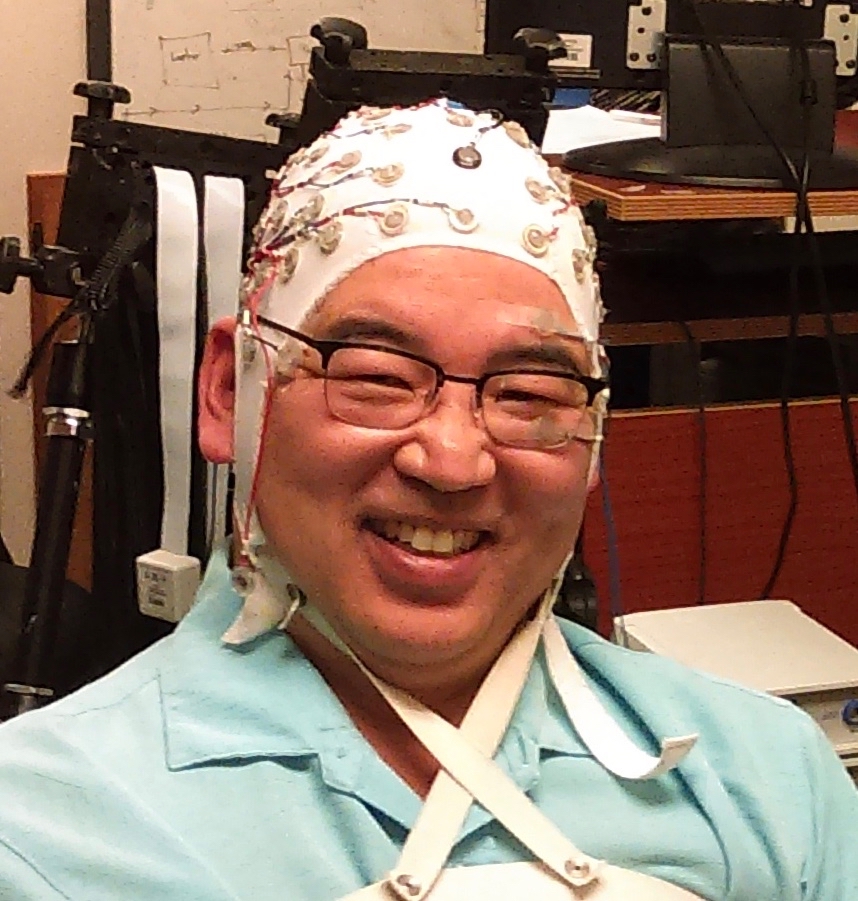
Getting an EEG to test whether my brain works. It does! [downloaded from http://www.raymondsbrain.com/biocontact]
Much has been happening on this front. First for anyone unfamiliar with do-it-yourself biology, here’s more from its Wikipedia entry,
Do-it-yourself biology (DIY biology, DIY bio) is a growing biotechnological social movement in which individuals, communities, and small organizations study biology and life science using the same methods as traditional research institutions. DIY biology is primarily undertaken by individuals with extensive research training from academia or corporations, who then mentor and oversee other DIY biologists with little or no formal training. This may be done as a hobby, as a not-for-profit endeavour for community learning and open-science innovation, or for profit, to start a business.
A January 21, 2020 posting here listed the second Canadian DIY Biology Summit organized by the Public Health Agency of Canada (PHAC). It was possible to attend virtually from any part of Canada. The first meeting was in 2016 (you can see the agenda here). You’ll see in the agenda for the 2nd meeting in 2020 that there have been a few changes as groups rise into and fall out of existence.
From the 2020 agenda, here’s a list representing the players in Canada’s DIYbio scene,
Most of these organizations (e.g., Victoria Makerspace, Synbiota, Bricobio, etc.) seem to be relatively new (founded in 2009 or later) which is quite exciting to think about. This March 13, 2016 article in the Vancouver Observer gives you a pretty good overview of the DIY biology scene in Canada at the time while providing a preview of the then upcoming first DIY Biology summit.
*The Open Science Network in Vancouver was formerly known as DIYbio YVR. I’m not sure when the name change occurred but this July 17, 2018 article by Emily Ng for The Ubyssey (a University of British Columbia student newspaper) gives a little history,
…
In 2009, a group of UBC students and staff recognized these barriers and teamed up to democratize science, increase its accessibility and create an interdisciplinary platform for idea exchange. They created the Open Science Network (OSN).
The Open Science Network is a non-profit society that serves the science and maker community through education, outreach and the provision of space. Currently, they run an open community lab out of the MakerLabs space on East Cordova and Main street, which is a compact space housing microscopes, a freezer, basic lab equipment and an impressive amount of activity.
The lab is home to a community of citizen scientists, professional scientists, artists, designers and makers of all ages who are pursuing their own science projects.
…
Members who are interested in lab work can receive some training in “basic microbiology techniques like pipetting, growing bacteria, using the Polymerase Chain Reaction machine (PCR) [to amplify DNA] and running gels [through a gel ectrophoresis machine to separate DNA fragments by size] from Scott Pownall, a PhD graduate from UBC and the resident microbiologist,” said Wong [ Wes Wong, a staff member of UBC Botany and a founding member of OSN].
The group has also made further efforts to serve their members by offering more advanced synthetic biology classes and workshops at their lab.
…
There is another organization called ‘Open Science Network’ (an ethnobiology group and not part of the Vancouver organization). Here is a link to the Vancouver-based Open Science Network (a community science lab) where they provide further links to all their activities including a regular ‘meetup’.
The word
I have poetry, a book, a television adaptation, three plays with mathematics and/or physics themes and more.
Poetry
In 2012 there was a night of poetry readings in Vancouver. What made it special was that five poets had collaborated with five scientists (later amended to four scientists and a landscape architect) according to my December 4, 2012 posting. The whole thing was conceptualized and organized by Aileen Penner who went on to produce a chapbook of the poetry. She doesn’t have any copies available currently but you can contact her on her website’s art/science page if you are interested in obtaining a copy. She doesn’t seem to have organized any art/science projects since. For more about Aileen Penner who is a writer and poet, go to her website here.
The Banff International Research Station (BIRS) it’s all about the mathematics) hosted a workshop for poets and mathematicians way back in 2011. I featured it (Mathematics: Muse, Maker, and Measure of the Arts) after the fact in my January 9, 2012 posting (scroll down about 30% of the way). If you have the time, do click on my link to Nassif Ghoussoub’s post on his blog (Piece of Mind) about mathematicians, poetry, and the arts. It’s especially interesting in retrospect as he is now the executive director for BIRS, which no longer seems to have workshops that meld any of the arts with mathematics, and science.
One of the guests at that 2011 meeting was Alice Major, former poet laureate for Edmonton and the author of a 2011 book titled, Intersecting Sets: A Poet Looks at Science.
That sadly seems to be it for poetry and the sciences, including mathematics. If you know of any other poetry/science projects or readings, etc. in Canada during the 2010-9 decade, please let me know in the comments.
Books
Karl Schroeder, a Canadian science fiction author, has written many books but of particular interest here are two futuristic novels for the Canadian military.The 2005 novel, Crisis in Zefra, doesn’t fit the time frame I’ve established for this review but the the 2014 novel, Crisis in Urla (scroll down) fits in nicely. His writing is considered ‘realistic’ science fiction in that it’s based on science research and his work is also associated with speculative realism (from his Wikipedia entry; Note: Links have been removed),
Karl Schroeder (born September 4, 1962) is a Canadianscience fiction author. His novels present far-future speculations on topics such as nanotechnology, terraforming, augmented reality, and interstellar travel, and are deeply philosophical.
The other author I’m mentioning here is Margaret Atwood. The television adaptation of her book, ‘The Handmaid’s Tale’ has turned a Canadian literary superstar into a supernova (an exploding star whose luminosity can be the equivalent of an entire galaxy). In 2019, she won the Booker Prize, for the second time for ‘The Testaments’ (a followup to ‘The Handmaid’s Tale’), sharing it with Bernardine Evaristo and her book ‘Girl, Woman, Other’. Atwood has described her work (The Handmaid’s Tale, and others) as speculative fiction rather than science fiction. For me, she bases her speculation on the social sciences and humanities, specifically history (read her Wikipedia entry for more).
In 2017 with the television adaptation of ‘The Handmaid’s Tale’, Atwood’s speculative fiction novel became a pop culture phenomenon. Originally published in 1985, the novel was also adapted for a film in 1990 and for an opera in 2000 before it came to television, according to its Wikipedia entry.
There’s a lot more out there, Schroeder and Atwood are just two I’ve stumbled across.
Theatre
I have drama, musical comedy and acting items.
Drama
Pi Theatre’s (Vancouver) mathematically-inclined show, ‘Long Division‘, ran in April 2017 and was mentioned in my April 20, 2017 posting (scroll down about 50% of the way).
This theatrical performance of concepts in mathematics runs from April 26 – 30, 2017 (check here for the times as they vary) at the Annex at 823 Seymour St. From the Georgia Straight’s April 12, 2017 Arts notice,
“Mathematics is an art form in itself, as proven by Pi Theatre’s number-charged Long Division. This is a “refreshed remount” of Peter Dickinson’s ambitious work, one that circles around seven seemingly unrelated characters (including a high-school math teacher, a soccer-loving imam, and a lesbian bar owner) bound together by a single traumatic incident. Directed by Richard Wolfe, with choreography by Lesley Telford and musical score by Owen Belton, it’s a multimedia, movement-driven piece that has a strong cast. … “
You can read more about the production here. As far as I’m aware, there are no upcoming show dates.
There seems to be some sort of affinity between theatre and mathematics, I recently featured (January 3, 2020 posting) a theatrical piece by Hannah Moscovitch titled, ‘Infinity‘, about time, physics, math and more. It had its first production in Toronto in 2015.
John Mighton, a playwright and mathematician, wrote ‘The Little Years’ which has been produced in both Vancouver and Toronto. From a May 9, 2005 article by Kathleen Oliver for the Georgia Straight,
The Little Years is a little jewel of a play: small but multifaceted, and beautifully crafted.
John Mighton’s script gives us glimpses into different stages in the life of Kate, a woman whose early promise as a mathematician is cut short. At age 13, she’s a gifted student whose natural abilities are overlooked by 1950s society, which has difficulty conceiving of women as scientists. Instead, she’s sent to vocational school while her older brother, William, grows up to become one of the most widely praised poets of his generation.
John Mighton is a successful playwright and mathematician, yet at times in his life, he’s struggled with doubt. However, he also learned there was hope, and that’s the genesis of The Little Years, which opens at the Tarragon Theatre on Nov. 16 and runs to Dec. 16 [2012].
In keeping (more or less) with this subsection’s theme ‘The Word’, Mighton has recently had a new book published, ‘All Things Being Equal: Why Math is the Key to a Better World’, according to a January 24, 2020 article (online version) by Jamie Portman for Postmedia,
It’s more than two decades since Canadian mathematician and playwright John Mighton found himself playing a small role in the film, Good Will Hunting. What he didn’t expect when he took on the job was that he would end up making a vital contribution to a screenplay that would go on to win an Oscar for its writers, Ben Affleck and Matt Damon.
What happened on that occasion tells you a great deal about Mighton’s commitment to the belief that society grossly underestimates the intellectual capacity of human beings — a belief reiterated with quiet eloquence in his latest book, All Things Being Equal.
…
Mighton loved the experience but as shooting continued he became troubled over his involvement in a movie that played “heavily on the idea that geniuses like Will are born and not made.” This was anathema to his own beliefs as a mathematician and he finally summoned up the courage to ask Affleck and Damon if he could write a few extra lines for his character. This speech was the result: “Most people never get the chance to see how brilliant they can be. They don’t find teachers who believe in them. They get convinced they’re stupid.”
At a time of growing controversy across Canada over the teaching of mathematics in school and continuing evidence of diminishing student results, Mighton continues to feel gratitude to the makers of Good Will Hunting for heeding his concerns. [I will be writing a post about the latest PISA scores where Canadian students have again slipped in their mathematics scores.]
…
Mighton is on the phone from from Toronto, his voice soft-spoken but still edged with fervour. He pursues two successful careers — as an award-winning Canadian playwright and as a renowned mathematician and philosopher who has devoted a lifetime to developing strategies that foster the intellectual potential of all children through learning math. But even as he talks about his 2001 founding of JUMP Math, a respected charity that offers a radical alternative to conventional teaching of the subject, he’s anxious to remind you that he’s a guy who almost failed calculus at university and who once struggled to overcome his “own massive math anxiety.”
…
You can find out more about John Mighton in his Wikipedia entry (mostly about his academic accomplishments) and on the JUMP Math website (better overall biography).
Musical Comedy
It’s called ‘Math Out Loud’ and was first mentioned here in a January 9, 2012 posting (the same post also featured the BIRS poetry workshop),
“When Mackenzie Gray talks about the way Paul McCartney used a recursive sequence to make the song “I Want You (She’s So Heavy)” seem to last forever, you realize that part of the Beatles’ phenomenal success might have sprung from McCartney’s genius as a mathematician.
When Roger Kemp draws on a napkin to illustrate that you just have to change the way you think about numbers to come up with a binary code for pi (as in 3.14 ad infinitum), you get a sense that math can actually be a lot of fun.”
Produced by MITACS which in 2012 was known as ‘Mathematics of Information Technology and Complex Systems’, a not-for-profit research organization, the musical went on tour in the Fall of 2012 (according to my September 7, 2012 posting). Unusually, I did not embed the promotional trailer for this 2012 musical so, here it is now,
Since 2012, Mitacs has gone through some sort of rebranding process and it’s now described as a nonprofit national research organization. For more you can read its Wikipedia entry or go to its website.
Acting and storytelling
It turns out there was an acting class (five sessions) for scientists at the University of Calgary in 2017. Here’s more from the course’s information sheet,
Act Your Science: Improve Your Communication Skills with Training in Improvisation 2 hours a session, 5 sessions, every Wednesday starting November 14 [2017] …
Dr. Jeff Dunn, Faculty of Graduate Studies, Graduate Students Association, the Canadian Science Writers Association [also known as Science Writers and Communicators of Canada] and the Loose Moose Theatre have teamed together to provide training in a skill which will be useful where ever your career takes you.
The goal of this project is to improve the science communication skills of graduate students in science fields. We will improve your communication through the art of training in improvisation. Training will help with speech and body awareness. Improvisation will provide life‐long skills in communication, in a fun interactive environment.
For many years, Alan Alda, a well-known actor (originally of the “MASH” television series fame), has applied his acting skills and improvisation training to help scientists improve their communication. He developed the Alan Alda Centre for Communicating Science at Stony Brook University.
…
The training will involve five 2hr improvisation workshop sessions led by one of Canada’s top professional improvisation trainers, Dennis Cahill, the Artistic Director from Loose Moose Theatre. Dennis has an international reputation for developing the theatrical style of improvisation. Training involves a lot of moving around (and possibly rolling on the floor!) so dress casually. Be prepared to release your inhibitions!
…
The information sheet includes a link to this University of Chicago video (posted on Youtube February 24, 2014) of actor Alan Alda discussing science communication,
As for the storytelling, we’re back at the University of Calgary. A student video and storytelling workshop and contest (Innovation Untold) was held on Tuesday, February 4, 2020. Here’s more from the University of Calgary event page for Storytelling Workshop: Do photos and videos have voices?,
…
About the speaker:
Victoria Bouvier, a Michif-Metis woman, is of the Red River Settlement and Boggy Creek, Manitoba, and born and raised in Calgary. She is an Assistant professor in Indigenous Studies at Mount Royal University and a doctoral candidate in Educational Research [emphasis mine] at the University of Calgary. Her research is exploring how Michif/Métis people, born and raised in urban environments, practice and express their self-understandings, both individually and collectively through using an Indigenous oral system and visual media as methodology.
In a technology-laden society, people are capturing millions of photographs and videos that document their lived experiences, followed by uploading them to social media sites. As mass amounts of media is being shared each day, the question becomes: are we utilizing photos and videos to derive meaning from our everyday lived experiences, while settling in to a deeper sense of our self-in-relation?
This session will explore how photos and videos, positioned within an Indigenous oral system, are viewed and interacted with as a third perspective in the role of storytelling.
Finally, h/t to Jennifer Bon Bernard’s April 19, 2017 article (reposted Dec. 11, 2019) about Act Your Science for the Science Writers and Communicators blog. The original date doesn’t look right to me but perhaps she participated in a pilot project.
Neuroscience, science policy, and science advice
The end of this part is almost in sight
Knitting in Toronto and drawings in Vancouver (neuroscience)
In 2017, Toronto hosted a neuroscience event which combined storytelling and knitting (from my October 12, 2017 posting (Note: the portion below is an excerpt from an ArtSci Salon announcement),
With NARRATING NEUROSCIENCE we plan to initiate a discussion on the role and the use of storytelling and art (both in verbal and visual forms) to communicate abstract and complex concepts in neuroscience to very different audiences, ranging from fellow scientists, clinicians and patients, to social scientists and the general public. We invited four guests to share their research through case studies and experiences stemming directly from their research or from other practices they have adopted and incorporated into their research, where storytelling and the arts have played a crucial role not only in communicating cutting edge research in neuroscience, but also in developing and advancing it.
The ArtSci Salon folks also announced this (from the Sept. 25, 2017 ArtSci Salon announcement; received via email),
ATTENTION ARTSCI SALONISTAS AND FANS OF ART AND SCIENCE!! CALL FOR KNITTING AND CROCHET LOVERS!
In addition to being a PhD student at the University of Toronto, Tahani Baakdhah is a prolific knitter and crocheter and has been the motor behind two successful Knit-a-Neuron Toronto initiatives. We invite all Knitters and Crocheters among our ArtSci Salonistas to pick a pattern (link below) and knit a neuron (or 2! Or as many as you want!!)
BRING THEM TO OUR OCTOBER 20 ARTSCI SALON! Come to the ArtSci Salon and knit there!
That link to the patterns is still working.
Called “The Beautiful Brain” and held in the same time frame as Toronto’s neuro event, Vancouver hosted an exhibition of Santiago Ramon y Cajal’s drawings from September 5 to December 3, 2017. In concert with the exhibition, the local ‘neuro’ community held a number of outreach events. Here’s what I had in my September 11, 2017 posting where I quoted from the promotional material for the exhibition,
…
The Beautiful Brain is the first North American museum exhibition to present the extraordinary drawings of Santiago Ramón y Cajal (1852–1934), a Spanish pathologist, histologist and neuroscientist renowned for his discovery of neuron cells and their structure, for which he was awarded the Nobel Prize in Physiology and Medicine in 1906. Known as the father of modern neuroscience, Cajal was also an exceptional artist. He combined scientific and artistic skills to produce arresting drawings with extraordinary scientific and aesthetic qualities.
A century after their completion, Cajal’s drawings are still used in contemporary medical publications to illustrate important neuroscience principles, and continue to fascinate artists and visual art audiences. …
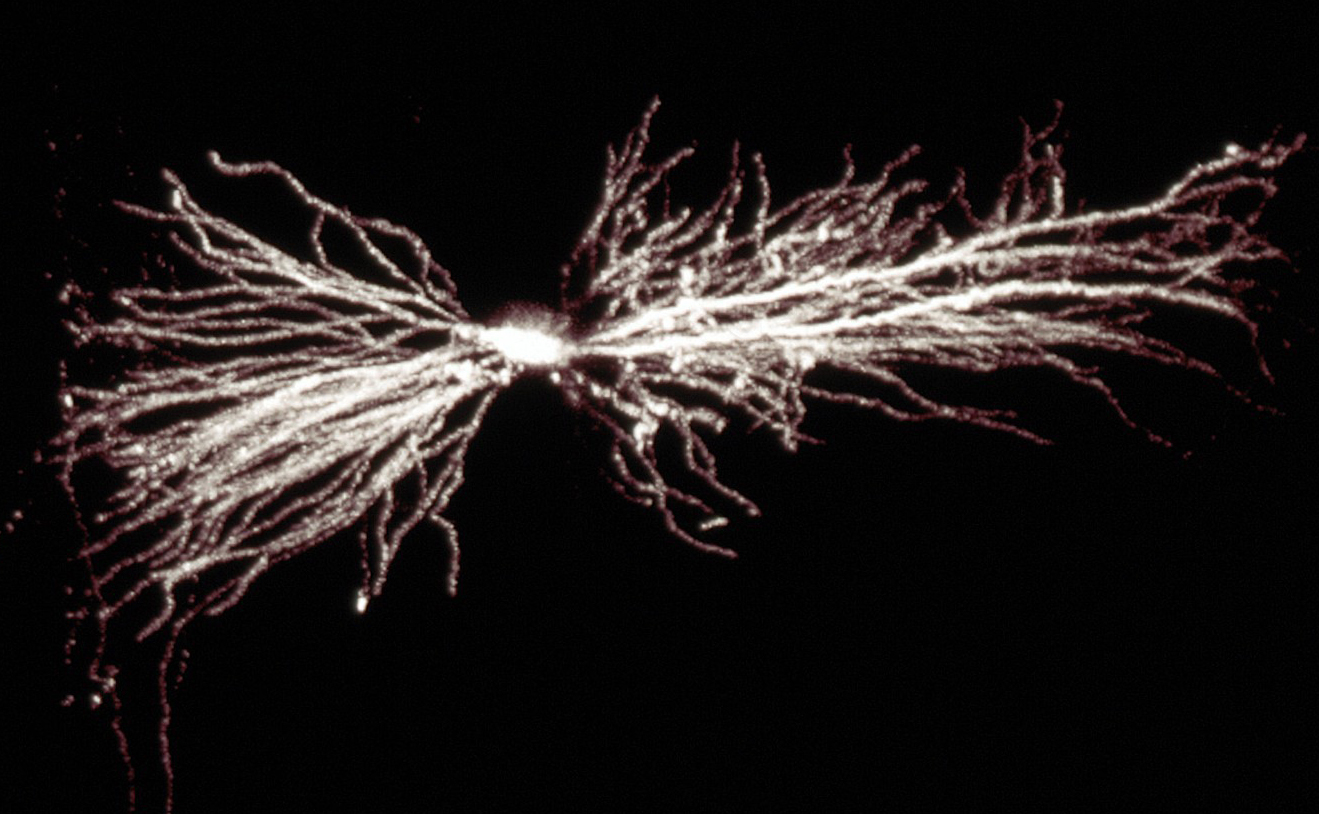
Pictured: Santiago Ramón y Cajal, injured Purkinje neurons, 1914, ink and pencil on paper. Courtesy of Instituto Cajal (CSIC).
From Vancouver, the exhibition traveled to a gallery in New York City and then onto the Massachusetts Institute of Technology (MIT).
Mehrdad Hariri has done a an extraordinary job as its founder and chief executive officer. The CSPC has developed from a single annual conference to an organization that hosts different events throughout the year and publishes articles and opinion pieces on Canadian science policy and has been instrumental in the development of a Canadian science policy community.
The magnitude of Hariri’s accomplishment becomes clear when reading J.w. Grove’s [sic] article, Science Policy, in The Canadian Encyclopedia and seeing that the most recent reports on a national science policy seem to be the Science Council’s (now defunct) 4th report in 1968, Towards a National Science Policy in Canada, the OECD’s (Organization for Economic Cooperation and Development) 1969 Review of [Canada’s] Science Policy, and 3 reports from the Senate’s Lamontagne Committee (Special Committee on Science Policy). Grove’s article takes us only to 1988 but I have been unable to find any more recent reports focused on a national science policy for Canada. (If you have any information about a more recent report, please do let me know in the comments.)
A November 5, 2019 piece (#VoteScience: lessons learned and building science advocacy beyond the election cycle) on the CSPC website further illustrates how the Canadian science policy community has gained ground (Note: Links have been removed),
… on August 8, 2019, a coalition of Canadian science organizations and student groups came together to launch the #VoteScience campaign: a national, non-partisan effort to advocate for science in the federal elections, and make science an election issue.
Specifically, we — aka Evidence for Democracy, Science & Policy Exchange (SPE), and the Toronto Science Policy Network (TSPN) [emphases mine] — built a collection of tools and resources to empower Canadian scientists and science supporters to engage with their local candidates on science issues and the importance of evidence-informed decision-making. Our goal was to make it easy for as many Canadians as possible to engage with their candidates — and they did.
Over the past three months, our #VoteScience portal received over 3,600 visitors, including 600 visitors who used our email form to reach out directly to their local candidates. Collectively, we took #VoteScience selfies, distributed postcards to supporters across Canada, and even wrote postcards to every sitting Member of Parliament (in addition to candidates from all parties in each of our own ridings). Also of note, we distributed a science policy questionnaire to the federal parties, to help better inform Canadians about where the federal parties stand on relevant science issues, and received responses from all but one party. We’ve also advocated for science through various media outlets, including commenting for articles appearing in The Narwhal and Nature News, and penning op-eds for outlets such as the National Observer, University Affairs, Le Devoir, and Découvrir.
Prior to SPIN, the Council of Canadian Academies (CCA; more about them in part 4), issued a 2017 report titled, Science Policy: Considerations for Subnational Governments. The report was the outcome of a 2016 CCA workshop originally titled, Towards a Science Policy in Alberta. I gather the scope broadened.
Interesting trajectory, yes?
Chief Science advisors/scientists
In September 2017, the Canadian federal government announced that a Chief Science Advisor, Dr. Mona Nemer, had been appointed. I have more about the position and Dr. Nemer in my September 26, 2017 posting. (Prior to Dr. Nemer’s appointment a previous government had discontinued a National Science Advisor position that existed from 2004 to 2008.)
The Office of the Chief Science Advisor released it first annual report in 2019 and was covered here in a March 19, 2019 posting.
Québec is the only province (as far as I know) to have a Chief Scientist, Rémi Quirion who was appointed in 2011.
Onto Part 4 where you’ll find we’ve gone to the birds and more.
*The Canadian Science Policy Centre (CSPC) section was written sometime in February 2020. I believe they are planning to publish an editorial piece I submitted to them on April 20, 202 (in other words, before this post was published) in response to their call for submissions (see my April 1, 2020 post for details about the call). In short, I did not praise the organization with any intention of having my work published by them. (sigh) Awkward timing.
The Cajal exhibit of drawings was here in Vancouver (Canada) this last fall (2017) and I still carry the memory of that glorious experience (see my Sept. 11, 2017 posting for more about the show and associated events). It seems Cajal’s drawings had a similar response in New York city, from a January 18, 2018 article by Roberta Smith for the New York Times,
It’s not often that you look at an exhibition with the help of the very apparatus that is its subject. But so it is with “The Beautiful Brain: The Drawings of Santiago Ramón y Cajal” at the Grey Art Gallery at New York University, one of the most unusual, ravishing exhibitions of the season.
Spotlight Tours
Explorations led by local and Spanish scientists, artists, and entrepreneurs who will share their unique perspectives on particular aspects of the exhibition. (2:00 pm on select Tuesdays and Saturdays)
Tue, May 8 – Mark Harnett, Fred and Carole Middleton Career Development Professor at MIT and McGovern Institute Investigator Sat, May 26 – Marion Boulicault, MIT Graduate Student and Neuroethics Fellow in the Center for Sensorimotor Neural Engineering Tue, June 5 – Kelsey Allen, Graduate researcher, MIT Center for Brains, Minds, and Machines Sat, Jun 23 – Francisco Martin-Martinez, Research Scientist in MIT’s Laboratory for Atomistic & Molecular Mechanics and President of the Spanish Foundation for Science and Technology Jul 21 – Alex Gomez-Marin, Principal Investigator of the Behavior of Organisms Laboratory in the Instituto de Neurociencias, Spain Tue, Jul 31– Julie Pryor, Director of Communications at the McGovern Institute for Brain Research at MIT Tue, Aug 28 – Satrajit Ghosh, Principal Research Scientist at the McGovern Institute for Brain Research at MIT, Assistant Professor in the Department of Otolaryngology at Harvard Medical School, and faculty member in the Speech and Hearing Biosciences and Technology program in the Harvard Division of Medical Sciences
Idea Hub
Drop in and explore expansion microscopy in our maker-space.
Neuron Paint Night
Create a painting of cerebral cortex neurons and learn about the EyeWire citizen science game.
Cerebral Cinema Series
Hear from researchers and then compare real science to depictions on the big screen.
Brainy Trivia
Test your brain power in a night of science trivia and short, snappy research talks.
Come back to see our exciting lineup for the fall!
If you don’t have a chance to see the show or if you’d like a preview, I encourage you to read Smith’s article as it has embedded several Cajal drawings and rendered them exceptionally well.
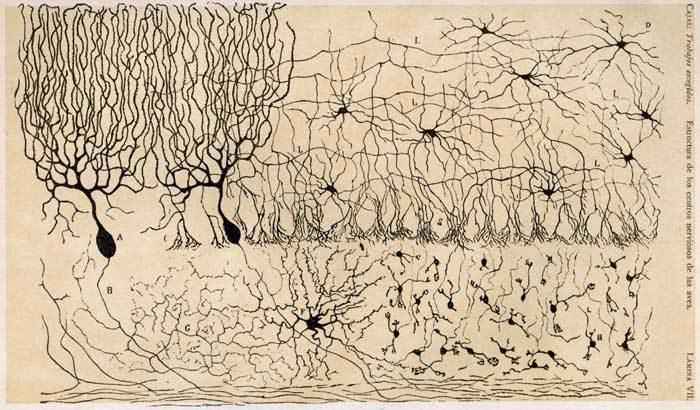
Drawing of the cells of the chick cerebellum by Santiago Ramón y Cajal, from “Estructura de los centros nerviosos de las aves,” Madrid, circa 1905
Modern neuroscience, for all its complexity, can trace its roots directly to a series of pen-and-paper sketches rendered by Nobel laureate Santiago Ramón y Cajal in the late 19th and early 20th centuries.
His observations and drawings exposed the previously hidden composition of the brain, revealing neuronal cell bodies and delicate projections that connect individual neurons together into intricate networks.
As he explored the nervous systems of various organisms under his microscope, a natural question arose: What makes a human brain different from the brain of any other species?
…
At least part of the answer, Ramón y Cajal hypothesized, lay in a specific class of neuron—one found in a dazzling variety of shapes and patterns of connectivity, and present in higher proportions in the human brain than in the brains of other species. He dubbed them the “butterflies of the soul.”
Known as interneurons, these cells play critical roles in transmitting information between sensory and motor neurons, and, when defective, have been linked to diseases such as schizophrenia, autism and intellectual disability.
Despite more than a century of study, however, it remains unclear why interneurons are so diverse and what specific functions the different subtypes carry out.
Now, in a study published in the March 22 [2018] issue of Nature, researchers from Harvard Medical School, New York Genome Center, New York University and the Broad Institute of MIT and Harvard have detailed for the first time how interneurons emerge and diversify in the brain.
Using single-cell analysis—a technology that allows scientists to track cellular behavior one cell at a time—the team traced the lineage of interneurons from their earliest precursor states to their mature forms in mice. The researchers identified key genetic programs that determine the fate of developing interneurons, as well as when these programs are switched on or off.
The findings serve as a guide for efforts to shed light on interneuron function and may help inform new treatment strategies for disorders involving their dysfunction, the authors said.
“We knew more than 100 years ago that this huge diversity of morphologically interesting cells existed in the brain, but their specific individual roles in brain function are still largely unclear,” said co-senior author Gordon Fishell, HMS professor of neurobiology and a faculty member at the Stanley Center for Psychiatric Research at the Broad.
“Our study provides a road map for understanding how and when distinct interneuron subtypes develop, giving us unprecedented insight into the biology of these cells,” he said. “We can now investigate interneuron properties as they emerge, unlock how these important cells function and perhaps even intervene when they fail to develop correctly in neuropsychiatric disease.”
A hippocampal interneuron. Image: Biosciences Imaging Gp, Soton, Wellcome Trust via Creative Commons
Origins and Fates
In collaboration with co-senior author Rahul Satija, core faculty member of the New York Genome Center, Fishell and colleagues analyzed brain regions in developing mice known to contain precursor cells that give rise to interneurons.
Using Drop-seq, a single-cell sequencing technique created by researchers at HMS and the Broad, the team profiled gene expression in thousands of individual cells at multiple time points.
This approach overcomes a major limitation in past research, which could analyze only the average activity of mixtures of many different cells.
In the current study, the team found that the precursor state of all interneurons had similar gene expression patterns despite originating in three separate brain regions and giving rise to 14 or more interneuron subtypes alone—a number still under debate as researchers learn more about these cells.
“Mature interneuron subtypes exhibit incredible diversity. Their morphology and patterns of connectivity and activity are so different from each other, but our results show that the first steps in their maturation are remarkably similar,” said Satija, who is also an assistant professor of biology at New York University.
“They share a common developmental trajectory at the earliest stages, but the seeds of what will cause them to diverge later—a handful of genes—are present from the beginning,” Satija said.
As they profiled cells at later stages in development, the team observed the initial emergence of four interneuron “cardinal” classes, which give rise to distinct fates. Cells were committed to these fates even in the early embryo. By developing a novel computational strategy to link precursors with adult subtypes, the researchers identified individual genes that were switched on and off when cells began to diversify.
For example, they found that the gene Mef2c—mutations of which are linked to Alzheimer’s disease, schizophrenia and neurodevelopmental disorders in humans—is an early embryonic marker for a specific interneuron subtype known as Pvalb neurons. When they deleted Mef2c in animal models, Pvalb neurons failed to develop.
These early genes likely orchestrate the execution of subsequent genetic subroutines, such as ones that guide interneuron subtypes as they migrate to different locations in the brain and ones that help form unique connection patterns with other neural cell types, the authors said.
The identification of these genes and their temporal activity now provide researchers with specific targets to investigate the precise functions of interneurons, as well as how neurons diversify in general, according to the authors.
“One of the goals of this project was to address an incredibly fascinating developmental biology question, which is how individual progenitor cells decide between different neuronal fates,” Satija said. “In addition to these early markers of interneuron divergence, we found numerous additional genes that increase in expression, many dramatically, at later time points.”
The association of some of these genes with neuropsychiatric diseases promises to provide a better understanding of these disorders and the development of therapeutic strategies to treat them, a particularly important notion given the paucity of new treatments, the authors said.
Over the past 50 years, there have been no fundamentally new classes of neuropsychiatric drugs, only newer versions of old drugs, the researchers pointed out.
“Our repertoire is no better than it was in the 1970s,” Fishell said.
“Neuropsychiatric diseases likely reflect the dysfunction of very specific cell types. Our study puts forward a clear picture of what cells to look at as we work to shed light on the mechanisms that underlie these disorders,” Fishell said. “What we will find remains to be seen, but we have new, strong hypotheses that we can now test.”
As a resource for the research community, the study data and software are open-source and freely accessible online.
A gallery of the drawings of Santiago Ramón y Cajal is currently on display in New York City, and will open at the MIT Museum in Boston in May 2018.
Christian Mayer, Christoph Hafemeister and Rachel Bandler served as co-lead authors on the study.
This work was supported by the National Institutes of Health (R01 NS074972, R01 NS081297, MH071679-12, DP2-HG-009623, F30MH114462, T32GM007308, F31NS103398), the European Molecular Biology Organization, the National Science Foundation and the Simons Foundation.
Here’s link to and a citation for the paper,
Developmental diversification of cortical inhibitory interneurons by Christian Mayer, Christoph Hafemeister, Rachel C. Bandler, Robert Machold, Renata Batista Brito, Xavier Jaglin, Kathryn Allaway, Andrew Butler, Gord Fishell, & Rahul Satija. Nature volume 555, pages 457–462 (22 March 2018) doi:10.1038/nature25999 Published: 05 March 2018
What is it with the Canadian neuroscience community? First, there’s The Beautiful Brain an exhibition of the extraordinary drawings of Santiago Ramón y Cajal (1852–1934) at the Belkin Gallery on the University of British Columbia (UBC) campus in Vancouver and a series of events marking the exhibition (for more see my Sept. 11, 2017 posting ; scroll down about 30% for information about the drawings and the events still to come).
I guess there must be some money floating around for raising public awareness because now there’s a neuroscience and ‘storytelling’ event (Narrating Neuroscience) in Toronto, Canada. From a Sept. 25, 2017 ArtSci Salon announcement (received via email),
With NARRATING NEUROSCIENCE we plan to initiate a discussion on the role and the use of storytelling and art (both in verbal and visual forms) to communicate abstract and complex concepts in neuroscience to very different audiences, ranging from fellow scientists, clinicians and patients, to social scientists and the general public. We invited four guests to share their research through case studies and experiences stemming directly from their research or from other practices they have adopted and incorporated into their research, where storytelling and the arts have played a crucial role not only in communicating cutting edge research in neuroscience, but also in developing and advancing it.
OUR GUESTS
MATTEO FARINELLA, PhD, Presidential Scholar in Society and Neuroscience – Columbia University
SHELLEY WALL , AOCAD, MSc, PhD – Assistant professor, Biomedical Communications Graduate Program and Department of Biology, UTM
ALFONSO FASANO, MD, PhD, Associate Professor – University of Toronto Clinician Investigator – Krembil Research Institute Movement Disorders Centre – Toronto Western Hospital
TAHANI BAAKDHAH, MD, MSc, PhD candidate – University of Toronto
DATE: October 20, 2017
TIME: 6:00-8:00 pm
LOCATION: The Fields Institute for Research in Mathematical Sciences
222 College Street, Toronto, ON
Events Facilitators: Roberta Buiani and Stephen Morris (ArtSci Salon) and Nina Czegledy (Leonardo Network)
TAHANI BAAKDHAH is a PhD student at the University of Toronto studying how the stem cells built our retina during development, the mechanism by which the light sensing cells inside the eye enable us to see this beautiful world and how we can regenerate these cells in case of disease or injury.
MATTEO FARINELLA combines a background in neuroscience with a lifelong passion for drawing, making comics and illustrations about the brain. He is the author of _Neurocomic_ (Nobrow 2013) published with the support of the Wellcome Trust, _Cervellopoli_ (Editoriale Scienza 2017) and he has collaborated with universities and educational institutions around
the world to make science more clear and accessible. In 2016 Matteo joined Columbia University as a Presidential Scholar in Society and Neuroscience, where he investigates the role of visual narratives in science communication. Working with science journalists, educators and cognitive neuroscientists he aims to understand how these tools may
affect the public perception of science and increase scientific literacy (cartoonscience.org [2]).
ALFONSO FASANO graduated from the Catholic University of Rome, Italy, in 2002 and became a neurologist in 2007. After a 2-year fellowship at the University of Kiel, Germany, he completed a PhD in neuroscience at the Catholic University of Rome. In 2013 he joined the Movement Disorder Centre at Toronto Western Hospital, where he is the co-director of the
surgical program for movement disorders. He is also an associate professor of medicine in the Division of Neurology at the University of Toronto and clinician investigator at the Krembil Research Institute. Dr. Fasano’s main areas of interest are the treatment of movement disorders with advanced technology (infusion pumps and neuromodulation), pathophysiology and treatment of tremor and gait disorders. He is author of more than 170 papers and book chapters. He is principal investigator of several clinical trials.
SHELLEY WALL is an assistant professor in the University of Toronto’s Biomedical Communications graduate program, a certified medical illustrator, and inaugural Illustrator-in-Residence in the Faculty of Medicine, University of Toronto. One of her primary areas of research, teaching, and creation is graphic medicine—the intersection of comics with illness, medicine, and caregiving—and one of her ongoing projects is a series of comics about caregiving and young onset Parkinson’s disease.
You can register for this free Toronto event here.
One brief observation, there aren’t any writers (other than academics) or storytellers included in this ‘storytelling’ event. The ‘storytelling’ being featured is visual. To be blunt I’m not of the ‘one picture is worth a thousand words’ school of thinking (see my Feb. 22, 2011 posting). Yes, sometimes pictures are all you need but that tiresome aphorism which suggests communication can be reduced to one means of communication really needs to be retired. As for academic writing, it’s not noted for its storytelling qualities or experimentation. Academics are not judged on their writing or storytelling skills although there are some who are very good.
Getting back to the Toronto event, they seem to have the visual part of their focus ” … discussion on the role and the use of storytelling and art (both in verbal and visual forms) … ” covered. Having recently attended a somewhat similar event in Vancouver, which was announced n my Sept. 11, 2017 posting, there were some exciting images and ideas presented.
The ArtSci Salon folks also announced this (from the Sept. 25, 2017 ArtSci Salon announcement; received via email),
ATTENTION ARTSCI SALONISTAS AND FANS OF ART AND SCIENCE!!
CALL FOR KNITTING AND CROCHET LOVERS!
In addition to being a PhD student at the University of Toronto, Tahani Baakdhah is a prolific knitter and crocheter and has been the motor behind two successful Knit-a-Neuron Toronto initiatives. We invite all Knitters and Crocheters among our ArtSci Salonistas to pick a pattern
(link below) and knit a neuron (or 2! Or as many as you want!!)
BRING THEM TO OUR OCTOBER 20 ARTSCI SALON!
Come to the ArtSci Salon and knit there!
You can’t come?
Share a picture with @ArtSci_Salon @SciCommTO #KnitANeuronTO [3] on
social media
Or…Drop us a line at artscisalon@gmail.com !
I think it’s been a few years since my last science knitting post. No, it was Oct. 18, 2016. Moving on, I found more neuron knitting while researching this piece. Here’s the Neural Knitworks group, which is part of Australia’s National Science Week (11-19 August 2018) initiative (from the Neural Knitworks webpage),
Neural Knitworks is a collaborative project about mind and brain health.
Whether you’re a whiz with yarn, or just discovering the joy of craft, now you can crochet wrap, knit or knot—and find out about neuroscience.
During 2014 an enormous number of handmade neurons were donated (1665 in total!) and used to build a giant walk-in brain, as seen here at Hazelhurst Gallery [scroll to end of this post]. Since then Neural Knitworks have been held in dozens of communities across Australia, with installations created in Queensland, the ACT, Singapore, as part of the Cambridge Science Festival in the UK and in Philadelphia, USA.
In 2017, the Neural Knitworks team again invites you to host your own home-grown Neural Knitwork for National Science Week*. Together we’ll create a giant ‘virtual’ neural network by linking your displays visually online.
* If you wish to host a Neural Knitwork event outside of National Science Week or internationally we ask that you contact us to seek permission to use the material, particularly if you intend to create derivative works or would like to exhibit the giant brain. Please outline your plans in an email.
Your creation can be big or small, part of a formal display, or simply consist of neighbourhood neuron ‘yarn-bombings’. Knitworks can be created at home, at work or at school. No knitting experience is required and all ages can participate.
See below for how to register your event and download our scientifically informed patterns.
What is a neuron?
Neurons are electrically excitable cells of the brain, spinal cord and peripheral nerves. The billions of neurons in your body connect to each other in neural networks. They receive signals from every sense, control movement, create memories, and form the neural basis of every thought.
Neural Knitworks are based on the principle that yarn craft, with its mental challenges, social connection and mindfulness, helps keep our brains and minds sharp, engaged and healthy.
Have fun as you
design your own woolly neurons, or get inspired by our scientifically-informed knitting, crochet or knot patterns;
natter with neuroscientists and teach them a few of your crafty tricks;
contribute to a travelling textile brain exhibition;
increase your attention span and test your memory.
Calm your mind and craft your own brain health as you
forge friendships;
solve creative and mental challenges;
practice mindfulness and relaxation;
teach and learn;
develop eye-hand coordination and fine motor dexterity.
Gather together a group of friends who knit, crochet, design, spin, weave and anyone keen to give it a go. Those who know how to knit can teach others how to do it, and there’s even an easy no knit pattern that you can knot.
Download a neuroscience podcast to listen to, and you’ve got a Neural Knitwork!
Join the Neural Knitworks community on Facebook to share and find information about events including public talks featuring neuroscientists.
Tweet #neuralknitworks to show us your creations.
Find display ideas in the pattern book and on our Facebook page.
Finally,, the knitted neurons from Australia’s 2014 National Science Week brain exhibit,
[downloaded from https://www.scienceweek.net.au/neural-knitworks/]
ETA Oct. 24, 2017: If you’re interested on how the talk was received, there’s an Oct. 24, 2017 posting by Magosia Pakulska for the Research2Reality blog.
The Sept. 19, 2017 Café Scientifique event, “Art in the Details A look at the role of art in science,” in Vancouver seems to be part of a larger neuroscience and the arts program at the University of British Columbia. First, the details about the Sept. 13, 2017 event from the eventful Vancouver webpage,
Café Scientifique – Art in the Details: A look at the role of art in science
Art in the Details: A look at the role of art in science With so much beauty in the natural world, why does the misconception that art and science are vastly different persist? Join us for discussion and dessert as we hear from artists, researchers and academic professionals about the role art has played in scientific research – from the formative work of Santiago Ramon Y Cajal to modern imaging, and beyond – and how it might help shape scientific understanding in the future. September 19th, 2017 7:00 – 9:00 pm (doors open at 6:45pm) TELUS World of Science [also known as Science World], 1455 Quebec St., Vancouver, BC V6A 3Z7 Free Admission [emphasis mine] Experts Dr Carol-Ann Courneya Associate Professor in the Department of Cellular and Physiological Science and Assistant Dean of Student Affairs, Faculty of Medicine, University of British Columbia Dr Jason Snyder Assistant Professor, Department of Psychology, University of British Columbia http://snyderlab.com/ Dr Steven Barnes Instructor and Assistant Head—Undergraduate Affairs, Department of Psychology, University of British Columbia http://stevenjbarnes.com/ Moderated By Bruce Claggett Senior Managing Editor, NEWS 1130 This evening event is presented in collaboration with the Djavad Mowafaghian Centre for Brain Health. Please note: this is a private, adult-oriented event and TELUS World of Science will be closed during this discussion.
The Art in the Details event page on the Science World website provides a bit more information about the speakers (mostly in the form of links to their webpage),,
Experts
Dr Carol-Ann Courneya
Associate Professor in the Department of Cellular and Physiological Science and Assistant Dean of Student Affairs, Faculty of Medicine, University of British Columbia
Should you click though to obtain tickets from either the eventful Vancouver or Science World websites, you’ll find the event is sold out but perhaps the organizers will include a waitlist.
Even if you can’t get a ticket, there’s an exhibition of Santiago Ramon Y Cajal’s work (from the Djavad Mowafaghian Centre for Brain Health’s Beautiful brain’s webpage),
Drawings of Santiago Ramón y Cajal to be shown at UBC
Pictured: Santiago Ramón y Cajal, injured Purkinje neurons, 1914, ink and pencil on paper. Courtesy of Instituto Cajal (CSIC).
The Beautiful Brain is the first North American museum exhibition to present the extraordinary drawings of Santiago Ramón y Cajal (1852–1934), a Spanish pathologist, histologist and neuroscientist renowned for his discovery of neuron cells and their structure, for which he was awarded the Nobel Prize in Physiology and Medicine in 1906. Known as the father of modern neuroscience, Cajal was also an exceptional artist. He combined scientific and artistic skills to produce arresting drawings with extraordinary scientific and aesthetic qualities.
A century after their completion, Cajal’s drawings are still used in contemporary medical publications to illustrate important neuroscience principles, and continue to fascinate artists and visual art audiences. Eighty of Cajal’s drawings will be accompanied by a selection of contemporary neuroscience visualizations by international scientists. The Morris and Helen Belkin Art Gallery exhibition will also include early 20th century works that imaged consciousness, including drawings from Annie Besant’s Thought Forms (1901) and Charles Leadbeater’s The Chakras (1927), as well as abstract works by Lawren Harris that explored his interest in spirituality and mysticism.
After countless hours at the microscope, Cajal was able to perceive that the brain was made up of individual nerve cells or neurons rather than a tangled single web, which was only decisively proven by electron microscopy in the 1950s and is the basis of neuroscience today. His speculative drawings stemmed from an understanding of aesthetics in their compressed detail and lucid composition, as he laboured to clearly represent matter and processes that could not be seen.
In a special collaboration with the Morris and Helen Belkin Art Gallery and the VGH & UBC Hospital Foundation this project will encourage meaningful dialogue amongst artists, curators, scientists and scholars on concepts of neuroplasticity and perception. Public and Academic programs will address the emerging field of art and neuroscience and engage interdisciplinary research of scholars from the sciences and humanities alike.
“This is an incredible opportunity for the neuroscience and visual arts communities at the University and Vancouver,” says Dr. Brian MacVicar, who has been working diligently with Director Scott Watson at the Morris and Helen Belkin Art Gallery and with his colleagues at the University of Minnesota for the past few years to bring this exhibition to campus. “Without Cajal’s impressive body of work, our understanding of the anatomy of the brain would not be so well-formed; Cajal’s legacy has been of critical importance to neuroscience teaching and research over the past century.”
A book published by Abrams accompanies the exhibition, containing full colour reproductions of all 80 of the exhibition drawings, commentary on each of the works and essays on Cajal’s life and scientific contributions, artistic roots and achievements and contemporary neuroscience imaging techniques.
Join the UBC arts and neuroscience communities for a free symposium and dance performance celebrating The Beautiful Brain at UBC on September 7. [link removed]
The Beautiful Brain: The Drawings of Santiago Ramón y Cajal was developed by the Frederick R. Weisman Art Museum, University of Minnesota with the Instituto Cajal. The exhibition at the Morris and Helen Belkin Art Gallery, University British Columbia is presented in partnership with the Djavad Mowafaghian Centre for Brain Health with support from the VGH & UBC Hospital Foundation. We gratefully acknowledge the generous support of the Canada Council for the Arts, the British Columbia Arts Council and Belkin Curator’s Forum members.
The Morris and Helen Belkin Art Gallery’s Beautiful Brain webpage has a listing of upcoming events associated with the exhibition as well as instructions on how to get there (if you click on About),
… Cajal was also an exceptional artist and studied as a teenager at the Academy of Arts in Huesca, Spain. He combined scientific and artistic skills to produce arresting drawings with extraordinary scientific and aesthetic qualities. A century after their completion, his drawings are still used in contemporary medical publications to illustrate important neuroscience principles, and continue to fascinate artists and visual art audiences. Eighty of Cajal’s drawings are accompanied by a selection of contemporary neuroscience visualizations by international scientists.
…
Organizationally, this seems a little higgledy piggledy with the Cafe Scientifique event found on some sites, the Belkin Gallery events found on one site, and no single listing of everything on any one site for the Beautiful Brain. Please let me know if you find something I’ve missed.